

Royidris singularis
- Scientific Name
- Royidris singularis
- Tribe
- Crematogastrini
- Subfamily
- Myrmicinae
- Author
- Bolton & Fisher, 2014
- Distribution
- Found in 1 countries
Royidris singularis Overview
Royidris singularis is an ant species of the genus Royidris. It is primarily documented in 1 countries , including Madagascar. Detailed taxonomic data and occurrence records can be further explored via authoritative databases such as AntWeb or the Global Biodiversity Information Facility (GBIF).
Royidris singularis
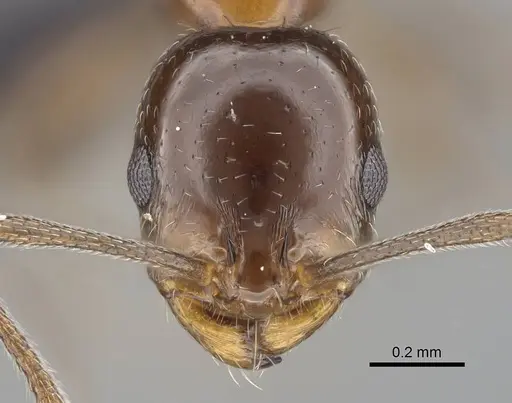
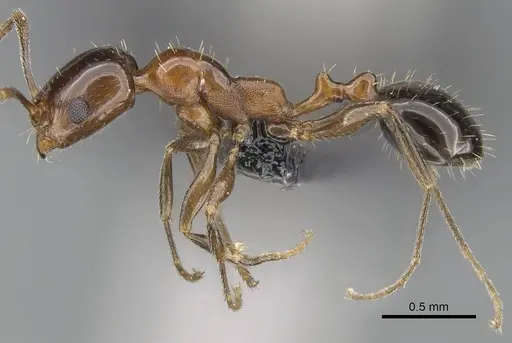
Royidris singularis is an extremely rare tiny ant endemic to the highlands of Madagascar. Workers measure just 2.0mm in total length, making them one of the smaller ant species kept in captivity [1]. They have a distinctive appearance with a smooth, glassy head and brown body contrasting against a jet-black gaster (abdomen). The species is characterized by its relatively long antennae (scapes) that extend past the back of the head when laid flat, and a 4-segmented antennal club [1]. This ant belongs to the notorthotenes species group within the genus Royidris and is only known from two worker specimens collected in uapaca woodland at 1513m elevation [1][2].
What makes this species particularly interesting is its extreme rarity in the wild and the complete absence of documented colony structure, queen morphology, or reproductive behavior in scientific literature. The genus Royidris was only formally described in 2014,meaning these ants represent a relatively new addition to myrmecology [1]. For antkeepers, this means you're dealing with one of the least-studied species in the hobby, where nearly all care requirements must be inferred from related species and general Myrmicinae biology rather than direct observation.
Quick Summary
- Difficulty: Expert
- Origin & Habitat: Endemic to the central highlands of Madagascar, specifically found in uapaca woodland at 1513m elevation. Uapaca woodland is a type of Madagascar highland forest characterized by trees from the genus Uapaca, creating a relatively shaded, humid understory environment [1][2].
- Colony Type: Unknown, only worker caste has been documented. Colony structure (single-queen vs multi-queen) has not been studied. Related Royidris species likely have single-queen colonies, but this is unconfirmed for R. singularis.
- Size & Growth:
- Queen: Unknown, queens have never been documented [1]
- Worker: 2.0mm total length (TL), with head 0.64mm and body width 0.53mm [1]
- Colony: Unknown, only two workers have ever been collected [1]
- Growth: Unknown, no development data exists
- Development: Unknown, no brood development studies exist for this species. Based on typical Myrmicinae patterns and their tiny size, development likely takes 4-8 weeks at optimal temperature, but this is purely estimated. (No direct data exists. Estimates based on genus-level inference and typical Myrmicinae development patterns.)
- Antkeeping:
- Temperature: Inferred: 22-26°C. The highland uapaca woodland habitat suggests moderate temperatures without extreme heat. Avoid temperatures above 30°C given their montane origin. Start in the mid-20s°C range and observe colony activity [2].
- Humidity: Inferred: 60-80%. Uapaca woodland provides moderate to high humidity. Keep the nest substrate consistently moist but not waterlogged, with some drier areas available for the ants to self-regulate [2].
- Diapause: Unknown, no studies on overwintering requirements exist. Madagascar highlands may experience cooler dry seasons, but specific diapause behavior is unconfirmed. Consider providing a slight temperature reduction (5-10°C) during winter months as a precaution, but monitor for negative effects [2].
- Nesting: Inferred: Likely prefers humid, enclosed spaces similar to other small Myrmicinae. A test tube setup or Y-tong (AAC) nest with small chambers works well. The tiny worker size (2mm) requires tight-fitting lids and fine mesh barriers to prevent escapes. Provide a moisture reservoir to maintain humidity [2].
- Behavior: Temperament is unknown, only two workers have ever been studied. Based on related species and their tiny size, they are likely shy and non-aggressive, avoiding confrontation with larger ants. Their small size (2mm) means escape prevention is critical, they can squeeze through remarkably small gaps. Foraging style is unknown but likely involves foraging for small prey and honeydew in the leaf litter layer, similar to other small Myrmicinae. Treat as potentially skittish and provide enrichment opportunities [1][2].
- Common Issues: complete lack of documented care information means all recommendations are inferred, not confirmed, tiny 2mm size makes escape prevention critical, use fine mesh and tight-fitting lids, no known colony structure means founding success rates are completely unknown, only two specimens ever collected suggests this species may be naturally rare or difficult to find in the wild, no documented diet acceptance, must experiment with various small prey and sugar sources, absence of queen documentation means you cannot obtain a founding queen from the wild
Why Royidris singularis is an Expert-Only Species
This species is absolutely NOT recommended for beginners. In fact, even experienced antkeepers should approach this species with caution. The primary reason is simple: there is essentially zero scientific literature on captive care. We're not talking about a species where some details are missing, literally every aspect of colony maintenance (founding behavior, queen care, diet acceptance, temperature tolerance, humidity requirements, development times) must be inferred from related species or guessed entirely. The only documented specimens are two workers collected in Madagascar in 2007 [1]. No queens, no males, no colony fragments, no behavioral observations in the wild or captivity exist anywhere in scientific literature. This makes keeping R. singularis more of a research project than standard antkeeping. You will essentially be contributing to citizen science with every observation. That said, if you're an experienced keeper looking for a genuine challenge and want to help establish husbandry protocols for a completely undocumented species, this could be incredibly rewarding, but go in with realistic expectations that you may face many failures while figuring out what works [1][2].
Housing and Escape Prevention
Given their tiny 2mm worker size, excellent escape prevention is non-negotiable. Use test tubes with cotton plugs that are firmly packed, or better yet, use tubes with tight-fitting rubber stoppers. If using any formicarium or outworld setup, all connections must have fine mesh barriers (at least 0.5mm or smaller). Standard ant keepers often use fluon on the inner rim of containers, but given this species' minute size, consider double-barrier approaches. A small plastic test tube (15mm diameter or less) works as a founding setup. For established colonies, a small Y-tong (AAC) nest with chambers scaled to their tiny size provides appropriate housing. The nest material should be able to hold moisture consistently, plaster, acrylic, or soil-based setups all work for small Myrmicinae. Ensure the outworld is also escape-proof, these ants can and will find any gap you didn't think was possible [2].
Feeding and Diet - An Unknown Frontier
No documented feeding observations exist for this species. You will need to experiment. Start with small live prey appropriate for 2mm ants: springtails, fruit fly larvae, small mealworms, and other micro-arthropods. Given their tiny size, even small fruit flies may be large prey items. Offer sugar water or honey diluted with water at very low concentrations (25-50%) in a small container (like a bottle cap) to prevent drowning. Given their likely origin foraging in leaf litter, they may also accept honeydew from small aphids or scale insects. The key is patience and careful observation, note what is accepted, what is ignored, and what is killed but not eaten. Keep detailed records of your experiments since this information could be valuable for future keepers of this species. Remove uneaten prey within 24-48 hours to prevent mold [2].
Temperature and Humidity Management
Since no captive data exists, we must infer care parameters from their natural habitat. The collection location at 1513m elevation in Madagascar suggests they experience moderate temperatures with significant seasonal variation. Aim for a temperature gradient of 22-26°C in the nest area, with the warmer end around 26°C. Avoid temperatures above 30°C, these are highland ants, not tropical heat-lovers. For humidity, uapaca woodland provides a moderately humid environment. Target 60-80% relative humidity in the nest. Keep the substrate consistently moist but never waterlogged, small test tube setups with water reservoirs work well for maintaining stable humidity. Monitor for condensation, some condensation is good but excessive moisture leads to mold problems. A small hygrometer placed near the nest helps you monitor conditions accurately [1][2].
Acquiring This Species
This is perhaps the biggest challenge. Royidris singularis is not a species you're likely to find from commercial ant sellers, it's simply too rare and too newly described. The only known specimens are in museum collections (the holotype is deposited at CASC, California Academy of Sciences). If this species becomes available in the antkeeping hobby, it will likely be through very specialized breeders or possibly through carefully permitted field collection in Madagascar (which would require proper permits and expertise). Do not support illegal wildlife trade. The best approach is to connect with antkeeping communities and specialized exotic ant dealers who may work with rare Malagasy species. Alternatively, consider starting with more established Malagasy species like some Tetramorium or Monomorium species that have established care protocols, then expand to R. singularis once you have significant experience with the genus [1][2].
Frequently Asked Questions
Is Royidris singularis suitable for beginners?
No. This species is absolutely not suitable for beginners or even intermediate antkeepers. There is zero documented captive care information, no one has successfully kept this species in captivity before. Every aspect of care must be inferred or guessed. You will essentially be conducting research rather than keeping ants. Only experienced keepers who are comfortable with experimental husbandry and potential failures should consider this species [1][2].
How big do Royidris singularis colonies get?
Unknown. Only two workers have ever been documented in scientific literature. Based on related tiny Myrmicinae, colonies likely reach under 100 workers, possibly significantly fewer. The maximum colony size is completely speculative at this point [1].
What do Royidris singularis eat?
Unconfirmed. No feeding observations exist. Based on their tiny 2mm size and likely leaf-litter foraging behavior, they probably accept small live prey (springtails, micro-arthropods, fruit fly larvae) and likely tend aphids for honeydew. You will need to experiment with various small prey items and sugar sources to determine acceptance. Keep detailed records of your experiments [2].
Do Royidris singularis ants sting?
Unknown. As Myrmicinae, they have the anatomical capability for a sting, but no documented defensive behavior or sting observations exist. Given their tiny size, any sting would likely be negligible to humans. Treat them as potentially capable of stinging but unlikely to be significant [2].
Can I keep Royidris singularis in a test tube?
Yes, a test tube setup is likely appropriate for founding colonies given their tiny 2mm size. Use a small-diameter tube (15mm or less) with a well-packed water reservoir. Ensure the cotton is firmly inserted and consider adding a secondary barrier (like a small piece of cotton behind the primary plug) to prevent escapes. Monitor humidity levels as test tubes can dry out or flood easily [2].
What temperature should I keep Royidris singularis at?
Inferred: 22-26°C. Their highland Madagascar origin (1513m elevation) suggests moderate temperatures. Start around 24°C and observe colony behavior. Avoid temperatures above 30°C. A slight temperature gradient allows the ants to self-regulate. This is an estimate based on habitat inference, not confirmed requirements [1][2].
Do Royidris singularis need hibernation or diapause?
Unknown. No studies exist on their seasonal requirements. The Madagascar highlands do experience cooler seasons, so a slight temperature reduction (5-10°C) during winter months may be appropriate as a precaution. Monitor for negative effects and adjust accordingly. This is speculative advice based on regional climate, not documented behavior [2].
How long does it take for Royidris singularis to develop from egg to worker?
Unknown. No development studies exist for this species. Based on typical Myrmicinae patterns and their tiny 2mm size, development likely takes 4-8 weeks at optimal temperature, but this is a complete guess. Expect significant variation and document your observations carefully [2].
Where can I get Royidris singularis queens or colonies?
This species is extremely rare in the antkeeping hobby. It is not commonly available from commercial sellers. If it becomes available, it will likely be through specialized breeders working with rare Malagasy species. Do not support illegal collection from Madagascar. Connect with antkeeping communities and specialized exotic ant dealers who may have access to rare Malagasy Myrmicinae [1][2].
Are Royidris singularis aggressive?
Unknown. No behavioral observations exist. Based on their tiny size and likely position in the leaf-litter ant community, they are probably shy and non-aggressive, avoiding confrontation. They are likely to flee rather than engage defensively when disturbed. Treat them as potentially skittish rather than aggressive [2].
What humidity do Royidris singularis need?
Inferred: 60-80%. Their uapaca woodland habitat suggests moderate to high humidity. Keep the nest substrate consistently moist but not waterlogged. Small test tube setups with water reservoirs work well. Monitor for mold, which thrives in overly humid conditions. Some drying is acceptable as long as the nest doesn't completely dry out [1][2].
Why is so little known about Royidris singularis?
This species was only formally described in 2014 and is endemic to Madagascar. It is known from only two worker specimens collected in 2007, the holotype and one additional specimen. No queens, males, or colony fragments have ever been documented. This extreme rarity in the wild, combined with the species' recent scientific description, means virtually no research has been conducted on its biology or captive care requirements [1].
References

This caresheet is licensed under CC BY-SA 4.0 .
CASENT0128362
View on AntWeb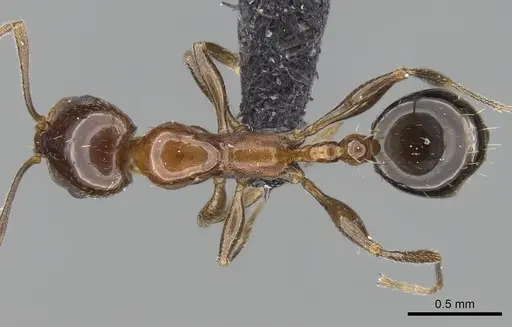
Literature
Loading...Loading products...