

Royidris pallida
- Scientific Name
- Royidris pallida
- Tribe
- Crematogastrini
- Subfamily
- Myrmicinae
- Author
- Bolton & Fisher, 2014
- Distribution
- Found in 0 countries
Royidris pallida Overview
Royidris pallida is an ant species of the genus Royidris. It is primarily documented in 0 countries . Detailed taxonomic data and occurrence records can be further explored via authoritative databases such as AntWeb or the Global Biodiversity Information Facility (GBIF).
Royidris pallida
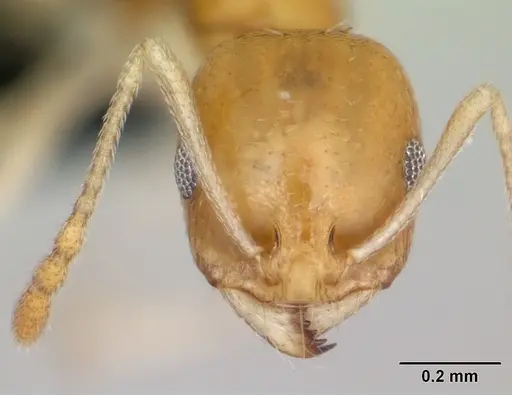
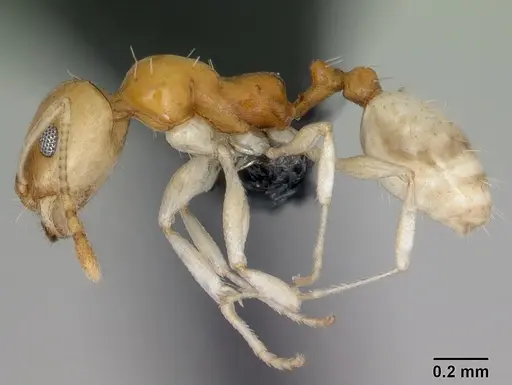
Royidris pallida is an extremely rare myrmicine ant from Madagascar, known from a single specimen collected in 2002. Workers are tiny at just 2.5mm total length, with a distinctive pale yellow to almost white coloration that gives the species its name 'pallida' (meaning pale). The head, mesosoma, petiole and postpetiole are yellow, while the legs and gaster are even lighter, nearly white. They have a 3-segmented antennal club, short scapes that just reach the posterior head margin when laid back, and a smooth, polished head surface. The promesonotum is convex and domed in profile. This species belongs to the robertsoni species group within Royidris and was described by Bolton and Fisher in 2014. What makes this ant truly remarkable is its extreme rarity, it has never been found again since that single specimen was collected at a light trap in spiny forest habitat [1].
Quick Summary
- Difficulty: Expert
- Origin & Habitat: Endemic to Madagascar, specifically from Forêt Tsinjoriaky in Toliara Province. The single known specimen was collected in spiny forest thicket at 70m elevation, foraging nocturnally at a light trap [1][2].
- Colony Type: Unknown, only a single worker (holotype) has ever been collected. No queen, male, or colony samples exist. The colony structure is entirely unconfirmed.
- Size & Growth:
- Queen:{.size-link} Unknown, no queen specimens have been collected or described [1].
- Worker:{.size-link} 2.5mm total length (TL), with head 0.59mm long (HL) and 0.50mm wide (HW) [1].
- Colony: Unknown, no colony samples have ever been collected [1].
- Growth: Unknown
- Development: Unknown, no development data exists for this species (No brood has ever been observed in captivity or described from field samples)
- Antkeeping:
- Temperature: Unknown, no temperature data exists for this species. The type locality in southwestern Madagascar experiences warm conditions typical of spiny forest habitat, but specific requirements are unconfirmed.
- Humidity: Unknown, no humidity data exists. The spiny forest region is generally dry, but specific moisture preferences are unconfirmed.
- Diapause: Unknown, no seasonal data exists for this species
- Nesting: Unknown, no natural nesting observations exist. The single specimen was collected while foraging at night [1].
- Behavior: Known only from a single nocturnal forager collected at a light trap. Beyond this, no behavioral observations exist in scientific literature. Foraging activity, colony structure, defense mechanisms, and interaction with other ants are entirely unstudied [1].
- Common Issues: This species has never been kept in captivity, no husbandry information exists, Only a single worker specimen exists, meaning we know nothing about queen biology, colony founding, or social structure, No diet information exists, we don't know what they eat in the wild, Temperature and humidity requirements are completely unknown, The single specimen was collected in 2002 and the species has never been found again, suggesting either extreme rarity or very localized distribution
Species Overview and Rarity
Royidris pallida represents one of the most poorly known ant species in the hobby, with only a single specimen ever collected. This holotype worker was captured in March 2002 during a nighttime collection at a light trap in southwestern Madagascar's spiny forest region. The species was formally described in 2014 by ant taxonomy experts Barry Bolton and Brian Fisher, who noted its distinctive pale coloration and membership in the robertsoni species group. The fact that this species has never been collected again in over two decades of intensive ant surveys in Madagascar suggests it is either extremely rare, highly localized in distribution, or perhaps active at times or places not typically surveyed. For antkeepers, this means absolutely no captive husbandry information exists, this is not a species that can be ethically or practically kept without first understanding its basic biology in the wild [1].
Identification and Morphology
The worker of Royidris pallida is tiny at just 2.5mm total length, making it one of the smaller Myrmicinae ants. The head is smooth and polished, with relatively short scapes (antennal segments) that just reach the posterior margin when laid straight back. The eyes are positioned very close to the midlength of the head capsule. The antennal club consists of 3 segments. The mesosoma has a distinctively domed, convex promesonotum (the first two fused segments of the middle body), while the propodeum (the third mesosoma segment) is strongly depressed below the highest point of the promesonotum. The most striking feature is the coloration: head, mesosoma, petiole and postpetiole are yellow, while the legs and gaster (abdomen) are extremely pale yellow to almost white, this pale appearance is what gives the species its name 'pallida.' The metafemur (hind femur) is relatively slender. This combination of pale color, smooth head, lack of metanotal groove, short scapes, and slender metafemur distinguishes R. pallida from other species in the robertsoni group [1].
Distribution and Habitat
Royidris pallida is endemic to Madagascar, known only from a single locality in Toliara Province (southwestern Madagascar). The type locality is Forêt Tsinjoriaky, located 6.2 km east of Tsifota at coordinates 22°48'S,43°25'E, at an elevation of 70 meters. This area is part of the spiny forest ecosystem, a unique and threatened habitat characterized by thorny, drought-resistant vegetation including species of Didierea, Alluaudia, and Euphorbia. The spiny forest experiences a hot, dry climate with minimal rainfall. The single specimen was collected in early March 2002,during the wet season, while foraging at night, this represents the only known behavioral observation of the species. The fact that it was attracted to artificial light suggests nocturnal foraging behavior, similar to many other small Myrmicinae ants that avoid daytime heat [1][2].
Why This Species Cannot Be Kept
This section exists to explain why Royidris pallida should NOT be sought after by antkeepers. First, the species has never been found since 2002, no one knows where to find colonies or even if stable populations exist. Second, only a single worker is known to science, we have no information about queens, males, colony size, or basic biology. Third, even if specimens were somehow obtained, keeping them would be entirely experimental with no established protocols. Fourth, and most importantly, there is no ethical way to establish a captive breeding program for a species we cannot locate in the wild. Any 'R. pallida' offered for sale would either be misidentified or illegally collected. Instead, antkeepers interested in rare Madagascan species should focus on better-documented species like Strumigenys species, Dacetini, or other Myrmicinae that have established husbandry protocols in the hobby. The scientific priority should be field surveys to locate living colonies of R. pallida, not captive breeding [1].
Frequently Asked Questions
Can I keep Royidris pallida ants?
No, Royidris pallida cannot be kept in captivity. Only a single worker specimen has ever been collected (in 2002), and the species has never been found again. No information exists about their biology, diet, nesting preferences, or colony structure. There is no ethical or practical way to establish a captive colony [1].
Where can I find Royidris pallida for sale?
Royidris pallida is not available in the antkeeping hobby and likely never will be. The species is known from a single specimen collected in 2002 and has not been found since. Any ants sold as 'R. pallida' would be either misidentified or illegally collected. If you're interested in rare ants, consider better-documented Madagascan species with established care protocols [1].
What does Royidris pallida eat?
Unknown, no diet information exists for this species. The only known specimen was collected while foraging at night at a light trap, but this tells us nothing about their natural diet. Related Royidris species in the robertsoni group may be generalist foragers or predators, but this is entirely speculative for R. pallida [1].
How big do Royidris pallida colonies get?
Unknown, no colony samples have ever been collected. We don't know if colonies consist of dozens, hundreds, or thousands of workers. The single known worker measures 2.5mm, but without colony samples, colony size is entirely unknown [1].
Does Royidris pallida have a queen?
Unknown, no queen specimens have ever been collected or described. The species is known only from a single worker (holotype). Without finding additional specimens, we cannot determine whether the species has typical winged queens, ergatoid (wingless) queens, or uses other reproductive strategies [1].
Are Royidris pallida ants rare?
Extremely rare, they are known from a single specimen collected in 2002. The species has not been found in over two decades of subsequent ant surveys in Madagascar. This could indicate genuine rarity, a very restricted range, or perhaps seasonal/behavioral patterns that make them difficult to collect [1].
What temperature do Royidris pallida ants need?
Unknown, no temperature data exists for this species. While the spiny forest region of southwestern Madagascar is generally warm, specific temperature preferences are unstudied. Without knowing where to find colonies, no captive husbandry protocols can be developed [1].
Do Royidris pallida ants sting?
Unknown, no defensive behavior has ever been observed. As a Myrmicinae ant, they possess a stinger, but whether it is functional or used defensively is completely unstudied. Related small Myrmicinae typically use their stinger only when directly threatened [1].
How long do Royidris pallida workers live?
Unknown, no longevity data exists for this species. Even basic lifespan information requires observing living colonies, which have never been found [1].
Report an Issue
The current care sheet is based fully on literature. See inconsistencies, or something that's incorrect? Please , it will be resolved after review from an admin. Contributing to the blogs tab also helps providing information, to make us be able to further improve the caresheets. Thank you for your support!
References

This caresheet is licensed under CC BY-SA 4.0 .
CASENT0085017
View on AntWeb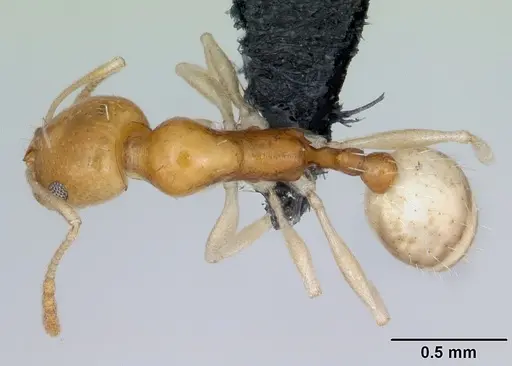
Literature
Loading...Loading products...