

Royidris depilosa
- Scientific Name
- Royidris depilosa
- Tribe
- Crematogastrini
- Subfamily
- Myrmicinae
- Author
- Bolton & Fisher, 2014
- Distribution
- Found in 1 countries
Royidris depilosa Overview
Royidris depilosa is an ant species of the genus Royidris. It is primarily documented in 1 countries , including Madagascar. Detailed taxonomic data and occurrence records can be further explored via authoritative databases such as AntWeb or the Global Biodiversity Information Facility (GBIF).
Royidris depilosa
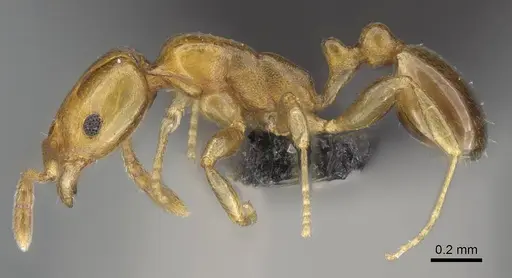
Royidris depilosa is an extremely tiny ant species endemic to Madagascar, measuring just 1.9-2.3mm in total length [1]. Workers are dull yellow to yellowish brown, with the gaster often appearing slightly darker. The species name 'depilosa' refers to their most distinctive feature, they lack setae (hair) across the entire dorsal surface of the mesosoma, giving them a remarkably smooth and polished appearance compared to related species [1]. They belong to the admixta species group within the genus Royidris and are closely related to Royidris admixta, though that species is more densely sculptured and pilose [1].
This is one of the least-studied ant species in the hobby, with only the worker caste ever described. No queens, males, or colony biology has been documented in scientific literature. They inhabit leaf litter in Madagascar's dry forests, spiny forest thickets, and gallery forests, environments characterized by warm temperatures and seasonal dryness [1]. For antkeepers, this species represents a true challenge: almost nothing is known about their captive care requirements, colony structure, or founding behavior.
Quick Summary
- Difficulty: Expert
- Origin & Habitat: Endemic to Madagascar. Found in tropical dry forest, spiny forest thicket, and gallery forest habitats at elevations around 25m. Collected from sifted leaf litter samples and pitfall traps [1][2].
- Colony Type: Unknown, only worker caste has been described. Colony structure (monogyne/polygyne) has not been documented.
- Size & Growth:
- Queen: Unknown, queen caste has not been described [1]
- Worker: 1.9-2.3mm total length (TL) [1]
- Colony: Unknown, colony size has not been documented
- Growth: Unknown, no development or growth data exists
- Development: Unknown, no brood development data exists for this species (Development timeline is completely unstudied. Related Myrmicinae in similar habitats typically develop from egg to worker in 4-8 weeks at optimal temperatures, but this is a rough estimate with very low confidence.)
- Antkeeping:
- Temperature: Based on Madagascar spiny forest habitat, likely prefers warm conditions in the range of 24-30°C. No direct data exists, use condition-based guidance starting around 26°C and observe colony activity.
- Humidity: Likely prefers moderate to dry conditions typical of dry forests. The spiny forest and tropical dry forest habitats experience seasonal rainfall patterns. Start with moderate humidity (50-60%) and adjust based on colony behavior. Avoid overly damp conditions.
- Diapause: Unknown, no seasonal behavior data exists. Madagascar has mild winters, so diapause may not be required or may be minimal.
- Nesting: Found in leaf litter samples, suggesting they nest in small cavities in soil, under stones, or in rotting wood fragments. In captivity, a small test tube setup with minimal space or a small naturalistic terrarium with litter material would be appropriate. Their tiny size means they require very tight chambers and narrow passages.
- Behavior: Behavior is essentially unstudied. Based on their small size, they are likely cryptic foragers that hunt micro-prey in leaf litter. Their 3-segmented antennal club suggests specialized sensory capabilities. Escape prevention is critical due to their extremely small size, they can squeeze through the tiniest gaps. No aggression data exists, but given their size, they are likely non-aggressive and may be overlooked by larger ants.
- Common Issues: no documented captive care exists, this is essentially an unkept species, tiny size makes feeding and escape prevention extremely challenging, no queen or founding behavior known, cannot establish colonies from wild queens, colony size and growth rate completely unknown, risk of colony collapse from standard husbandry practices due to unknown requirements
Why Royidris depilosa Is an Expert-Only Species
This species is genuinely one of the most challenging ants you could attempt to keep. Scientists have only ever described workers, no queens, no males, no colony founding observations, no dietary preferences, no development timeline. Nothing. The entire biological knowledge base consists of 8 worker specimens collected from leaf litter in Madagascar [1].
This means you cannot establish a colony. Without described queens, there is no way to start a colony legally or ethically (wild-queen hunting is impossible when queens are unknown to science). Any colony in captivity would require either a) finding a mated queen in the wild (extremely unlikely given their tiny size and cryptic nature) or b) obtaining existing stock from a very specialized researcher, neither option is realistic for hobbyists.
Even if you somehow obtained workers, their care requirements are complete guesses. We infer they prefer warm, drier conditions based on their spiny forest habitat, but this is inference, not confirmed care guidelines. Standard ant food might be too large for them. Standard nest sizes would be like housing humans in houses, the chambers would be impossibly large for their tiny bodies.
Natural History and Habitat
Royidris depilosa is known only from Madagascar, specifically from the southwestern region around Toliara province. The type locality is P.N. Tsimanampetsotsa (Tsimanampetsotsa National Park), collected at an elevation of 25 meters [1].
They inhabit three distinct forest types: tropical dry forest, spiny forest thicket, and gallery forest. The spiny forest is a unique Madagascar ecosystem characterized by drought-resistant vegetation including Didieraceae (the iconic bottle-shaped plants), Alluaudia, and Euphorbia species. This habitat experiences extreme seasonality, hot, dry conditions for most of the year with brief rainy seasons [1].
The ants were collected using two methods: sifted litter samples and pitfall traps. This indicates they are ground-dwelling litter ants, foraging in the top layer of forest floor debris. Their tiny size (under 2.5mm) makes them part of the micro-ant fauna that most people would never notice [1].
Identification and Morphology
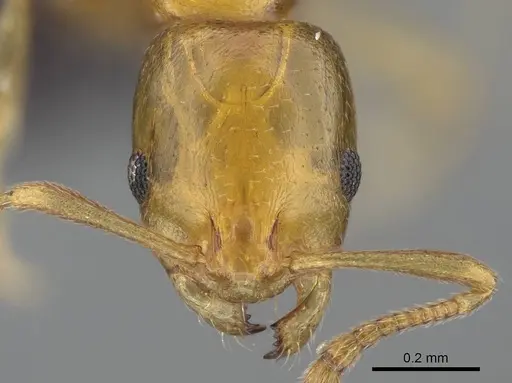
Workers are extremely small at 1.9-2.3mm total length, with a 3-segmented antennal club and notably short scapes that do not reach the posterior margin of the head when laid straight back [1]. The eyes are positioned in front of the midlength of the head capsule.
The most diagnostic feature is the complete absence of setae on the dorsal mesosoma, the pronotum lacks setae at the humeral angles, and the entire dorsum of the mesosoma is hairless [1]. This smooth appearance distinguishes them from their close relative R. admixta, which is more densely sculptured and pilose.
The promesonotum is not swollen or domed, appearing shallowly convex in profile. The propodeal dorsum is more or less flat to shallowly convex and slopes posteriorly. The postpetiole is relatively broad in dorsal view. Coloration ranges from dull yellow to yellowish brown, with the gaster sometimes appearing darker [1].
Related Species and Taxonomic Context
Royidris is a genus of tiny Myrmicine ants endemic to Madagascar, described in 2014 by Bolton and Fisher as part of a major taxonomic revision of Madagascan endemic myrmicine ants related to Eutetramorium [1]. R. depilosa belongs to the admixta species group, which is characterized by the relatively unspecialized nature of the mesosoma compared to other Royidris species.
The two species in this group (R. depilosa and R. admixta) are closely related and separated from other Royidris primarily by their mesosoma morphology. However, they differ significantly in sculpturing and pilosity, admixta is much more densely sculptured and hairy than the smooth, hairless depilosa [1].
This taxonomic context matters for keepers because it tells us these are highly specialized, island-endemic ants with very narrow distributions. They have evolved in isolation on Madagascar for millions of years, making them potentially fragile in captive conditions that don't match their specialized habitat.
Frequently Asked Questions
Can I keep Royidris depilosa ants?
Practically speaking, no. This species has never been kept in captivity because only workers have ever been described, no queens are known to science. Without described queens, there is no way to establish a colony. Even if workers were somehow obtained, their care requirements are completely unknown, making successful maintenance essentially impossible.
Where does Royidris depilosa live?
They are endemic to Madagascar, specifically found in the southwestern region around Toliara province. Their habitats include tropical dry forest, spiny forest thicket, and gallery forest at low elevations around 25 meters [1].
How big are Royidris depilosa workers?
They are extremely tiny ants, measuring only 1.9-2.3mm in total length [1]. This makes them among the smallest ants in the hobby, requiring specialized micro-husbandry techniques.
Do Royidris depilosa ants sting?
Not documented. As a Myrmicinae member, they technically have a stinger, but their tiny size and cryptic nature mean stinging behavior has never been studied. Given their micro-size, any sting would be negligible to humans.
What do Royidris depilosa eat?
Unknown. No dietary observations exist. Based on their tiny size and litter-dwelling habits, they likely hunt micro-arthropods like springtails, mites, and other minute soil fauna. They probably also consume honeydew from root aphids or tiny extrafloral nectaries. Standard ant foods would likely be too large for them.
How long do Royidris depilosa live?
Unknown, no lifecycle data exists for this species. Development from egg to worker has never been documented. Related small Myrmicinae in tropical habitats may develop in 4-8 weeks, but this is pure speculation.
Do Royidris depilosa need hibernation?
Unknown. No seasonal behavior data exists. Given their Madagascar origin (mild winters), any dormancy period would likely be minimal or unnecessary. The spiny forest experiences temperatures rarely dropping below 15°C even in winter.
Are Royidris depilosa good for beginners?
Absolutely not. This is an expert-only, research-level species that has never been successfully kept in captivity. The complete lack of any care data, combined with the impossibility of obtaining a queen, makes this species unsuitable for anyone. Even experienced antkeepers would be working with pure speculation.
Can I find Royidris depilosa queens in the wild?
No queens have ever been described or documented. The species is known only from 8 worker specimens collected in 2002 [1]. Finding a queen would require extremely specialized field work in Madagascar and would be a significant scientific discovery, not a hobbyist activity.
What makes Royidris depilosa different from other ants?
Several things: they are one of the smallest ants in the world at under 2.3mm, they are completely hairless on the dorsal mesosoma (hence the name 'depilosa' meaning hairless), they are endemic to Madagascar's unique spiny forest ecosystem, and they represent a completely unstudied genus from a taxonomic perspective. For antkeepers, the key difference is that virtually nothing is known about them compared to common hobby species.
References

This caresheet is licensed under CC BY-SA 4.0 .
CASENT0020786
View on AntWeb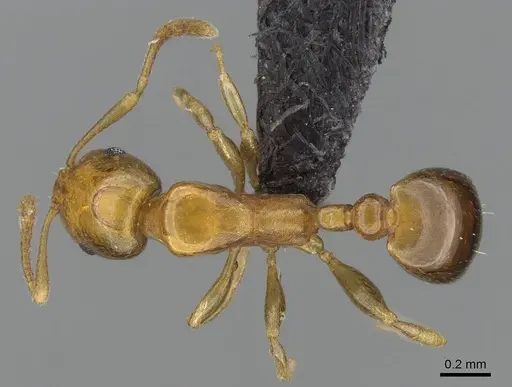
Literature
Loading...Loading products...