

Rogeria lacertosa
- Scientific Name
- Rogeria lacertosa
- Tribe
- Solenopsidini
- Subfamily
- Myrmicinae
- Author
- Kempf, 1963
- Distribution
- Found in 1 countries
Rogeria lacertosa Overview
Rogeria lacertosa is an ant species of the genus Rogeria. It is primarily documented in 1 countries , including Brazil. Detailed taxonomic data and occurrence records can be further explored via authoritative databases such as AntWeb or the Global Biodiversity Information Facility (GBIF).
Rogeria lacertosa
Rogeria lacertosa is a tiny ant species native to southern Brazil, measuring just 3.6-4.0mm in total worker length. Workers have a yellowish-brown body with a slightly darker gaster, and display the characteristic features of the genus including strong longitudinal rugae on the head and a distinctive clypeal structure with a median notch. This species belongs to the Myrmicinae subfamily, tribe Solenopsidini, and is known only from worker castes collected in the state of Rio Grande do Sul at elevations of 100-200m [1].
Unfortunately, almost nothing is known about the biology of Rogeria lacertosa, this is one of the most poorly documented ant species in the hobby. What we can infer comes from its geographic origin in southern Brazil and its placement in the Solenopsidini tribe. The genus Rogeria consists of small, cryptic ants that typically nest in soil, rotting wood, or leaf litter in forest environments. Based on related species and its subtropical origin, this ant likely requires moderate temperatures, good humidity, and would benefit from a winter rest period. This species represents a genuine frontier for antkeeping, expect to learn alongside your colony rather than following established protocols.
Quick Summary
- Difficulty: Expert
- Origin & Habitat: Southern Brazil (Rio Grande do Sul state), specifically the Sinimbu region at 100-200m elevation [1]. Found in lowland areas of the Atlantic Forest biome.
- Colony Type: Unknown, only workers have been collected. No queens, males, or colony samples have been documented. Colony structure is entirely unconfirmed.
- Size & Growth:
- Queen: Unknown, no queens have been collected or described.
- Worker: 3.6-4.0mm total length.
- Colony: Unknown, no colony size data exists for this species.
- Growth: Unknown, no development or growth data has been documented.
- Development: Unknown. Based on typical small Myrmicinae from subtropical Brazil, estimate 6-10 weeks at optimal temperature, but this is a rough guess. (No direct observations of colony development exist. Estimates based on genus-level patterns for small tropical/subtropical Myrmicinae.)
- Antkeeping:
- Temperature: Aim for roughly 20-26°C. Southern Brazil experiences mild winters, so some seasonal temperature variation is likely beneficial. Start with room temperature (around 22-24°C) and adjust based on colony activity.
- Humidity: Keep substrate moderately moist but not waterlogged. These are likely forest-floor ants that prefer stable, humid conditions without being wet. Provide a moisture gradient so ants can choose their preferred zone.
- Diapause: Likely beneficial but not confirmed. Southern Brazil (around 29-30°S latitude) has mild winters with temperatures occasionally dropping near freezing. A cool period around 10-15°C for 2-3 months during winter months (June-August in the Southern Hemisphere) would likely be appropriate.
- Nesting: Unknown specific preferences. Most Rogeria species nest in soil, rotting wood, or under stones in humid forest environments. A naturalistic setup with moist substrate or a Y-tong/plaster nest with good humidity retention would be a reasonable starting point.
- Behavior: Not documented. Based on related Rogeria species, these are likely cryptic, slow-moving ants that forage individually on the forest floor. Their small size (under 4mm) means escape prevention must be excellent, they can easily slip through standard mesh. Expect non-aggressive temperament typical of small cryptic ants.
- Common Issues: no documented biology means all care is experimental, expect to adapt based on colony observations, colony acquisition is extremely difficult since only workers have ever been collected and no queens are known, escape prevention is critical due to tiny 3.6-4mm worker size, no information on diet acceptance, start with standard myrmicinae foods (sugar, protein insects) and observe, no data on founding behavior, queen type (claustral vs semi-claustral) is completely unknown, winter care is uncertain, use mild cooling period and monitor colony response
Species Overview and Discovery
Rogeria lacertosa was described by Kempf in 1963 based on worker specimens collected by the renowned ant collector Friedrich Plaumann in Rio Grande do Sul, southern Brazil. The type locality is Sinimbu, at approximately 200m elevation, with additional specimens from Pardinho at 100m elevation [1]. The species name 'lacertosa' means 'robust' or 'strong' in Latin, referring to its relatively large size compared to similar Rogeria species.
The original description was later supplemented by Kugler in 1994,who provided additional morphological details including the sting apparatus, microsculpture, and variation among paratypes. Notably, this species is only known from workers, no queens, males, or complete colonies have ever been collected or documented. This makes Rogeria lacertosa one of the most poorly known ant species in the hobby, with virtually all biological questions remaining unanswered.
Identification and Morphology
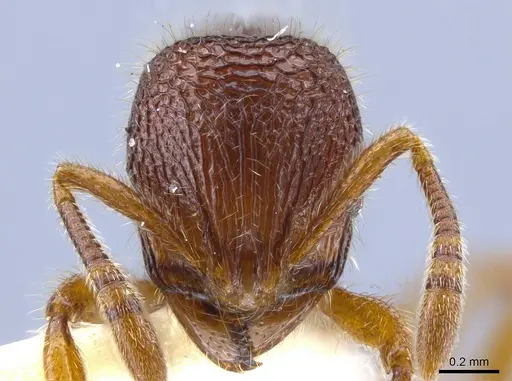
Workers of Rogeria lacertosa measure 3.6-4.0mm in total length, making them small but not tiny ants. The body is yellowish-brown with a slightly darker gaster, and legs and antennae are often lighter, more yellowish. The head features strong, widely spaced longitudinal rugae on the front and cheeks, becoming coarsely reticulate-rugose on the vertex and occiput. The clypeus has a distinctive median notch, and the frontal carinae are broadly expanded.
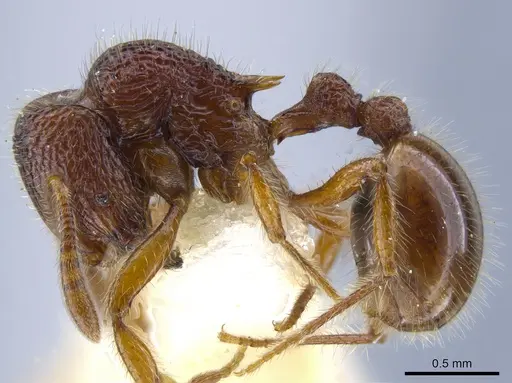
The mesosoma shows sharp, narrow promesonotal rugae similar to those on the head. The epinotum bears widely separated spines that are short and gently raised. Both the petiole and postpetiole have distinctive macroareolate sculpture on their sides. Erect, fine hairs are abundant on the body, including on the scapes, but the gaster lacks decumbent hairs between the erect ones. The compound eyes have 15-20 facets depending on body size. [1]
Habitat and Distribution
Rogeria lacertosa is known only from the state of Rio Grande do Sul in southern Brazil, near the town of Sinimbu [1]. This region lies at approximately 29-30°S latitude, placing it in the Subtropical or Temperate zone. The elevation of 100-200m suggests these ants inhabit lowland areas rather than highland cloud forests.
Southern Brazil features the Atlantic Forest biome with humid, subtropical conditions. The region experiences distinct seasons, mild summers and cool winters where temperatures can occasionally drop near freezing, though frost is not constant. This climate suggests Rogeria lacertosa likely experiences seasonal temperature variations in the wild and would benefit from similar conditions in captivity.
Care Recommendations
Since nothing is known about the biology of this species, all care recommendations are educated guesses based on geography and genus-level patterns. Start with a standard setup: a test tube, Y-tong, or plaster nest with consistent moisture. Keep temperatures in the low-to-mid 20s°C range (roughly 22-26°C) and provide a mild winter cooling period of 2-3 months around 10-15°C.
For feeding, begin with standard myrmicinae offerings: sugar water or honey as an energy source, and small protein sources like fruit flies, pinhead crickets, or other tiny insects. Observe your colony's preferences and adjust accordingly. Given their tiny size, use fine mesh for escape prevention and ensure any gaps in the setup are minimal.
The biggest challenge with this species is simply obtaining a colony. Since only workers have ever been collected and no queens are known, you may need to maintain a worker-only colony or hope that future collections or cultures become available. This makes Rogeria lacertosa a true species for advanced antkeepers who enjoy experimentation and discovery.
Research Priorities
For antkeepers interested in contributing to scientific knowledge, Rogeria lacertosa offers genuine opportunities. Key questions that remain unanswered include: What is the colony structure (single queen or multiple)? How do queens found colonies, do they seal themselves in (claustral) or must they forage (semi-claustral)? What is the complete diet in captivity? How long does development take from egg to worker? What are the nuptial flight timing and conditions?
Documenting any observations of captive colonies, feeding acceptance, development times, behavior, queen presence, would be scientifically valuable. Consider sharing observations with ant research communities or databases. This species represents a genuine frontier where keeper observations could contribute to our understanding of this poorly known ant.
Frequently Asked Questions
How do I care for Rogeria lacertosa ants?
Care is entirely experimental since nothing is known about this species' biology. Start with moderate temperatures (22-26°C), moderately humid conditions, and standard myrmicinae foods (sugar and small protein). Provide a mild winter cooling period. Be prepared to adapt based on your colony's behavior.
Where does Rogeria lacertosa come from?
This species is known only from southern Brazil, specifically Rio Grande do Sul state at 100-200m elevation [1]. The region has a subtropical climate with mild winters.
How big do Rogeria lacertosa workers get?
Workers are tiny, measuring 3.6-4.0mm in total length. This is small but not among the smallest ants in the hobby.
Can I keep multiple queens of Rogeria lacertosa together?
Unknown, no queens have ever been documented for this species, so colony structure is entirely unconfirmed. There is no data on whether they are single-queen (monogyne) or multi-queen (polygyne).
How long does it take for Rogeria lacertosa to develop from egg to worker?
Unknown, no development data exists for this species. Based on typical small Myrmicinae from subtropical Brazil, a rough estimate would be 6-10 weeks at optimal temperature, but this is entirely speculative.
What do Rogeria lacertosa ants eat?
Unknown in captivity. Based on genus-level patterns, they likely accept sugar sources and small protein prey. Start with honey/sugar water and small insects like fruit flies, then observe preferences.
Do Rogeria lacertosa need hibernation or diapause?
Likely yes, based on their origin in southern Brazil which has distinct winters. A mild cooling period of 2-3 months around 10-15°C during winter months would likely be appropriate, though this is unconfirmed.
Why is Rogeria lacertosa so rarely kept?
This is one of the most poorly known ant species in existence. Only workers have ever been collected, no queens, males, or colony samples exist in any museum or culture. Acquiring a colony is extremely difficult since the species has never been cultured.
Is Rogeria lacertosa good for beginners?
No, this species is for expert antkeepers only. There is no established care protocol, no documented biology, and colonies may be impossible to obtain. This is a species for those who enjoy experimentation and discovery.
How do I set up a nest for Rogeria lacertosa?
Since nesting preferences are unknown, use a standard setup that provides humidity control. A Y-tong nest, plaster nest, or naturalistic setup with moist substrate would be reasonable starting points. Ensure escape prevention is excellent given their tiny 3-4mm size.
References

This caresheet is licensed under CC BY-SA 4.0 .
MZSP67223
View on AntWeb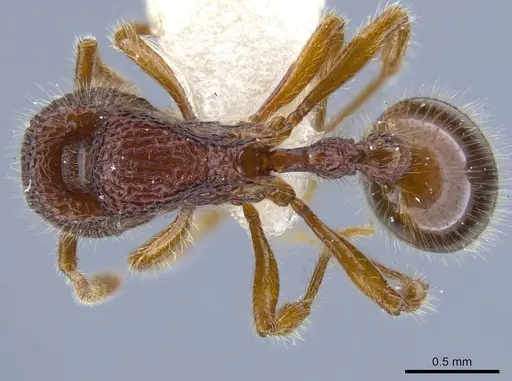
Literature
Loading...Loading products...