

Protalaridris punctata
- Scientific Name
- Protalaridris punctata
- Tribe
- Attini
- Subfamily
- Myrmicinae
- Author
- Lattke, 2018
- Distribution
- Found in 1 countries
Protalaridris punctata Overview
Protalaridris punctata is an ant species of the genus Protalaridris. It is primarily documented in 1 countries , including Venezuela, Bolivarian Republic of. Detailed taxonomic data and occurrence records can be further explored via authoritative databases such as AntWeb or the Global Biodiversity Information Facility (GBIF).
Protalaridris punctata
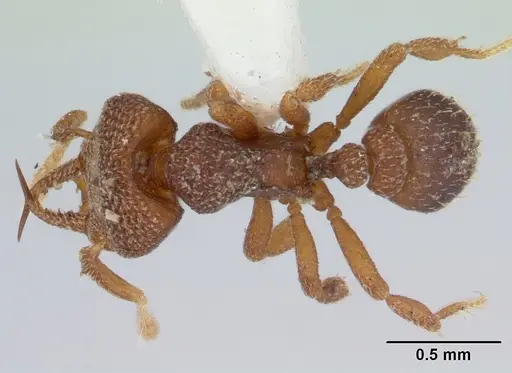
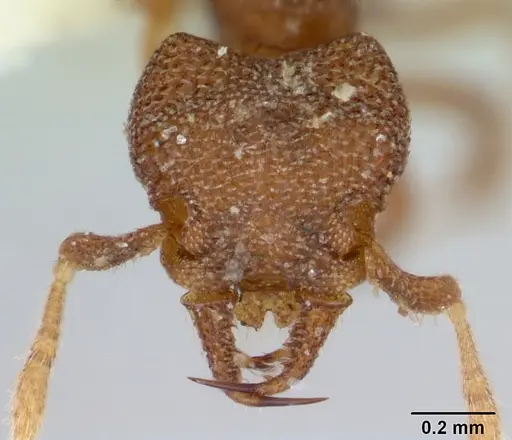
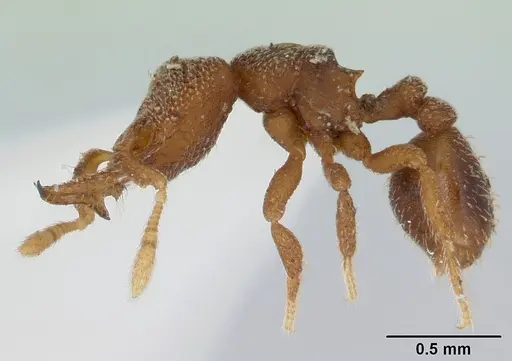
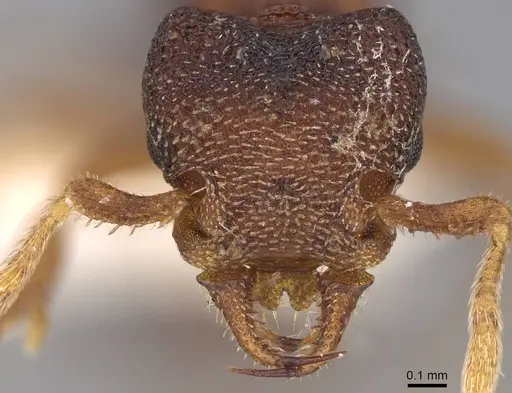
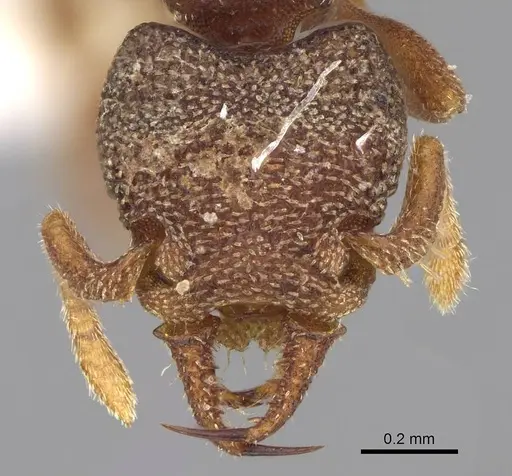
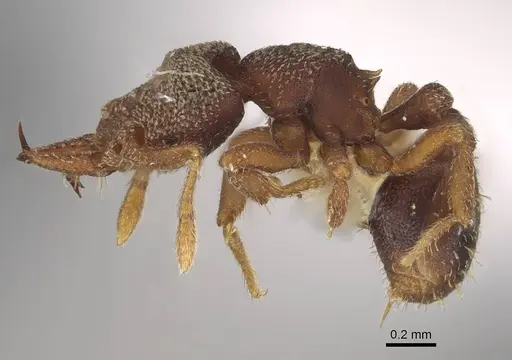
Protalaridris punctata is an extremely rare, newly described ant species from the cloud forests of Venezuela. Workers are tiny at only 0.62-0.67mm in head length, making them among the smallest ants you could keep [1]. They have remarkably complex, deadly-looking mandibles with multiple teeth and a prominent ventral tooth, the genus name literally means 'more than just deadly mandibles' [1]. Their most distinctive features include a hexagonal-shaped head with a transverse crest, and 8-10 erect hairs on the scape (antenna) [1]. The species is only known from a single location in Parque Nacional Henri Pittier at 1225m elevation in Venezuela's Coastal Mountains [1].
This is one of the least-studied ant species in the hobby. The genus belongs to the tribe Attini (the same group as leaf-cutter ants), but Protalaridris are predators, not fungus-growers. Their elaborate mandibles suggest specialized prey capture. The queen is unusual, she was found in a soil sample and appears to have reduced eyes compared to workers [1]. Almost nothing is known about their colony size, founding behavior, or captive care requirements.
Quick Summary
- Difficulty: Expert
- Origin & Habitat: Cloud forest in Parque Nacional Henri Pittier, Venezuela at 1225m elevation. Found in leaf litter in the Coastal Mountains near the Universidad Central de Venezuela's biological station [1][2].
- Colony Type: Unknown. Only known from a handful of specimens, workers from a single leaf litter sample and one dealate queen from a soil sample [1]. No data on whether colonies are single-queen or multi-queen.
- Size & Growth:
- Queen: 0.70mm head length [1]. Note: queen appears smaller than workers in some measurements, which is unusual.
- Worker: 0.62-0.67mm head length [1]. Workers are tiny, among the smallest ants in the Myrmicinae.
- Colony: Unknown. Only a few specimens have ever been collected [1].
- Growth: Unknown. No colony development data exists.
- Development: Unknown. No development data exists for this species [1]. (This species has never been kept in captivity. No timeline data is available.)
- Antkeeping:
- Temperature: Inferred from cloud forest habitat: aim for 18-22°C. Avoid warm conditions, they come from a cool, misty mountain environment [1].
- Humidity: High humidity required. Cloud forests are constantly moist. Keep substrate consistently damp but not waterlogged. Provide a water tube and maintain humidity above 70%.
- Diapause: Unknown. Cloud forests have mild seasons, they may not need a true hibernation but could benefit from a cool period (15-18°C) during winter months.
- Nesting: Likely nested in soil or rotting wood in nature. In captivity, use a test tube setup with moist substrate or a small plaster/acrylic nest. Their tiny size means they need very small chambers and passages.
- Behavior: No behavioral observations exist for this species. Based on their morphology (reduced eyes, complex mandibles), they are likely slow-moving, cryptic predators that hunt small prey in leaf litter. Their mandibles suggest they can handle prey larger than themselves. Escape risk is high due to their tiny size, use fine mesh barriers. Aggression level is unknown but likely moderate, they have defensive hairs and a sting.
- Common Issues: no captive breeding data exists, this species has never been kept in captivity, extremely small size makes feeding difficult, likely needs micro-prey like springtails, only known from a handful of wild specimens, availability is extremely limited, no information on what they eat in captivity or how to start a colony, high humidity requirements may lead to mold problems if ventilation is poor
Discovery and Rarity
Protalaridris punctata was only described in 2018,making it one of the newest ant species in the hobby. The entire world population is known from a single 1m² leaf litter sample taken at 1225m elevation in Venezuela's Parque Nacional Henri Pittier cloud forest [1]. A single dealate queen was also found in a soil sample at about 200m higher altitude [1]. This extreme rarity means almost nothing is known about their biology in the wild, and they have never been kept in captivity. If you obtain this species, you would be pioneering their captive care entirely.
The genus Protalaridris is remarkable for its elaborate mandibles, the species name 'punctata' comes from the Latin for 'to prick or puncture, ' referring to their exquisitely pointed mandibular apices designed for impaling prey [1]. The genus is in the tribe Attini, which includes leaf-cutter ants, but Protalaridris are clearly predators, not fungus farmers.
Identification and Morphology
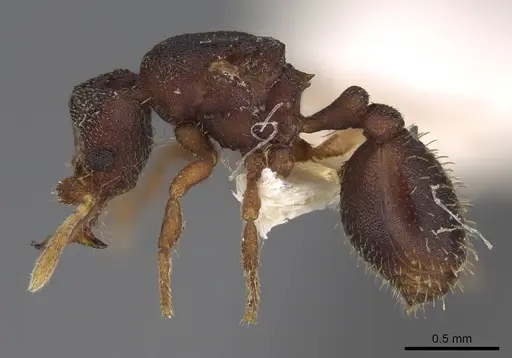
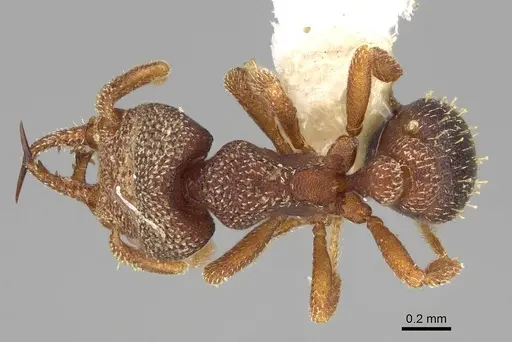
Workers are tiny at only 0.62-0.67mm head length, smaller than many mite species [1]. Their most striking feature is the complex mandible structure: they have a dorsal row of 5-8 preapical teeth plus a prominent ventromedially directed tooth that crosses with its opposite when mandibles close [1]. The head is roughly hexagonal in frontal view with a distinctive transverse crest that separates the elevated posterior region from the lower anterior region [1].
The scape (antenna) has 8-10 erect hairs that are weakly spatulate, these likely help with sensing their environment [1]. Eyes are reduced but distinct, oriented anteroventrally [1]. The propodeal tooth is broad and roughly shaped like an equilateral triangle [1]. Workers are mostly ferruginous (rusty brown) in color with darker tints on the head crest and gaster [1].
Natural Habitat and Conditions
This species is known only from the cloud forests of Venezuela's Coastal Mountains in Parque Nacional Henri Pittier [1]. Cloud forests are characterized by constant mist, high humidity (often above 80%), and cool temperatures due to elevation. The area around the Universidad Central de Venezuela's biological station is at approximately 1225m elevation [1].
In captivity, you should replicate these conditions: keep temperatures cool (18-22°C), maintain high humidity (70%+), and provide a moist substrate. Avoid drying conditions entirely. The tiny size of these ants means they are susceptible to desiccation and must be kept in a humid environment.
Feeding and Diet
The diet of Protalaridris punctata is entirely unconfirmed, but their morphology provides strong clues. Their elaborate mandibles with multiple teeth suggest they are specialized predators, likely hunting small arthropods in leaf litter [1]. The genus is in the tribe Attini, but unlike their leaf-cutter relatives, they appear to be predators.
In captivity, you should start with small live prey: springtails, tiny isopods, or fruit fly larvae would be appropriate size. Their tiny size means even small prey items are significant. Do not attempt sugar water, these are likely strict predators. If they accept initial prey, you could experiment with other micro-arthropods. Success with this species would be entirely experimental.
Housing and Nesting
Given their tiny size and cloud forest origin, housing requires careful attention. A test tube setup with a constant water reservoir works well for founding colonies, the small diameter helps maintain humidity. For established colonies, a small acrylic or plaster nest with very tight chambers (scaled to their 0.6mm body size) would be appropriate.
Escape prevention is critical, these ants are tiny enough to squeeze through standard test tube barriers. Use fine mesh (at least 0.5mm gap tolerance) on any openings. Provide a moist substrate but ensure some dry areas exist for the ants to regulate their own humidity. The nest should be kept in a humid enclosure like a plastic tub with ventilation holes. [1]
Frequently Asked Questions
Can I keep Protalaridris punctata as a pet ant?
This species has never been kept in captivity and is extremely rare in the wild. There is no captive care information available. Only expert antkeepers with significant resources should attempt this species, you would be pioneering all aspects of their care.
How big do Protalaridris punctata colonies get?
Unknown. Only a handful of workers have ever been collected from a single leaf litter sample. The maximum colony size in the wild is completely unstudied [1].
What do Protalaridris punctata eat?
Unconfirmed, but their elaborate mandibles suggest they are predators. In captivity, you should offer small live prey like springtails, tiny isopods, or fruit fly larvae. Their tiny size means even these small prey are substantial meals. Do not offer sugar water, they are likely strict predators.
What temperature do Protalaridris punctata need?
Cool conditions. Based on their cloud forest origin at 1225m elevation, aim for 18-22°C. Avoid warm conditions entirely, they come from a cool, misty mountain environment [1].
How long does it take for Protalaridris punctata to develop from egg to worker?
Unknown. This species has never been studied in captivity, and no development timeline data exists [1].
Are Protalaridris punctata good for beginners?
No. This is an expert-only species. They have never been kept in captivity, their care requirements are completely unknown, their tiny size makes them difficult to house and feed, and they are extremely rare to obtain. You would be pioneering all aspects of their captive care.
Do Protalaridris punctata need hibernation?
Unknown. Cloud forests have mild seasons, so they may not need a true hibernation. However, they might benefit from a cool period (15-18°C) during winter months to simulate seasonal changes. Observe your colony's activity patterns and adjust accordingly.
Can I keep multiple Protalaridris punctata queens together?
Unknown. Only a single dealate queen has ever been found in the wild, and no colony structure data exists [1]. Do not attempt combining unrelated queens, there is no information on whether they tolerate this.
Where is Protalaridris punctata found in the wild?
Only in Parque Nacional Henri Pittier, Venezuela, at approximately 1225m elevation in cloud forests near the Universidad Central de Venezuela's biological station [1]. This is the only known location for this species anywhere in the world.
References

This caresheet is licensed under CC BY-SA 4.0 .
Literature
Loading...Loading products...