

Pheidole violacea
- Scientific Name
- Pheidole violacea
- Tribe
- Attini
- Subfamily
- Myrmicinae
- Author
- Wilson, 2003
- Distribution
- Found in 1 countries
Pheidole violacea Overview
Pheidole violacea is an ant species of the genus Pheidole. It is primarily documented in 1 countries , including Costa Rica. Detailed taxonomic data and occurrence records can be further explored via authoritative databases such as AntWeb or the Global Biodiversity Information Facility (GBIF).
Pheidole violacea
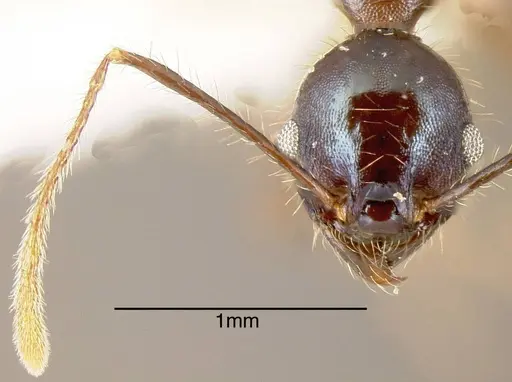
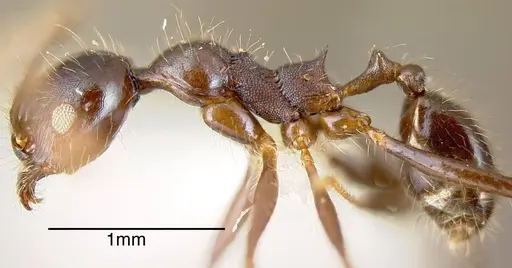
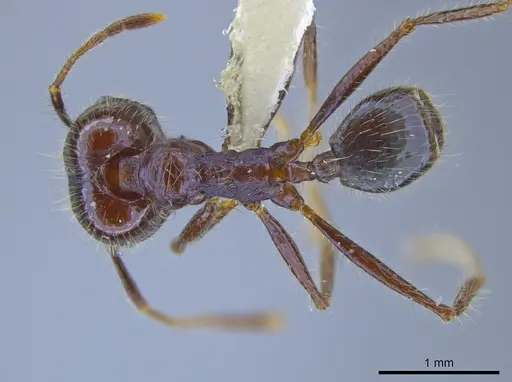
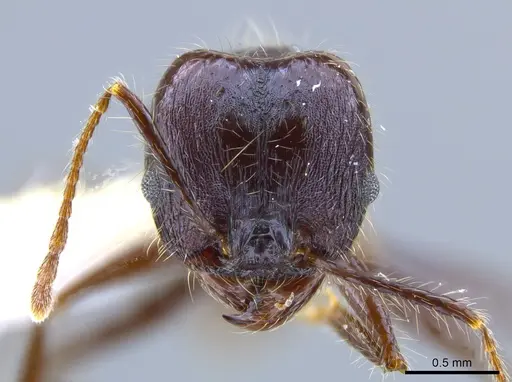
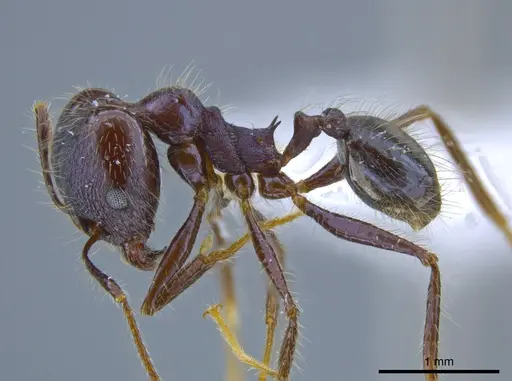
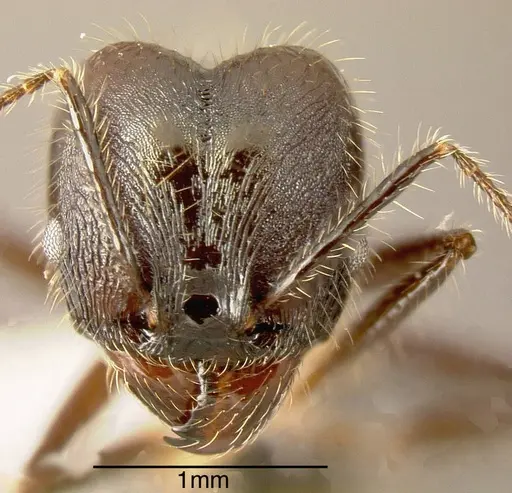
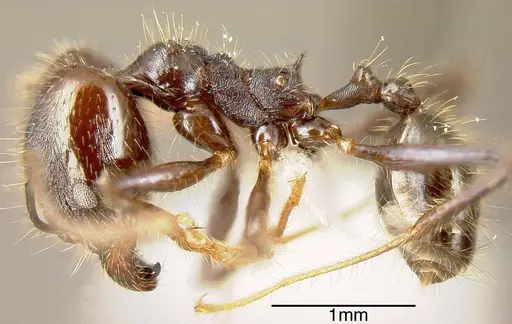
Pheidole violacea is a small ant species native to the wet forests of Costa Rica. Majors are medium brown with a bicolorous head, while minors have a distinctive light brown body with striking bluish to violet reflections that appear in certain lighting, this is how it got its name 'violacea', meaning violet-colored [1]. Workers come in two sizes: majors (major workers) measure around 1.3mm head width, while minors (minor workers) are much smaller at around 0.64mm head width [1]. This species is known for building remarkable 'ant gardens', spherical nests made of carton material that support growing seedlings and epiphytes [1].
What makes Pheidole violacea special is its nesting behavior. Unlike most ants that nest in soil or rotting wood, this species builds globular nests wrapped around vegetation in wet forest clearings. These nests can reach half the size of a soccer ball and are polydomous, meaning the colony lives in multiple connected nests, with one nest enveloping shrub stems and another just a meter away on the underside of leaves [1]. This is one of the few Pheidole species confirmed as a true ant garden builder in Costa Rica [2].
Quick Summary
- Difficulty: Medium
- Origin & Habitat: Upper elevation Cordillera de Tilaran, Atlantic slope of Costa Rica, specifically the Peñas Blancas Valley at 950m elevation. They live in wet forest clearings where they build ant gardens on low vegetation and shrubs [1].
- Colony Type: Polydomous colonies, the species nests in multiple connected locations. Colony structure (single queen vs multiple queens) is unconfirmed for this species.
- Founding: Claustral
- Size & Growth:
- Queen: Unconfirmed, estimated 6-8mm based on genus patterns
- Worker: Majors: 1.3mm head width, Minors: 0.64mm head width [1]
- Colony: Unknown but likely several hundred to a few thousand workers based on typical Pheidole colony sizes
- Growth: Moderate, estimated based on genus patterns
- Development: 6-10 weeks, estimated based on typical Pheidole development (Development time is not directly studied for this species. Estimates based on related Pheidole species suggest 6-10 weeks from egg to first worker at optimal tropical temperatures.)
- Antkeeping:
- Temperature: Keep at 22-26°C, they come from a warm, wet tropical forest at 950m elevation in Costa Rica. A gentle gradient is recommended.
- Humidity: High humidity is essential, they inhabit wet forest clearings. Keep nest substrate consistently moist but not waterlogged. Mist the outworld regularly and provide a water source.
- Diapause: No, as a tropical species from Costa Rica, they do not require hibernation. Maintain consistent warm temperatures year-round.
- Nesting: This species builds ant gardens in nature, wrapping nests around vegetation. In captivity, a naturalistic setup with live plants or a Y-tong/plaster nest with high humidity works well. They need tight chambers and will benefit from vertical space for their arboreal nesting behavior.
- Behavior: This is a relatively calm Pheidole species. Majors are larger and have the characteristic Pheidole 'major' head shape for seed processing. Minors are tiny and active. They are not aggressive but will defend their nest. Escape prevention is important due to their small minor workers, use fine mesh barriers. They build elaborate nests and are polydomous in nature.
- Common Issues: high humidity requirements mean mold can be a problem if ventilation is poor, small minor workers can escape through standard test tube barriers, use fine mesh, polydomous nesting behavior may be difficult to replicate in captivity, tropical species requires consistent warmth, cold temperatures can be fatal, ant garden nesting on vegetation is challenging to provide in standard formicariums
Natural History and Nesting Behavior
Pheidole violacea is one of the most interesting nesting species in the Pheidole genus. In the wild, they build true ant gardens, remarkable spherical nests made from carton material (a papier-mâché-like mixture of soil and plant material) that envelop the stems of shrubs and low vegetation. These nests can grow quite large, reaching about half the size of a soccer ball, and are discrete and irregularly spherical in shape [1].
The species is polydomous, meaning a single colony occupies multiple connected nests. Researchers have observed one nest enveloping stems of a shrub, with a second nest less than a meter away on the underside of a Xanthosoma leaf [1]. This arboreal nesting is unusual for Pheidole and reflects their adaptation to wet forest clearings where they can exploit vertical space.
What makes ant gardens particularly fascinating is that they become mini-ecosystems. The nests are covered with small dicot seedlings at the cotyledon stage, and well-developed ant gardens can support large epiphytes. The ants benefit from the plant structure, while the plants get nutrients from the ant nest materials, a mutualistic relationship [1].
Housing and Enclosure Setup
Keeping Pheidole violacea successfully requires replicating their unique arboreal, high-humidity nesting preferences. A naturalistic setup with live plants works best, you can provide a formicarium connected to a planted outworld where they can build their characteristic ant gardens on vegetation. The outworld should have plants, moss, or other surfaces they can wrap their nest around.
If a naturalistic setup isn't possible, a Y-tong (acrylic) nest or plaster nest with high humidity chambers works as an alternative. Keep the nest material consistently moist but not waterlogged. These ants need more vertical space than typical ground-nesting species due to their arboreal nesting habits.
Escape prevention is critical because minor workers are very small, use fine mesh barriers on all openings. Standard test tube setups may allow escapes, so check for gaps. Provide a water source in the outworld and mist regularly to maintain the high humidity they need.
Feeding and Diet
Like other Pheidole species, Pheidole violacea is an omnivore that likely eats seeds, small insects, and honeydew in the wild. In captivity, offer a varied diet: protein sources like small crickets, mealworms, or other small insects twice weekly. They will also accept sugar water or honey as an energy source.
Pheidole majors have enlarged heads designed for seed processing, so you might offer small seeds as enrichment, though they may not crack them open. Remove uneaten prey after 24-48 hours to prevent mold. Fresh water should always be available.
Temperature and Seasonal Care
As a tropical species from Costa Rica, Pheidole violacea requires warm, stable temperatures year-round. Keep the nest area at 22-26°C, with a slight gradient if possible. A heating cable on one side of the nest can help maintain warmth, but avoid direct heat that could dry out the nest.
Do not hibernate this species, they come from a warm, wet tropical environment where temperatures remain relatively stable throughout the year. Cold temperatures can be fatal or cause colony decline. Maintain consistent warmth and humidity regardless of the season.
The Peñas Blancas Valley where they live sits at 950m elevation, which is warm but not hot, think warm lowland forest conditions. Avoid temperatures below 20°C or above 30°C.
Colony Development and Growth
The colony structure of Pheidole violacea in the wild shows interesting patterns. Winged queens have been observed in nests in late June, suggesting nuptial flights occur during the wet season in Costa Rica [1]. The species is polydomous, with colonies spreading across multiple nest sites.
Colony growth is likely moderate, typical for Pheidole species. First workers (nanitics) will be smaller than normal workers. Based on genus patterns, expect 6-10 weeks from egg to first worker at optimal temperatures. Colonies likely reach several hundred to a few thousand workers over time.
The species has distinct castes: majors (major workers) with enlarged heads for seed processing, and minors (minor workers) that are much smaller and handle most foraging and brood care. Both castes are present in established colonies.
Frequently Asked Questions
How long does it take for Pheidole violacea to have first workers?
Based on typical Pheidole development patterns, expect 6-10 weeks from egg to first worker at optimal temperatures (22-26°C). This is an estimate since development time has not been directly studied for this species.
What do Pheidole violacea ants eat?
They are omnivores. Offer small insects like crickets or mealworms as protein twice weekly, along with sugar water or honey for energy. They may also accept small seeds.
Do Pheidole violacea ants need hibernation?
No. As a tropical species from Costa Rica, they do not require hibernation. Keep them warm year-round at 22-26°C.
What is the best nest type for Pheidole violacea?
A naturalistic setup with live plants works best since they build ant gardens on vegetation in the wild. A Y-tong or plaster nest with high humidity chambers is a good alternative. They need vertical space for their arboreal nesting behavior.
How big do Pheidole violacea colonies get?
Colony size is not directly documented, but based on typical Pheidole species, expect several hundred to a few thousand workers in an established colony.
Are Pheidole violacea good for beginners?
This species is rated as Medium difficulty. While not the hardest species, their high humidity requirements and unusual ant garden nesting behavior make them better suited for keepers with some experience. Beginners may struggle with the humidity needs.
Can I keep multiple queens together?
Colony structure (single queen vs multiple queens) is unconfirmed for this species. Pheidole violacea is polydomous in the wild, meaning they have multiple nest sites, but this is different from having multiple reproductive queens. It is not recommended to combine unrelated foundresses.
Why are my Pheidole violacea dying?
Common causes include: temperatures below 20°C (tropical species are cold-sensitive), low humidity (they need consistently moist conditions), poor escape prevention (minor workers are tiny), or mold from excessive moisture without ventilation. Check that all parameters are within range.
What makes Pheidole violacea special?
They are one of the few Pheidole species that build true ant gardens, spherical nests made of carton material wrapped around vegetation. They are also polydomous, with colonies living in multiple connected nests. The minors have beautiful bluish-violet reflections in certain lighting.
References

This caresheet is licensed under CC BY-SA 4.0 .
Literature
Loading...Loading products...