

Pheidole gilvescens
- Scientific Name
- Pheidole gilvescens
- Tribe
- Attini
- Subfamily
- Myrmicinae
- Author
- Creighton & Gregg, 1955
- Distribution
- Found in 2 countries
Pheidole gilvescens Overview
Pheidole gilvescens is an ant species of the genus Pheidole. It is primarily documented in 2 countries , including Mexico, United States of America. Detailed taxonomic data and occurrence records can be further explored via authoritative databases such as AntWeb or the Global Biodiversity Information Facility (GBIF).
Pheidole gilvescens
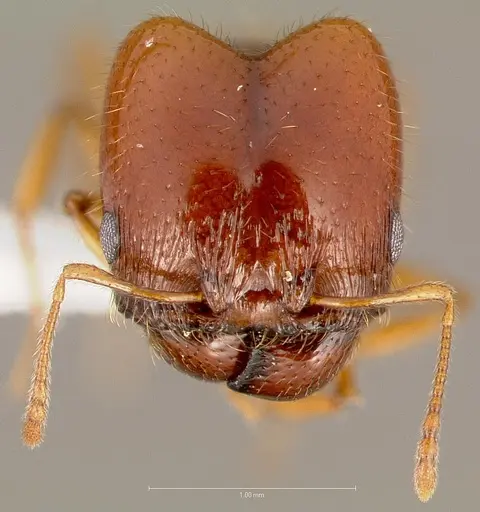
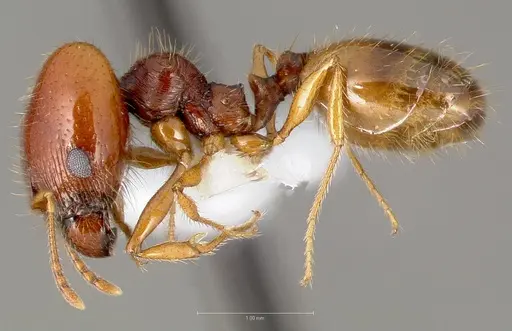
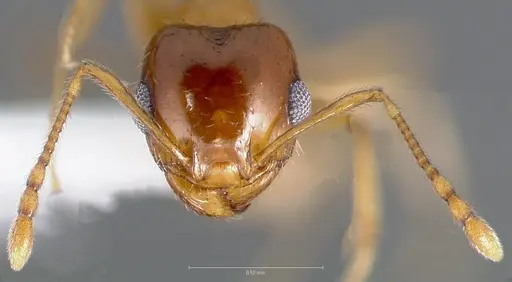
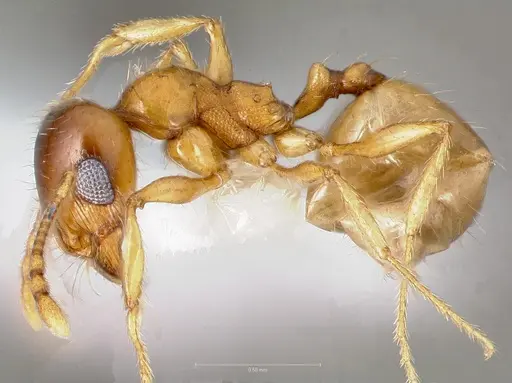
Pheidole gilvescens is a small seed-harvesting ant native to the deserts of the southwestern United States and northern Mexico. Majors have a distinctive reddish-yellow body with a transversely oval postpetiolar node, while minors are entirely yellow, the trait that gives the species its name (gilvescens means pale yellow). Workers average 2.2mm in length, with majors reaching about 1.4mm head width [1]. These ants build small crater nests in sandy soil, often surrounded by chaff debris, and form polydomous colonies that spread across multiple connected nest sites [2]. Unlike many Pheidole species, majors rarely leave the nest, making this a primarily minor-worker forager species.
Quick Summary
- Difficulty: Easy
- Origin & Habitat: Native to the southwestern United States (southern California, Arizona, southern Nevada) and northern Mexico. Found in desert habitats including grassland, creosote bush scrub, wash woodlands, and joshua tree woodlands at elevations between 150-1500m [3].
- Colony Type: Monogyne (single queen) colonies with polydomous structure, colonies spread across multiple connected nest sites [2]. Colonies remain relatively small, typically containing only a dozen or so majors and a few dozen minors.
- Colony: Monogyne
- Founding: Claustral
- Size & Growth:
- Queen: Approximately 5-6mm (estimated based on genus)
- Worker: Minors: 2.2mm average [1], Majors: ~3mm
- Colony: Up to 500 workers [3]
- Growth: Moderate
- Development: 6-8 weeks (estimated based on typical Pheidole development) (Development time is typical for desert Pheidole species, relatively fast in warm conditions)
- Antkeeping:
- Temperature: Keep at 24-28°C. These are desert ants adapted to warm conditions, but avoid extreme heat. Room temperature within this range works well.
- Humidity: Low to moderate. Provide a dry outworld with a moist nest chamber. Desert species do best with a humidity gradient, damp nest area, dry foraging space.
- Diapause: Yes, a mild winter rest period (4-6 weeks at 10-15°C) is recommended to simulate their natural seasonal cycle in the Mojave and Sonoran deserts.
- Nesting: Y-tong or acrylic nests work well. They prefer compact chambers over large open spaces. Provide sand or sandy substrate in the outworld for natural foraging behavior. Test tube setups are suitable for founding colonies.
- Behavior: These ants are primarily granivorous, they collect and store seeds, but also scavenge small arthropods. They forage in groups or columns during dusk through early morning, rarely traveling more than 3-4m from the nest [1]. Majors rarely leave the nest, making this a species dominated by minor workers. They show the 'dear enemy' effect, reduced aggression toward neighboring colonies [4]. Workers are not aggressive and rarely sting. Escape risk is moderate due to small size.
- Common Issues: small colony size means slow population growth, don't expect rapid expansion, desert species prone to mold if kept too humid, balance moisture carefully, seed-harvesting behavior means they may not accept all protein foods readily, offer seeds and dead insects, polydomous nature means they may spread between connected spaces if given the opportunity, nocturnal foraging means they may seem inactive during the day, this is normal
Nest Preferences and Housing
Pheidole gilvescens naturally nests in exposed sandy soil, building small crater nests often marked by chaff debris around the entrance [3]. In captivity, they adapt well to various nest types including Y-tong, acrylic, and test tube setups. The key is providing appropriately scaled chambers, these are small ants that prefer tight, compact spaces over large open areas. A naturalistic setup with a sandy substrate in the outworld allows them to exhibit natural seed-harvesting behavior. Because they are polydomous in the wild (forming multiple connected nest sites), they may benefit from having multiple connected chambers or the option to expand. Keep the nest area slightly moist while maintaining a dry outworld.
Feeding and Diet
As seed harvesters, these ants primarily collect and store seeds, this makes them similar to the well-known 'harvester ants'. They also scavenge small arthropods and insects, though they rarely actively hunt. In captivity, offer a mix of grass seeds, millet, and other small seeds as a staple. They also accept protein sources like dead insects (flightless fruit flies, small mealworms, crickets). Repletes (workers that store liquid food in their abdomens) have been observed in wild colonies [3], indicating they can store food for lean times. Feed seeds continuously and offer protein 2-3 times per week. Remove uneaten seeds periodically to prevent mold. Sugar water or honey is occasionally accepted but not a primary food source.
Temperature and Seasonal Care
These desert ants prefer warm conditions in the 24-28°C range. They are active in the Mojave and Sonoran deserts at elevations from 2200-5500 feet, where temperatures can fluctuate dramatically between day and night [5]. In captivity, avoid temperatures above 32°C and provide a gentle thermal gradient so ants can self-regulate. A heating cable on one side of the nest (placed on top, not underneath) can help maintain optimal temperatures. During winter, a mild diapause period of 4-6 weeks at 10-15°C mimics their natural seasonal cycle and supports colony health. Reduce feeding during this period and allow the colony to slow down naturally.
Foraging Behavior
Pheidole gilvescens is primarily nocturnal, beginning foraging at dusk and continuing through the night until early morning [3]. They forage in groups or columns rather than as solitary individuals, and typically stay within 3-4 meters of their nest entrance [1]. This is important for keepers to understand, if your ants seem inactive during the day, this is completely normal behavior. The majors (soldier caste) rarely leave the nest, making minor workers the primary foragers. They use recruitment strategies to coordinate food discovery, with workers leading nestmates to food sources. In captivity, this means offering food in the evening or night hours when they are naturally active.
Colony Structure and Development
This species forms monogyne colonies with a single reproductive queen. Colonies are polydomous, meaning they maintain multiple connected nest sites rather than a single central nest [2]. This is an unusual trait among ants and something to consider when housing, they may do better with expandable setups. Wild colonies typically contain up to 500 workers, though many observed colonies are much smaller, often just half a dozen majors and 2-3 dozen minors [3]. The small colony size means growth appears slow compared to faster-expanding species, but this is normal for this species. Queens are claustral, they seal themselves in a chamber and raise the first brood alone on stored body fat.
Frequently Asked Questions
How long does it take for Pheidole gilvescens to produce first workers?
Expect first workers (nanitics) to emerge in 6-8 weeks after the queen lays her first eggs, assuming temperatures around 24-26°C. This is typical for Pheidole species. Growth is relatively slow compared to some genera, so patience is needed during the founding stage.
Can I keep multiple Pheidole gilvescens queens together?
No. This species is monogyne, meaning colonies naturally have a single queen. Unlike some Pheidole species that can be polygynous, P. gilvescens colonies function with one queen. Combining unrelated queens will result in fighting.
What do Pheidole gilvescens eat?
They are primarily seed harvesters, offer grass seeds, millet, and small seeds as a staple. They also accept dead insects like fruit flies, small mealworms, or crickets for protein. Occasional honey or sugar water may be accepted but is not required.
Do they need hibernation?
Yes, a mild winter rest period is recommended. Keep them at 10-15°C for 4-6 weeks during winter months. This mimics their natural cycle in the desert Southwest where they experience cooler winters. Reduce feeding during this period.
Why are my ants only active at night?
This is completely normal. Pheidole gilvescens is naturally nocturnal, foraging from dusk through early morning. During the day, they rest inside the nest. You will see most activity if you check on them in the evening or leave food overnight.
When should I move them to a formicarium?
You can keep founding colonies in test tubes for many months. Move to a larger nest (Y-tong, acrylic, or naturalistic) once the colony reaches 50+ workers or when the test tube becomes crowded. They prefer compact chambers, so don't oversize the new enclosure.
How big do Pheidole gilvescens colonies get?
Maximum colony size is around 500 workers in well-established colonies [3]. This is relatively small compared to many ant species, and growth is slow. Most colonies you encounter will be smaller, with just a few dozen workers.
Are Pheidole gilvescens good for beginners?
Yes, they are considered an easy species to keep. They are forgiving of minor temperature or humidity fluctuations, don't require live prey, and are not aggressive. The main challenges are their slow growth and nocturnal activity pattern.
Why do my ants have majors that never leave the nest?
This is normal for this species. Unlike many Pheidole species where majors actively defend or forage, P. gilvescens majors rarely leave the nest [3]. The minor workers handle all foraging and external tasks. The majors serve as seed processors and defenders within the nest.
References

This caresheet is licensed under CC BY-SA 4.0 .
CASENT0005759
View on AntWeb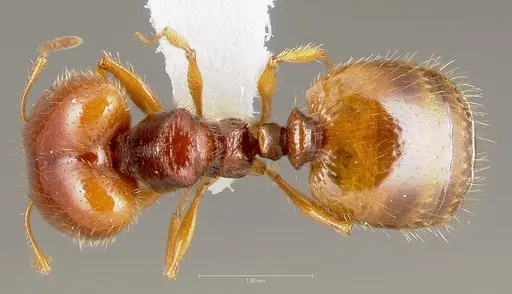
CASENT0005760
View on AntWeb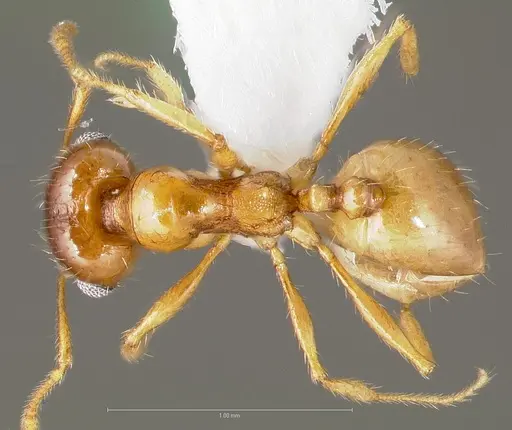
Literature
Loading...Loading products...