

Pheidole christinae
- Scientific Name
- Pheidole christinae
- Tribe
- Attini
- Subfamily
- Myrmicinae
- Author
- Fischer <i>et al.</i>, 2012
- Distribution
- Found in 2 countries
Pheidole christinae Overview
Pheidole christinae is an ant species of the genus Pheidole. It is primarily documented in 2 countries , including Gabon, Uganda. Detailed taxonomic data and occurrence records can be further explored via authoritative databases such as AntWeb or the Global Biodiversity Information Facility (GBIF).
Pheidole christinae
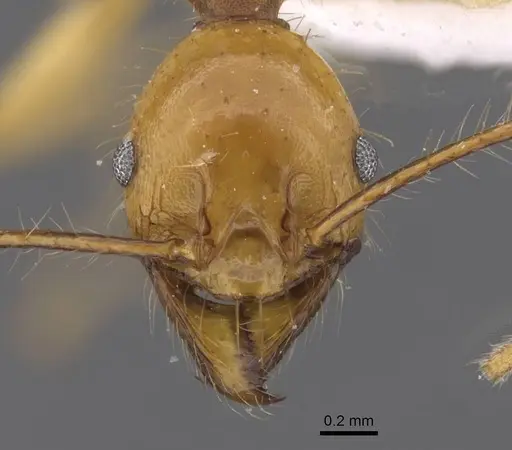
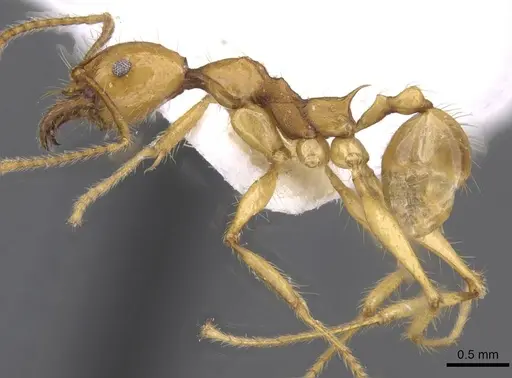
Pheidole christinae is a small African ant belonging to the pulchella species group. Minor workers measure just 0.73-0.83mm in head width and have a distinctive orange-yellow coloration [1]. They feature an elongated elliptical head, very long antennae that extend well past the back of the head, and notably long propodeal spines [1]. This species was only described in 2012 and is known from only a handful of specimens collected in the Budongo Forest in Uganda and the Democratic Republic of Congo [1][2]. The species was named in honor of the first author's wife Christina [1]. Major workers have never been collected, making this one of the more mysterious Pheidole species. In the wild, they live in leaf-litter environments in central African forests [1].
Quick Summary
- Difficulty: Medium
- Origin & Habitat: Native to the Afrotropical region, specifically the Democratic Republic of Congo and Uganda. Found in the Budongo Forest Reserve at elevations of 900-1000m, collected from sifted leaf-litter and through hand-collection [1][2].
- Colony Type: Unconfirmed, only minor workers have been collected in the wild, so colony structure (single queen vs multiple queens) is unknown. Most Pheidole species are monogyne (single queen colonies), but this has not been confirmed for P. christinae.
- Size & Growth:
- Queen: Unknown, queens have never been collected or described
- Worker: Minor workers: 0.73-0.83mm head width,0.88-1.02mm total length [1]
- Colony: Unknown, only minor workers have been collected, no colony size data available
- Growth: Unknown, no development data exists for this species
- Development: Unknown, no direct observations. Based on typical Pheidole patterns, expect 6-10 weeks at warm temperatures. (This is entirely estimated from genus-level data since no species-specific development research exists.)
- Antkeeping:
- Temperature: Based on their Ugandan forest habitat, aim for warm conditions around 24-28°C. Avoid temperatures below 20°C.
- Humidity: Forest floor species, keep substrate moderately humid. Provide a gradient from slightly damp to drier areas so ants can choose their preferred zone.
- Diapause: Unknown for this species. Many African ants from highland forests do not enter true diapause but may reduce activity during cooler periods.
- Nesting: In the wild, they live in leaf-litter and soil. In captivity, a naturalistic setup with moist substrate or a Y-tong/plaster nest works well. They are tiny, so chambers should be appropriately scaled.
- Behavior: No specific behavioral observations exist for this species. Based on genus patterns, they are likely generalist foragers that collect seeds and small insects. They are not aggressive and lack a functional stinger. Escape prevention is critical due to their very small size, use fine mesh barriers.
- Common Issues: very small size means escapes are likely without fine mesh barriers, no captive breeding records exist, this species is rarely kept, queen and major worker morphology completely unknown, limited distribution data makes precise care requirements uncertain, wild-caught colonies may have parasites given their leaf-litter habitat
Species Discovery and Status
Pheidole christinae was only formally described in 2012 by Fischer, Hita Garcia, and Peters [1]. This makes it one of the newer additions to the ant-keeping hobby. The species is known from a very limited number of specimens, only minor workers have ever been collected. This is unusual for Pheidole, as most species have well-documented major workers with their characteristic enlarged heads. The lack of major workers and queens means we know almost nothing about their colony structure or founding behavior. The entire natural history of this species remains to be discovered.
Identification and Appearance
Minor workers of Pheidole christinae are distinctive within the pulchella species group. They have an orange-yellow coloration and an elongated elliptical head shape, with the sides slightly converging toward the back of the head [1]. Their antennae are notably long, when laid back, they extend past the occipital margin by about one-third of their length [1]. They possess long propodeal spines that curve backward and relatively long legs. The pilosity (hair coverage) is variable in length with hairs often appearing blunted or split at the tips [1]. This species can be distinguished from close relatives like P. pulchella and P. heliosa by its longer propodeal spines, the small raised peaks at the humeri, and the shape of the dorsopropodeum [1].
Natural Habitat and Distribution
This species is known only from a small geographic area in central Africa, specifically the Budongo Forest in Uganda and the Democratic Republic of Congo [1][2]. The Budongo Forest is a tropical rainforest reserve at approximately 900-1000m elevation. Specimens have been collected from sifted leaf-litter, in pitfalls, and by hand-collection [1]. This suggests they are a leaf-litter dwelling species, living in the moist micro-environment of the forest floor. The population in Gabon differs slightly from the Ugandan specimens in having a deeper metanotal groove and longer propodeal spines [1].
Housing and Nesting
Since this species has never been kept in captivity, housing recommendations are based on genus-level knowledge and their likely leaf-litter habitat. A naturalistic setup with moist, loose substrate (a mix of soil and leaf litter material) would best mimic their natural environment. Alternatively, a Y-tong or plaster nest with appropriately scaled tiny chambers would work. The critical factor is escape prevention, these are very small ants that can squeeze through standard test tube cotton and most commercial formicarium gaps. Use fine mesh (0.5mm or smaller) for all barriers and ensure all connections are sealed. Provide a water tube for humidity but avoid flooding the nest area.
Feeding and Diet
No specific feeding observations exist for this species. However, Pheidole ants are typically generalist omnivores, they eat seeds, insect parts, and will scavenge protein. In captivity, you should offer a varied diet: small live prey (fruit flies, pinhead crickets, springtails), protein jelly or cat food, and occasional sugar sources (honey water, sugar water). Given their tiny size, prey items should be appropriately small. Remove uneaten food promptly to prevent mold in the humid conditions they require.
Temperature and Seasonal Care
Based on their collection location in Ugandan forests at 900-1000m elevation, they likely prefer warm, stable temperatures in the range of 24-28°C. Avoid temperatures below 20°C or sudden temperature fluctuations. A heating cable on one side of the nest can create a gradient, allowing ants to regulate their own temperature. Whether they require any dormancy period is unknown, many tropical ants maintain activity year-round. If your colony shows reduced activity during winter months, this may simply be a response to cooler room temperatures rather than a true diapause requirement.
Frequently Asked Questions
How do I keep Pheidole christinae ants?
This species has never been documented in the ant-keeping hobby, so no established care protocols exist. Housing recommendations are based on genus-level knowledge: use a naturalistic setup with moist substrate or a Y-tong nest with tiny chambers. Focus on excellent escape prevention using fine mesh barriers, as these are extremely small ants.
What do Pheidole christinae ants eat?
No species-specific feeding data exists. Based on typical Pheidole behavior, offer small live prey (fruit flies, springtails), protein sources, and occasional sugar water. Prey must be appropriately sized for these tiny ants.
How long does it take for Pheidole christinae to develop from egg to worker?
Unknown, no development data exists for this species. Based on related Pheidole species, expect approximately 6-10 weeks at warm temperatures (around 25°C).
Are Pheidole christinae ants aggressive?
No behavioral observations exist for this species. However, Pheidole ants in general are not aggressive and lack a painful sting. They are considered safe to handle.
What temperature do Pheidole christinae ants need?
Based on their Ugandan forest habitat, aim for warm conditions around 24-28°C. Avoid temperatures below 20°C.
Do Pheidole christinae ants need hibernation?
Unknown, no research exists on their seasonal requirements. Many African forest ants do not enter true diapause but may reduce activity during cooler periods.
How big do Pheidole christinae colonies get?
Unknown, only minor workers have ever been collected, and no colony size data exists. Most Pheidole colonies reach several hundred to a few thousand workers.
Can I keep multiple Pheidole christinae queens together?
Unknown, colony structure has not been documented for this species. Most Pheidole are monogyne (single queen), but this has not been confirmed for P. christinae.
Why are major workers unknown for Pheidole christinae?
This species was only described in 2012 from a limited number of specimens collected in Uganda and D.R. Congo. Major workers may exist in the wild but have simply never been collected, or this species may have an unusual development pattern where majors rarely appear.
Is Pheidole christinae a good species for beginners?
This species is not recommended for beginners. It has never been kept in captivity, no care protocols exist, and queens have never been documented. For a similar but more established species, consider common Pheidole species like P. pallidula or P. metallescens.
References

This caresheet is licensed under CC BY-SA 4.0 .
CASENT0218338
View on AntWeb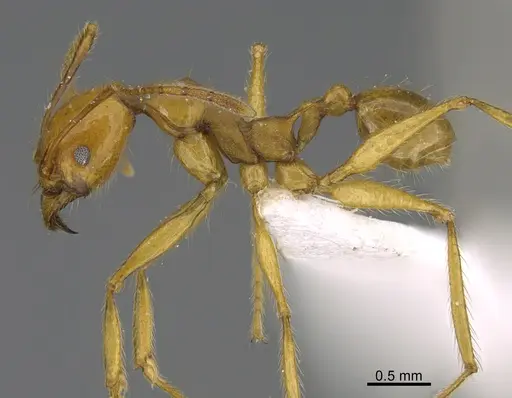
CASENT0227940
View on AntWeb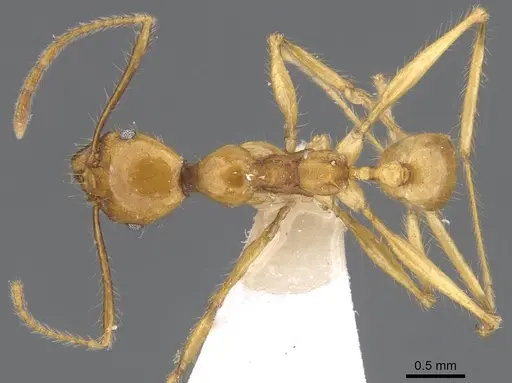
Literature
Loading...Loading products...