

Paraparatrechina splendida
- Scientific Name
- Paraparatrechina splendida
- Tribe
- Lasiini
- Subfamily
- Formicinae
- Author
- LaPolla & Cheng, 2010
- Distribution
- Found in 2 countries
Paraparatrechina splendida Overview
Paraparatrechina splendida is an ant species of the genus Paraparatrechina. It is primarily documented in 2 countries , including Gabon, Uganda. Detailed taxonomic data and occurrence records can be further explored via authoritative databases such as AntWeb or the Global Biodiversity Information Facility (GBIF).
Paraparatrechina splendida
Paraparatrechina splendida is a tiny rainforest ant native to Central Africa (Gabon and Uganda). Workers measure just 1.4-2.6mm, making them one of the smaller ant species you'll encounter. They have a distinctive dark brown body with a brilliant bluish-purple iridescence that gives them their 'splendid' name, under good lighting, their cuticle really does gleam with iridescent colors. Their head is noticeably longer than broad, and they have exceptionally long antennae scapes that extend well past the back of their head. These ants live in rainforest habitats where they likely nest in rotting wood or under debris on the forest floor. Only the worker caste has been described, making this a relatively poorly known species in the antkeeping hobby.
Quick Summary
- Difficulty: Unknown, limited data available
- Origin & Habitat: Rainforest habitats in Gabon and Uganda, Central Africa [1][2]
- Colony Type: Unknown, only workers have been collected, no queen or colony structure has been documented
- Size & Growth:
- Queen: Unknown, queen caste has not been described
- Worker: 1.4-2.6mm [1][2]
- Colony: Unknown, no colony size data available
- Growth: Unknown
- Development: Unknown, development has not been studied (No direct data available. Based on their tiny size and tropical rainforest habitat, development may be relatively fast (4-8 weeks at warm temperatures), but this is an estimate.)
- Antkeeping:
- Temperature: Keep warm at 24-28°C. Based on their rainforest origin from Central Africa, they need tropical conditions. A heating cable on one side of the nest can create a gradient.
- Humidity: High humidity (70-85%) is essential. Rainforest ants need consistently moist substrate. Mist regularly and ensure the nest substrate stays damp but not waterlogged.
- Diapause: Unknown, no data on overwintering requirements. As a tropical species from Central Africa, they may not need a true diapause, but a slight cool period during winter months may be beneficial.
- Nesting: Likely prefers humid setups with small chambers. A Y-tong (AAC) or plaster nest works well for these tiny ants. Keep nesting material consistently moist. Given their small size, escape prevention is critical, use fine mesh and tight-fitting barriers.
- Behavior: Behavior is not well documented. They are likely generalist foragers similar to other Paraparatrechina species. Their tiny size (under 3mm) makes them excellent escape artists, you must use fine mesh barriers and excellent escape prevention. They probably form small colonies in the wild. Handle with care as they are very small and can easily be crushed.
- Common Issues: tiny size makes escape likely without fine mesh barriers, no breeding stock available, this species is not established in the antkeeping hobby, humidity requirements are critical, dry conditions will kill colonies, limited biological data makes care recommendations uncertain, only worker caste known, cannot establish breeding colonies
Appearance and Identification
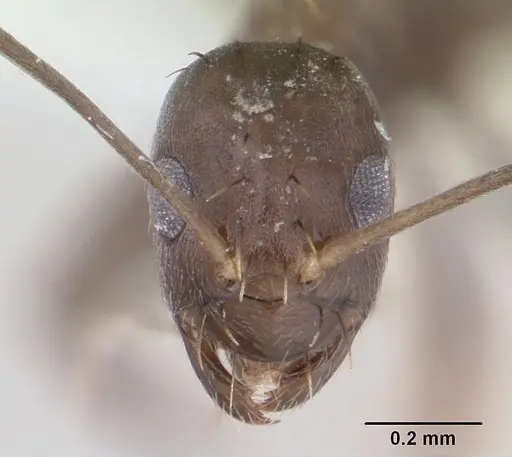
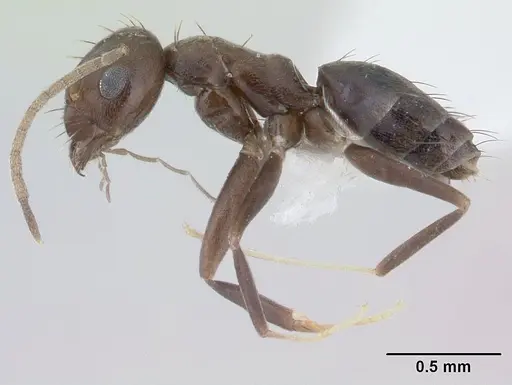
Paraparatrechina splendida workers are tiny ants measuring just 1.4-2.6mm in total length. Their most striking feature is the dark brown body with a brilliant bluish-purple iridescence that gives them their 'splendid' name, under good lighting, their cuticle reflects iridescent colors. The head is distinctly longer than broad, and they have exceptionally long antennae scapes that extend past the back of the head by about the length of the first 5 funicular segments. Their body is covered in short white pubescence. The legs are dark brown, but the tarsi (foot segments) are typically much lighter and become progressively whiter toward the last segment. This is the largest and darkest colored Afrotropical Paraparatrechina species. They are closely related to Paraparatrechina concinnata, which is similar in body shape but lighter in color [1][2].
Natural Habitat and Distribution
This species is known from rainforest habitats in Central Africa, specifically collected in Gabon and Uganda. Most specimens have been collected from rainforest environments, indicating they prefer humid, shaded forest floor conditions. The type locality is in the Monts Doudou reserve in Gabon at an elevation of 375 meters. They appear to be a rare or infrequently collected species, with limited occurrence data available [1][2].
Temperature and Humidity Requirements
As a rainforest species from Central Africa, Paraparatrechina splendida requires warm and humid conditions. Keep the nest at 24-28°C, which mimics their natural tropical environment. High humidity is essential, aim for 70-85% relative humidity. The substrate should remain consistently moist but not waterlogged. A heating cable placed on one side of the nest can create a temperature gradient, allowing the ants to self-regulate. Given their tiny size and likely forest-floor nesting habits, stable humidity is more critical than temperature extremes. Avoid dry conditions entirely, as this will quickly fatal to these rainforest ants.
Feeding and Diet
The specific diet of Paraparatrechina splendida has not been documented. Based on typical Paraparatrechina behavior and their small size, they are likely generalist foragers that collect honeydew from aphids and small insects. In captivity, you should offer a varied diet including sugar water or honey as an energy source, and small protein sources like fruit flies, pinhead crickets, or other tiny arthropods. Given their minute size, prey items must be appropriately sized, springtails or fruit fly pupae work well. Observe your colony to determine preferred foods and adjust accordingly.
Nesting and Housing
Since only workers have been collected and described, we must infer their nesting preferences from related species and habitat data. They likely nest in rotting wood, under stones, or in debris on the rainforest floor. For captive care, a small, humid nest setup works best. A Y-tong (AAC) nest or plaster nest with small chambers scaled to their tiny size is appropriate. The nesting material must remain consistently moist. Escape prevention is critical, these ants are extremely small (under 3mm) and can squeeze through standard barrier gaps. Use fine mesh (at least 0.5mm) and ensure all connections are tight-fitting.
Current Availability and Collection
Paraparatrechina splendida is not established in the antkeeping hobby. Only the worker caste has been scientifically described, meaning no queen has been documented and no breeding stock is available. This species remains primarily of interest to ant taxonomists and researchers rather than hobbyists. If you are interested in keeping Paraparatrechina species, you may have better success locating more common related species from the same genus that are established in captivity. The scientific description of this species is relatively recent (2010), and biological studies beyond morphology are lacking [1][2].
Frequently Asked Questions
Can I keep Paraparatrechina splendida as a pet ant?
This species is not available in the antkeeping hobby. Only the worker caste has been described scientifically, and no queens have been documented. There is no established breeding stock available, making captive keeping currently impossible. You would need to locate wild colonies, which is not recommended given the limited knowledge about this species.
How big do Paraparatrechina splendida ants get?
Workers are tiny at just 1.4-2.6mm in total length. This makes them among the smaller ant species you could keep. Their small size means escape prevention must be excellent, they can squeeze through the tiniest gaps [1][2].
What do Paraparatrechina splendida ants eat?
Their specific diet has not been studied. Based on related species, they likely are generalists that feed on honeydew and small insects. In captivity, offer sugar water or honey for energy and small prey like fruit flies or springtails for protein.
Do Paraparatrechina splendida ants need hibernation?
As a tropical rainforest species from Central Africa (Gabon and Uganda), they likely do not require true hibernation. However, their exact seasonal requirements are unknown. A slight temperature reduction during winter months may be appropriate, but avoid cold temperatures.
Are Paraparatrechina splendida ants aggressive?
Their temperament is not documented in scientific literature. Given their tiny size and likely ecological role as forest-floor foragers, they are probably not aggressive toward humans. However, they may defend their nest if threatened.
What temperature should I keep Paraparatrechina splendida at?
Based on their rainforest origin, keep them warm at 24-28°C. A heating cable on one side of the nest can create a gradient. Avoid temperatures below 20°C or above 32°C.
Why is Paraparatrechina splendida not available in ant shops?
This species was only scientifically described in 2010 and only the worker caste is known. No queens have been documented, so breeding colonies cannot be established. They also have a limited distribution in Central African rainforests.
How do I identify Paraparatrechina splendida?
They are tiny (1.4-2.6mm) dark brown ants with a distinctive bluish-purple iridescence on their cuticle. They have a distinctly long head and very long antennae scapes that extend past the back of the head. The tarsi (feet) are notably lighter than the legs, often appearing whitish. They are the largest and darkest colored Afrotropical Paraparatrechina species [1][2].
References

This caresheet is licensed under CC BY-SA 4.0 .
CASENT0178763
View on AntWeb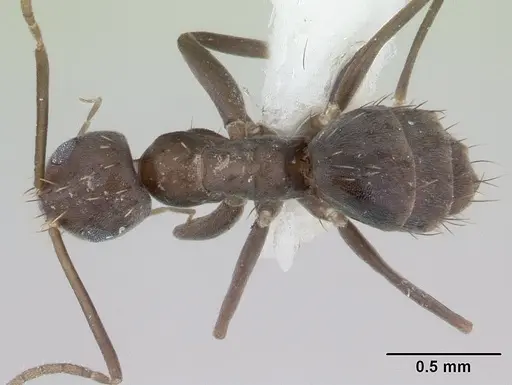
CASENT0362200
View on AntWeb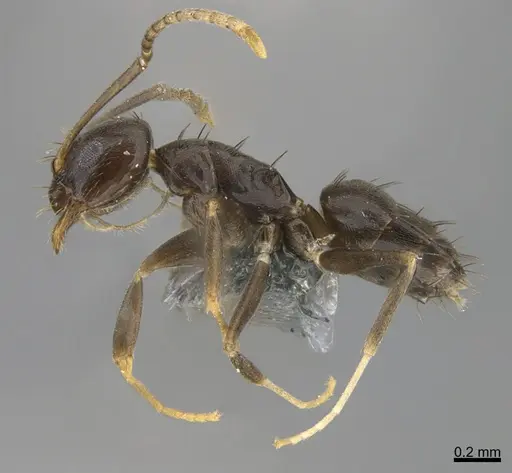
Literature
Loading...Loading products...