

Odontomachus minangkabau
- Scientific Name
- Odontomachus minangkabau
- Tribe
- Ponerini
- Subfamily
- Ponerinae
- Author
- Satria <i>et al.</i>, 2015
- Distribution
- Found in 1 countries
Odontomachus minangkabau Overview
Odontomachus minangkabau is an ant species of the genus Odontomachus. It is primarily documented in 1 countries , including Indonesia. Detailed taxonomic data and occurrence records can be further explored via authoritative databases such as AntWeb or the Global Biodiversity Information Facility (GBIF).
Odontomachus minangkabau
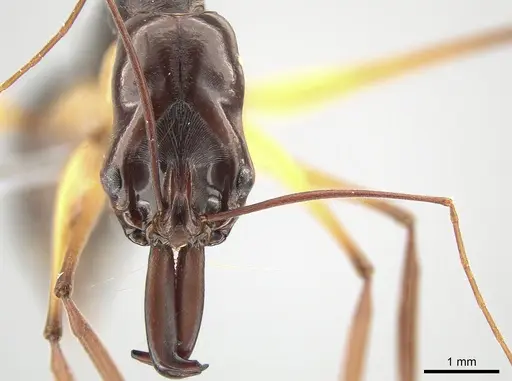
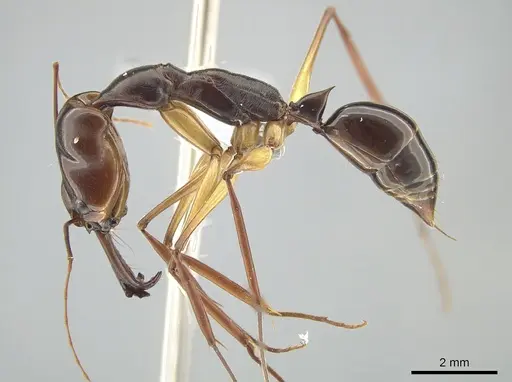
Odontomachus minangkabau is a large trap-jaw ant species endemic to Sumatra, Indonesia. Workers are impressively sized at 3.13-3.55mm head length and 4.15-4.65mm body length, making them significantly larger than their closest relatives O. rixosus and O. pararixosus [1]. They have the characteristic trap-jaw mandibles of the genus, with 11-14 denticles along the masticatory margin. Their body is dark reddish brown with a paler head, and yellowish-brown legs. This species was only described in 2015 and belongs to the O. rixosus species group [1].
What makes O. minangkabau special is its recent discovery and limited distribution, it's only known from secondary and primary lowland forests in West Sumatra, particularly around the Andalas University campus in Padang. These ants are subterranean nesters, building colonies in soil near the base of living trees. Studies using subterranean probes found them at depths of 12.5-37.5cm, making them true underground dwellers [2]. This preference for subterranean life, combined with their large size and powerful snap-jaw mandibles, makes them a fascinating species for advanced antkeepers.
Quick Summary
- Difficulty: Expert
- Origin & Habitat: Endemic to Sumatra Island, Indonesia. Inhabits secondary and primary lowland forests, nesting in soil near the base of living trees [1][2].
- Colony Type: Monogyne (single queen colonies). Colony structure is typical of the genus, single queen that seals herself in during founding.
- Colony: Monogyne
- Founding: Claustral
- Size & Growth:
- Queen: Approximately 3.29mm head length (HL) [1]. Estimated 8-10mm total length based on worker proportions.
- Worker: HL 3.13-3.55mm, WL 4.15-4.65mm [1]. Large for the genus.
- Colony: Unknown for this specific species. Related Odontomachus species typically reach 200-500 workers. Estimated moderate colony size based on genus patterns.
- Growth: Moderate. Development timeline unconfirmed for this species, but related trap-jaw ants typically take 6-10 weeks from egg to first worker at optimal temperature.
- Development: 6-10 weeks (estimated based on genus-level data for related Odontomachus species) (Development time is estimated from related species. Queens are claustral, they seal themselves in and raise first workers alone without foraging.)
- Antkeeping:
- Temperature: Keep at 24-28°C. As a tropical lowland forest species from Sumatra, they prefer warm, stable conditions. Use a heating cable on one side of the nest to create a gentle gradient.
- Humidity: High humidity (70-85%). These are subterranean ants from damp forest environments. Keep the nest substrate consistently moist but not waterlogged. The soil near tree bases where they nest is typically damp but well-draining.
- Diapause: No, this is a tropical species from Sumatra. They do not require hibernation. Maintain year-round warm conditions.
- Nesting: Naturalistic setup with soil or a Y-tong/plaster nest works well. They are subterranean nesters that prefer soil chambers near the base of trees. Use a moist substrate that holds humidity well. Avoid dry, airy setups.
- Behavior: Trap-jaw ants have extremely fast mandibles that snap shut on prey or threats. They are predatory hunters, using their powerful jaws to capture small invertebrates. Workers are alert and active foragers. They may show defensive behavior when the nest is disturbed, their snap-jaw can deliver a painful bite. Escape risk is moderate due to their size, standard barrier methods work well. They are not aggressive toward humans but will defend the nest.
- Common Issues: tropical species requires year-round warmth, cold temperatures will slow or stop development, subterranean nature means they need high humidity, dry nests cause colony decline, powerful bite from trap-jaw mandibles can be painful if handled roughly, recently described species (2015) means captive husbandry is not well-established, expect some experimentation, deep-nesting preference may require custom setups or naturalistic terrariums
Housing and Nest Setup
Odontomachus minangkabau is a subterranean species that naturally nests in soil near the base of living trees in Sumatran lowland forests. For captivity, a naturalistic setup with a deep soil layer works best, aim for at least 5-8cm of moist substrate to accommodate their natural nesting depth. A Y-tong (acrylic) nest with a soil chamber or a plaster nest with good moisture retention are both viable options. The key is maintaining high humidity while ensuring adequate ventilation to prevent mold. Use a moisture reservoir or regular misting to keep the substrate damp. These ants are not arboreal, they will not use elevated platforms or wooden structures as primary nesting areas. A naturalistic terrarium-style setup that mimics their forest floor habitat is ideal, with live plants, leaf litter, and a deep soil layer. [1][2]
Feeding and Diet
As predatory trap-jaw ants, they hunt and capture small invertebrates. In captivity, offer live prey such as small crickets, fruit flies, mealworms, and other appropriately-sized insects. Feed protein-rich foods 2-3 times per week, adjusting based on colony size. Unlike some ants, they are primarily predatory and may not accept sugar water or honey as a primary food source, though some keepers report occasional acceptance. The key is providing varied live prey. For larger colonies, increase feeding frequency and prey size. Remove uneaten prey after 24-48 hours to prevent mold. Fresh water should always be available, either through a water tube or by misting the setup.
Temperature and Seasonal Care
This is a tropical lowland species from Sumatra, Indonesia. Keep temperatures in the range of 24-28°C year-round. A slight temperature gradient (warm on one side, cooler on the other) allows the colony to self-regulate. Use a heating cable placed on top of the nest (never underneath where it could dry out the moisture) or a low-wattage heat mat. Room temperature alone may be insufficient, especially in cooler climates. These ants do not require hibernation or winter cooling, maintaining consistent tropical conditions is essential for colony health and brood development. Temperatures below 22°C will slow development, and prolonged cold can be fatal. Monitor with a thermometer placed near the nest. [1]
Behavior and Defense
Odontomachus minangkabau possesses the iconic trap-jaw mandibles of their genus. When threatened, they can snap their jaws shut with incredible speed, one of the fastest animal movements known. This serves both for hunting prey and defending the colony. While they are not aggressive toward humans, disturbing the nest may result in defensive snapping. The bite can be painful due to the force of the snap, though the ants are too small to break human skin significantly. Workers are active foragers that hunt individually, using their mandibles to capture small arthropods. They are not swarmers or particularly defensive outside their nest. Colony activity levels are moderate, you will see regular foraging but not the constant bustle of some faster-growing species.
Colony Founding
Like most Odontomachus species, O. minangkabau queens are claustral. A newly mated queen will seal herself in a small underground chamber and remain there, living entirely on her stored fat reserves, until her first workers (nanitics) emerge. This process typically takes 6-10 weeks under optimal conditions. The queen lays eggs, tends to the brood, and raises the first workers alone without any external food. Once the first workers emerge, they begin foraging to feed the growing colony. During founding, the queen needs complete darkness and stable humidity. Do not disturb a founding queen, vibrations or light can cause her to abandon or eat her brood. Wait until you see workers before offering any food.
Growth and Development
This species was only described in 2015,making it one of the more recently discovered ant species in the hobby. Specific development timelines are not documented in scientific literature, so estimates are based on related Odontomachus species. Expect 6-10 weeks from egg to worker at optimal temperature (around 26°C). Growth rate is moderate, not as fast as some Myrmicinae species, but faster than some slow-growing Ponerinae. Colonies likely reach several hundred workers at maturity. The large worker size (4-5mm body length) means each individual is substantial, so you may see faster population growth in terms of biomass compared to tiny species. Be patient, Ponerinae colonies often grow more slowly than the rapid development seen in Lasius or Camponotus. [1]
Frequently Asked Questions
How long does it take for Odontomachus minangkabau to produce first workers?
Based on related Odontomachus species, expect 6-10 weeks from egg to first worker at optimal temperature (around 26°C). This is typical for claustral Ponerine ants, the queen seals herself in and raises the first brood alone.
What do Odontomachus minangkabau eat?
They are predatory trap-jaw ants that hunt small invertebrates. Feed live prey such as small crickets, fruit flies, mealworms, and other appropriately-sized insects 2-3 times per week. Sugar sources are not a primary food, focus on protein-rich live prey.
What temperature do they need?
Keep them warm at 24-28°C year-round. This is a tropical lowland species from Sumatra that does not tolerate cold. Use a heating cable or heat mat to maintain warmth, especially in cooler climates.
Are they good for beginners?
No. This is an expert-level species due to several factors: they require high humidity and warm tropical conditions year-round, they are recently described (2015) so captive husbandry is not well-established, they are subterranean nesters requiring custom setups, and they are predatory requiring live prey. Experienced antkeepers with Ponerinae experience will have better success.
Do they need hibernation?
No. As a tropical species from Sumatra, Indonesia, they do not require hibernation or winter cooling. Maintain warm, stable conditions year-round for optimal colony health and development.
How big do colonies get?
Colony size is not documented for this specific species. Based on related Odontomachus species, expect moderate colonies of 200-500 workers at maturity. Their large individual size means each worker is substantial.
What type of nest should I use?
A naturalistic setup with deep, moist soil or a Y-tong/plaster nest with a soil chamber works best. They are subterranean ants that naturally nest in soil at depths of 12-37cm. The nest must maintain high humidity while allowing adequate ventilation.
Can I keep multiple queens together?
No. This is a monogyne (single-queen) species. Combining unrelated queens has not been documented and would likely result in fighting. Each colony should start with a single founding queen.
Why are my ants dying?
Common causes include: temperatures below 22°C (tropical species cannot tolerate cold), low humidity causing desiccation, improper founding conditions (disturbing the queen), and lack of appropriate live prey. This is an advanced species, ensure your setup matches their natural subterranean, humid, warm habitat.
References

This caresheet is licensed under CC BY-SA 4.0 .
ZRC
View on AntWeb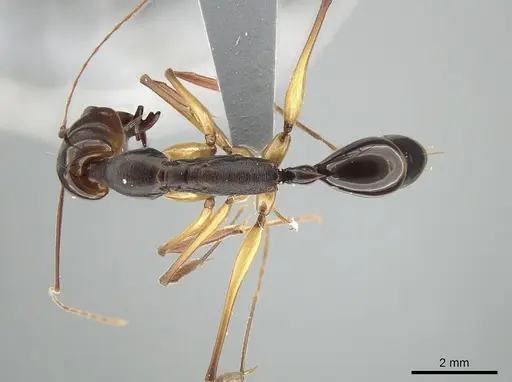
Literature
Loading...Loading products...