

Myrmoteras donisthorpei
- Scientific Name
- Myrmoteras donisthorpei
- Subgenus
- Myagroteras
- Tribe
- Myrmoteratini
- Subfamily
- Formicinae
- Author
- Wheeler, 1916
- Distribution
- Found in 3 countries
Myrmoteras donisthorpei Overview
Myrmoteras donisthorpei is an ant species of the genus Myrmoteras. It is primarily documented in 3 countries , including Brunei Darussalam, Indonesia, Malaysia. Detailed taxonomic data and occurrence records can be further explored via authoritative databases such as AntWeb or the Global Biodiversity Information Facility (GBIF).
Myrmoteras donisthorpei
Myrmoteras donisthorpei is a small to medium-sized ant species native to Borneo, Indonesia, and Malaysia. Workers measure 4.5-4.8mm with a distinctive orange-red to reddish-orange coloration, featuring notably pale femora, trochanters, and sometimes coxae that appear virtually white. The genus Myrmoteras belongs to the Formicinae subfamily and is known for their unusual mandibles with multiple teeth. This species is part of the 'donisthorpei group' characterized by a smooth and shining gaster, with the summit of the propodeum not being higher than the mesonotum. Queens are slightly smaller at 4.5mm while males are considerably smaller at around 3mm. The species has been collected from various Bornean forest habitats including limestone forest and dipterocarp forest [1].
Quick Summary
- Difficulty: Unknown, likely Expert
- Origin & Habitat: Native to Borneo, Indonesia, and Malaysia in the Indomalaya region. Found in various forest habitats including limestone forest and dipterocarp forest [1][2].
- Colony Type: Colony structure is unconfirmed. Only known from limited museum specimens, no field studies of live colonies exist.
- Size & Growth:
- Queen: 4.5mm
- Worker: 4.5-4.8mm
- Colony: Unknown, no colony size data available
- Growth: Unknown
- Development: Unconfirmed, no development data exists for this species (Development timeline has not been studied. Based on typical Formicinae patterns, expect 6-10 weeks at optimal temperature, but this is an estimate.)
- Antkeeping:
- Temperature: Unconfirmed, likely requires warm, humid tropical conditions similar to their native Bornean forest habitat. Start around 24-26°C and observe colony activity. Adjust based on behavior.
- Humidity: Unconfirmed, likely requires high humidity similar to other leaf-litter ants from Bornean rainforests. Keep nest substrate consistently moist but not waterlogged.
- Diapause: Unlikely, as a tropical species from Borneo, diapause is probably not required. However, this has not been studied.
- Nesting: In nature they likely nest in leaf litter, rotting wood, or under stones in forest floors. In captivity, a naturalistic setup with moist substrate or a Y-tong/plaster nest with high humidity would be appropriate. Their small size suggests narrow chambers work best.
- Behavior: Behavior is unstudied in captivity. Based on genus characteristics, they are likely relatively docile leaf-litter ants. Their small size (under 5mm) means escape prevention is critical, they can squeeze through very small gaps. No data on sting potency exists, but given their tiny size, any sting would be negligible to humans.
- Common Issues: no captive husbandry information exists, this is an essentially unstudied species in captivity, escape prevention is critical due to their small size, use fine mesh barriers, no established feeding protocols exist, likely accepts small insects and sugar sources like other Formicinae, extremely limited availability, rarely collected or available in the antkeeping hobby
Species Overview and Identification
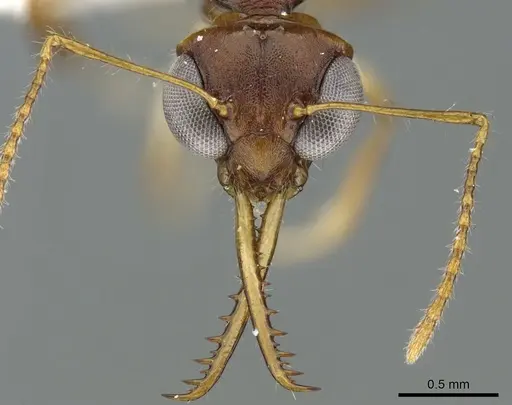
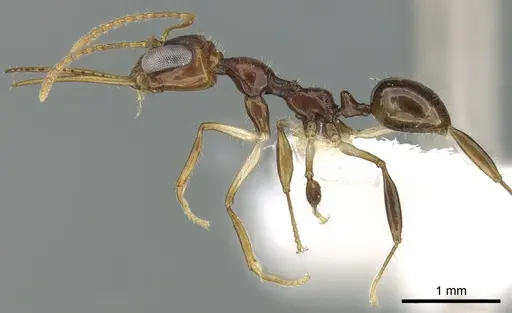
Myrmoteras donisthorpei is a rare and poorly studied ant species described by Wheeler in 1916 from a queen collected on Mount Matang in West Sarawak, Borneo. Workers were first described by Moffett in 1985. The species belongs to the Myrmoteratini tribe within the Formicinae subfamily and is part of the 'donisthorpei group' characterized by having a smooth and shining gaster. Workers measure 4.5-4.8mm with distinctive orange-red to reddish-orange coloration. The legs are particularly notable, femora, trochanters, and sometimes coxae appear virtually white, creating a striking contrast with the reddish body. The mandibles have 10-13 teeth with 2-4 preapical denticles. Queens are similar in size at 4.5mm, while males are much smaller at around 3mm. The species has been recorded from Borneo, Indonesia, and Malaysia, typically collected from forest habitats using Winkler extraction methods[2].
Natural Habitat and Distribution
This species is known only from the island of Borneo, which spans Indonesia, Malaysia, and Brunei. Specimens have been collected from various forest types including limestone forest and dipterocarp forest, both common forest types in Bornean lowland rainforests. The limited collection records suggest they are leaf-litter dwelling ants, living in the forest floor layer among decaying vegetation, rotting wood, and under stones. Borneo has a hot, humid tropical climate with year-round rainfall, providing constant warm temperatures and high humidity. Based on collection data, they appear to be a lowland to mid-elevation species, though exact elevation preferences are unclear due to limited records [1][2].
Trophic Position and Feeding
Stable isotope studies from Borneo provide some insight into the trophic position of Myrmoteras species. One study found a δ15Ncor value of 0.85 for Formicinae generally, while Myrmoteras specifically showed a higher value of 5.03 (±0.585) in limestone forest habitats, suggesting they occupy a higher trophic level than many other Formicinae [3][1]. This indicates they are likely more predatory or scavenge on other small invertebrates rather than being purely herbivorous. In captivity, they would likely accept small live prey such as springtails, fruit flies, and other tiny arthropods. Sugar sources may also be accepted, though this is speculative given the lack of captive observations.
Keeping Myrmoteras donisthorpei in Captivity
This is one of the most challenging species to keep because essentially no captive husbandry information exists. They have rarely been collected or observed in the antkeeping hobby. Based on their small size, forest-dwelling nature, and Bornean origin, they would require warm, humid conditions with excellent escape prevention. A naturalistic setup with moist substrate (like a terrarium-style formicarium) would likely work best, allowing them to create tunnels in damp soil or rotting wood. Temperature should likely be in the mid-20s°C (around 24-26°C) with high humidity, think steamy tropical conditions. Feeding should focus on small live prey items since isotope data suggests predatory behavior. Due to their tiny size (under 5mm), even standard test tube setups require careful attention to prevent escapes through air holes or gaps. This species is recommended only for experienced antkeepers who have the resources to experiment with husbandry methods, as no established protocols exist.
Conservation and Collection Status
Myrmoteras donisthorpei is known from relatively few specimens, suggesting it is either rare in the wild or difficult to collect. The species has been documented from several Borneo locations including West Sarawak (Mount Matang), Sabah, and Kalimantan. While not considered endangered, forest habitat loss from palm oil expansion and logging in Borneo could impact populations. Studies have shown that oil palm expansion into rainforests greatly reduces ant biodiversity in canopy, epiphytes, and leaf-litter communities [2]. For antkeepers, this highlights the importance of not collecting from the wild and only obtaining captive-bred colonies if they become available.
Frequently Asked Questions
Is Myrmoteras donisthorpei available in the antkeeping hobby?
No, this species is extremely rare in the antkeeping hobby. It has rarely been collected or observed in captivity, and there are no established breeding protocols. Most antkeepers will not find this species available for purchase.
How do I care for Myrmoteras donisthorpei?
No established care protocols exist. Based on their Bornean forest origin, they likely need warm (24-26°C), humid conditions with small live prey. This is an experimental species only suitable for very experienced antkeepers willing to develop their own husbandry methods.
What do Myrmoteras donisthorpei ants eat?
Based on limited trophic isotope data, they appear to be more predatory than typical Formicinae, suggesting they eat small invertebrates. In captivity, offer small live prey like springtails, fruit flies, and other tiny arthropods. Sugar sources may be accepted but are unconfirmed.
Where is Myrmoteras donisthorpei found in the wild?
They are native to Borneo, Indonesia, and Malaysia. Specimens have been collected from limestone forest and dipterocarp forest habitats in the Indomalaya region.
Is Myrmoteras donisthorpei a good species for beginners?
No. This species is not recommended for beginners. No captive husbandry information exists, they are extremely rare in the hobby, and they require conditions that are difficult to maintain. This is an expert-only species for antkeepers willing to experiment.
Do Myrmoteras donisthorpei colonies need hibernation?
Unlikely. As a tropical species from Borneo, they probably do not require hibernation. However, this has not been studied and no captive observations exist to confirm.
How big do Myrmoteras donisthorpei colonies get?
Unknown, no colony size data exists. Based on their small size and the limited number of specimens collected, colonies are likely small, possibly under 100 workers.
Can I keep multiple Myrmoteras donisthorpei queens together?
Unknown, colony structure has not been studied. No data exists on whether they are single-queen (monogyne) or multi-queen (polygyne) colonies. Combining unrelated queens is not recommended given the lack of information.
References

This caresheet is licensed under CC BY-SA 4.0 .
CASENT0906286
View on AntWeb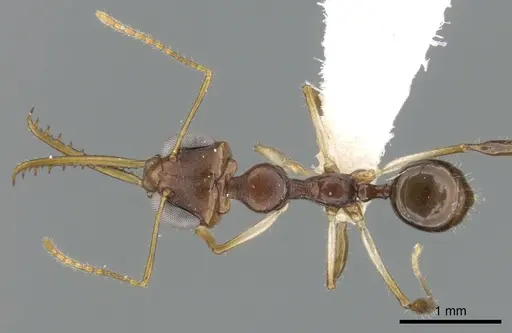
Literature
Loading...Loading products...