

Myrmoteras barbouri
- Scientific Name
- Myrmoteras barbouri
- Tribe
- Myrmoteratini
- Subfamily
- Formicinae
- Author
- Creighton, 1930
- Distribution
- Found in 1 countries
Myrmoteras barbouri Overview
Myrmoteras barbouri is an ant species of the genus Myrmoteras. It is primarily documented in 1 countries , including Malaysia. Detailed taxonomic data and occurrence records can be further explored via authoritative databases such as AntWeb or the Global Biodiversity Information Facility (GBIF).
Myrmoteras barbouri
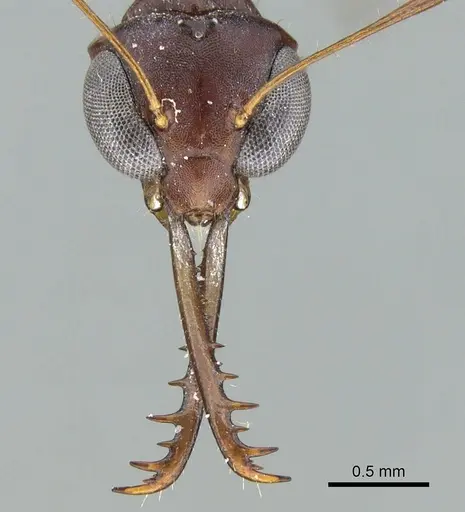
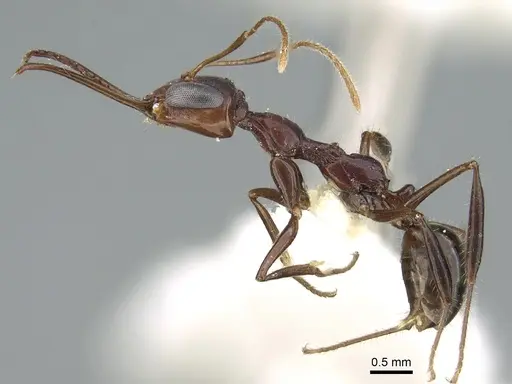
Myrmoteras barbouri is a small, reddish-orange ant known for its extraordinary trap-jaw mandibles. Workers measure 5.5-6.7mm with distinctive granulate sculpturing on the head, and their long spiny mandibles can open to an incredible 280 degrees [1]. This species belongs to the tribe Myrmoteratini within Formicinae and represents the only trap-jaw lineage in this subfamily [2]. Found across the Indomalaya region including Borneo, Java, Malaysia, and Singapore, these ants live in forest leaf litter where they hunt fast-moving prey [3].
What makes M. barbouri truly remarkable is its predatory trap-jaw system. The mandibles can snap shut in just 0.5 milliseconds, reaching speeds of 20.5 m/s [4][5][6]. Unlike some trap-jaw ants that use their jaws to stun prey, M. barbouri specializes in rapidly impaling and holding soft-bodied springtails that can escape by jumping within 10-50ms of detecting a threat [7][8][9]. The strike is triggered by specialized labral trigger hairs on the head that connect directly to fast motor neurons, creating one of the fastest neural pathways known in insects [10].
Quick Summary
- Difficulty: Expert
- Origin & Habitat: Tropical rainforests of Borneo, Indonesia (Java), Malaysia, and Singapore. Workers are found in forest leaf litter [3].
- Colony Type: Small colonies with 10-25 workers. Colonies may have single or multiple queens, three colonies in one study included queens [1]. Colony structure in the wild is not fully documented.
- Founding: Claustral
- Size & Growth:
- Queen: Approximately 6.9mm [3]
- Worker: 5.5-6.7mm (HW 1.01-1.28mm) [3]
- Colony: Small colonies up to approximately 25 workers in studied colonies
- Growth: Slow, small colony size suggests slow development
- Development: Unknown, no direct data available. Based on small colony sizes and tropical location, estimate 6-10 weeks at optimal temperature. (Development timeline has not been directly studied. Small colony sizes suggest slower growth than many common ant species.)
- Antkeeping:
- Temperature: Keep at 25°C based on laboratory conditions where colonies successfully maintained [5]. As a tropical species from Borneo/Malaysia, aim for 24-26°C with a slight gradient.
- Humidity: Requires moderate to high humidity matching their forest floor leaf litter habitat. Keep nest substrate consistently moist but not waterlogged.
- Diapause: No, as a tropical species from near the equator, they do not require hibernation or winter rest [3].
- Nesting: In captivity, colonies have been kept in plastic boxes with plaster-filled Petri dishes as nest chambers [2]. The plaster provides moisture retention while allowing the ants to create tunnels. A naturalistic setup with moist soil/leaf litter also works well.
- Behavior: These ants are specialized solitary predators that hunt alone in leaf litter [11]. They use their trap-jaw mandibles to rapidly impale springtails and other small soft-bodied prey [7][8]. They are not aggressive toward humans and their small size means they pose minimal sting risk. However, their excellent escape prevention is essential due to their small size, use fine mesh and tight-fitting lids. They readily accept sugar water and protein foods like termites or small crickets [4].
- Common Issues: small colony sizes mean any losses have significant impact on the colony, specialized diet on live springtails may be difficult to sustain long-term, escape prevention is critical due to small size, they can squeeze through standard gaps, trap-jaw mechanism is fragile, rough handling can damage mandibles, slow growth and small colony size require patience, colonies take a long time to establish
The Trap-Jaw Mechanism
Myrmoteras barbouri possesses one of the most specialized predatory systems in the ant world. Their mandibles can open to an extraordinary 280 degrees, nearly three times the opening angle of a typical ant [1]. The mandibles are long, thin, and spiny, approximately 1.5 times longer than the head itself . What makes this system work is a sophisticated power-storage mechanism. The queen seals herself in a chamber and relies entirely on stored fat reserves to survive until her first workers emerge. The large closer muscle acts like a spring, building potential energy while the mandibles are held open by a latch formed by co-contraction of the opener and closer muscles [11][4]. When the latch releases, that stored energy converts to kinetic energy in just 0.5 milliseconds [6]. The strike is triggered by specialized labral trigger hairs on the head, when these hairs contact prey, they activate thick sensory neurons that connect directly to the fast motor neurons controlling the mandible closer muscle [12][10]. This direct neural connection allows for remarkably fast reaction times, essential for catching springtails that can escape by jumping within 10-58 milliseconds of detecting a threat [9].
Feeding and Diet
Myrmoteras barbouri is a specialized predator that primarily hunts springtails (Collembolans) in the wild . These small hexapods are soft-bodied and can execute escape jumps very quickly, which is why the trap-jaw mechanism evolved in the first place [8][9]. In captivity, you should replicate this specialized diet as closely as possible. Live springtails are the ideal food and should form the primary protein source [4]. The research colonies were successfully maintained on live termites or frozen crickets offered three times per week [4]. They also readily accept sugar water, colonies were given sugar ad libitum in laboratory settings [4]. Other small live prey like fruit flies may also be accepted. Do not rely solely on sugar sources, these ants are obligate predators and need protein. Avoid large prey items, their specialized mandibles are designed for small, soft-bodied prey, not large insects.
Housing and Nest Setup
In laboratory settings, Myrmoteras barbouri colonies have been successfully kept in plastic boxes coated with Fluon (to prevent escape) with plaster-filled Petri dishes serving as nest chambers [2]. This setup provides several benefits: the plaster holds moisture to maintain humidity, the ants can tunnel through it, and the smooth plastic outworld prevents escape. For your colony, use a similar setup with a small formicarium connected to a foraging area. Because they are small and excellent climbers, escape prevention must be excellent, apply Fluon to all interior surfaces of the outworld. Keep the nest portion humid but allow the foraging area to remain drier. A small water test tube should be provided for drinking water, and sugar water should be available at all times. The nest should be kept dark (cover with a cloth or dark panel) as these leaf-litter ants prefer dim conditions.
Temperature and Care
Laboratory colonies were maintained at 25°C with a 12-hour light/dark cycle [5]. As a tropical species from Borneo and surrounding regions, Myrmoteras barbouri requires warm, stable temperatures in the range of 24-26°C. Avoid temperature drops below 22°C, especially for extended periods. A small heating cable on one side of the nest can create a gentle gradient if your room temperature runs cool. Place the heating element on top of the nest material rather than underneath to avoid evaporating moisture too quickly. Monitor the colony activity, if workers become sluggish and cluster together, the temperature may be too low. Unlike temperate ants, this species does not require any diapause or winter rest period [3]. Maintain consistent warmth year-round.
Behavior and Foraging
Unlike many ant species that recruit nestmates to food sources, Myrmoteras barbouri is a solitary forager [11]. Each worker hunts independently through the leaf litter, using its trap-jaw system to capture prey. This is reflected in their small colony sizes, they do not benefit from the collective hunting advantages that larger colonies enjoy. In captivity, you will observe workers patrolling the foraging area individually, investigating potential prey items. Their vision plays a role in detecting prey, and research suggests visual cues may also trigger mandible strikes [13]. Workers are not aggressive toward the keeper and their small size means even if they do attempt to bite, the mandibles are designed for prey capture, not defense. However, always handle gently to avoid damaging their specialized mouthparts.
Frequently Asked Questions
How long does it take for Myrmoteras barbouri to produce first workers?
The exact egg-to-worker timeline has not been documented for this species. Based on their small colony sizes (10-25 workers in studied colonies) and tropical distribution, estimate approximately 6-10 weeks at optimal temperature (25°C). Expect slow growth, these ants develop more slowly than many common ant species.
What do Myrmoteras barbouri ants eat?
They are specialized predators that primarily eat springtails (Collembolans) in the wild. In captivity, offer live springtails as the ideal protein source. They also accept sugar water continuously and other small live prey like termites or fruit flies. Do not rely only on sugar, they need regular protein to survive.
Are Myrmoteras barbouri good for beginners?
No, this species is recommended for experienced antkeepers only. They require specialized care including live prey (springtails), small colony management, excellent escape prevention, and specific temperature/humidity conditions. Their slow growth and small colony sizes also mean less margin for error.
What temperature do Myrmoteras barbouri need?
Keep them at 25°C based on successful laboratory colonies. As a tropical species from Borneo and Malaysia, aim for 24-26°C with a gentle gradient. Avoid temperatures below 22°C. No hibernation or winter rest is needed.
How big do Myrmoteras barbouri colonies get?
Studied colonies contained 10-25 workers . This is relatively small compared to many ant species. Wild colonies may reach larger sizes but documented colony sizes are small. Expect slow growth and modest final colony sizes.
Can I keep multiple Myrmoteras barbouri queens together?
The natural colony structure is not fully documented. Some studied colonies included queens, but it's unclear whether multiple queens coexist in established colonies. Combining unrelated queens is not recommended as this has not been documented and could result in aggression.
Why do Myrmoteras barbouri have trap-jaw mandibles?
Their trap-jaw system evolved to catch fast-moving prey, specifically springtails that can escape by jumping within 10-50 milliseconds of detecting a threat [9]. The 0.5ms strike speed is fast enough to catch prey before they can jump away. Unlike some trap-jaw ants that stun prey, M. barbouri uses its mandibles to rapidly impale and hold prey [7][8].
When should I move Myrmoteras barbouri to a formicarium?
Start them in a simple setup like a test tube or small plastic container with moist plaster as a nest chamber. Once the colony reaches 15+ workers and you observe consistent activity, you can connect them to a larger foraging area. The key is ensuring the nest portion maintains humidity while the foraging area remains dry enough to prevent mold.
Do Myrmoteras barbouri need hibernation?
No. As a tropical species from near the equator (Borneo, Java, Malaysia, Singapore), they do not require any diapause or winter rest period. Maintain warm temperatures (24-26°C) year-round.
References

This caresheet is licensed under CC BY-SA 4.0 .
CASENT0906283
View on AntWeb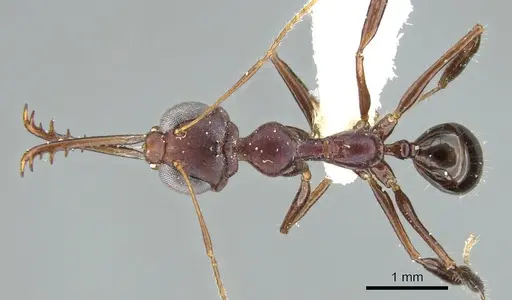
Literature
Loading...Loading products...