

Myrmicocrypta ednaella
- Scientific Name
- Myrmicocrypta ednaella
- Tribe
- Attini
- Subfamily
- Myrmicinae
- Author
- Mann, 1922
- Distribution
- Found in 4 countries
Myrmicocrypta ednaella Overview
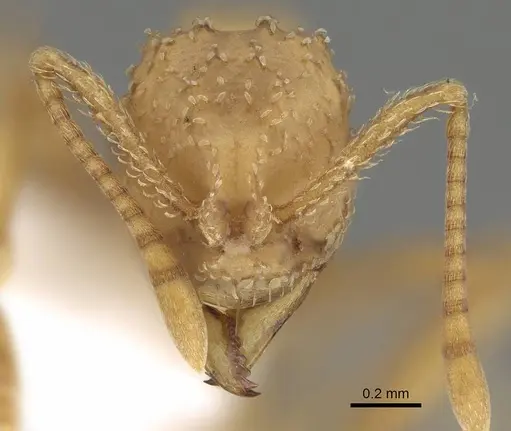
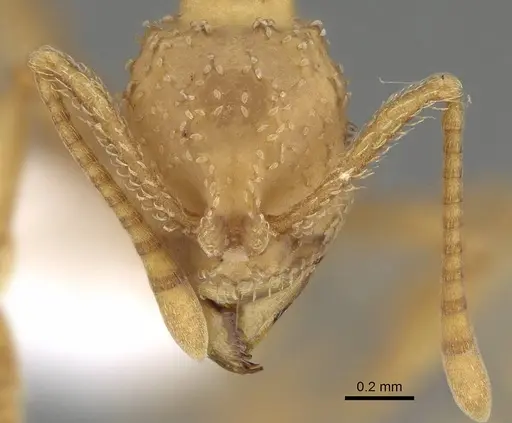
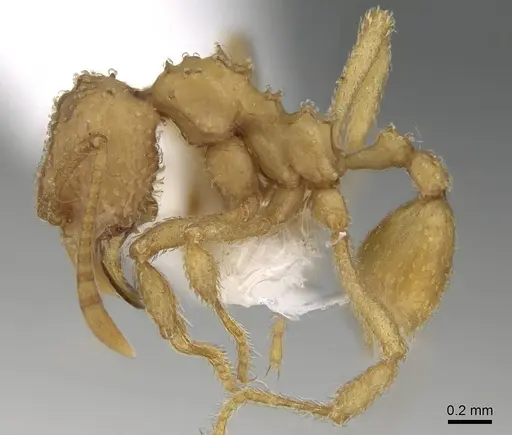
Myrmicocrypta ednaella is an ant species of the genus Myrmicocrypta. It is primarily documented in 4 countries , including Costa Rica, Mexico, Nicaragua. Detailed taxonomic data and occurrence records can be further explored via authoritative databases such as AntWeb or the Global Biodiversity Information Facility (GBIF).
Myrmicocrypta ednaella
Myrmicocrypta ednaella is a small, cryptic fungus-growing ant belonging to the tribe Attini. Workers are tiny at just 0.3 mg average body mass, with small eyes containing only 3-4 ommatidia in the longest row [1][2]. This species is one of the most basal members of the attine ants, the group that includes the famous leaf-cutting ants, and represents an early stage in the evolution of ant agriculture [3]. Found throughout the Neotropical region including Colombia, Costa Rica, Honduras, and Panama, these ants nest in the ground and cultivate a specific fungus for food [2][4].
What makes M. ednaella particularly interesting is its ancient farming system. Unlike the more derived leaf-cutting ants that cut fresh leaves, this species collects simpler substrates like wood chips, dry plant debris, and occasional insect corpses to feed its fungal garden [5][6]. The queen carries the fungal cultivar in her mouth when founding a new colony, passing it down through generations [7]. Workers forage solitarily and feed on plant nectar and sap, which they share with nestmates through trophallaxis [6][8].
Quick Summary
- Difficulty: Medium
- Origin & Habitat: Neotropical region, Colombia, Costa Rica, Honduras, Panama, and Brazil. Found in lowland tropical forests, typically nesting in soil 2-100cm below the surface [9][4].
- Colony Type: Single-queen colonies (monogyne) with singly-mated queens. Workers are monomorphic and colonies reach several hundred individuals [10][9]. Queens mate only once (monandrous), giving workers very high relatedness of 0.71-0.73 [10][3].
- Colony: Monogyne
- Founding: Claustral
- Size & Growth:
- Queen: Not specifically measured in primary literature, estimated based on genus patterns for basal attines
- Worker: Very small, average body mass 0.3 mg [1]
- Colony: Up to several hundred workers [9] (some sources indicate
- Growth: Moderate, slower than derived attines due to smaller colony sizes
- Development: Unconfirmed, likely 6-10 weeks based on related lower attine patterns (Development timeline not directly studied. Lower attines typically develop slower than derived leaf-cutting ants due to smaller colony sizes and simpler fungus gardens)
- Antkeeping:
- Temperature: Keep around 24-28°C, these are tropical ants requiring warm, stable conditions. A gentle heat gradient allows them to regulate temperature.
- Humidity: Moderate to high, fungus gardens require consistent moisture. Keep substrate damp but not waterlogged. The garden substrate (wood chips) should remain moist.
- Diapause: No, as a tropical species, they do not require hibernation. Maintain year-round warm conditions.
- Nesting: Ground-nesting species. Provide a naturalistic setup with soil or a plaster/acrylic nest with a chamber depth appropriate for their small size. The fungus garden needs to be suspended from the ceiling or attached to rootlets, this is critical for captive success.
- Behavior: These ants are docile and non-aggressive. Workers forage solitarily, collecting wood chips and small insects to feed their fungal garden [8]. They are not known to sting and pose no danger to keepers. Their tiny size (0.3 mg workers) means escape prevention is important, they can squeeze through small gaps. The most critical aspect of their behavior is the obligate dependence on their fungal cultivar: without the fungus, the colony will not survive. Workers feed on plant nectar and sap, then share food via trophallaxis with the fungus and other workers [6].
- Common Issues: Fungal garden collapse is the primary killer of captive colonies, maintain consistent humidity and avoid temperature swings that could harm the fungus, Tiny worker size means escape prevention must be excellent, use fine mesh barriers, Colony growth is slow compared to common ants, keepers may overfeed trying to speed up development, leading to mold problems, Obtaining the fungal cultivar is essential, wild-caught colonies bring their own fungus, but established colonies require a piece of the original garden to start new nests, Lower attine colonies remain small, do not expect the large colonies typical of Lasius or Camponotus species
The Fungus Garden: A Critical Symbiosis
Myrmicocrypta ednaella is an obligate fungus farmer, the colony cannot survive without its fungal cultivar. This is one of the most ancient forms of ant agriculture, with M. ednaella representing a basal lineage that diverged approximately 19.3 million years ago [6]. The ants cultivate clade 1 fungi (subclade B), which they feed primarily with wood chips, dry plant debris, leaf litter, seed fragments, and occasionally insect corpses [5][6]. The fungus grows in a chamber that workers tend constantly, feeding on the fungal tufts that develop. Both larvae and adults eat the fungus, it's the exclusive food for larvae and a partial diet for adults [7]. In captivity, you must maintain a living fungal culture. If you ever need to start a new colony from an existing one, you MUST transfer a piece of the fungus garden, the queen carries it in her mandibles when she founds a new nest [7].
Nest Setup and Chamber Design
In the wild, M. ednaella nests in the ground with the fungus garden chamber typically located 2-100cm below the surface [9]. The external nest appears as a small mound with an entrance about 2.5mm in diameter [11]. The queen uses her detached forewings as a platform for the incipient fungal garden during colony founding, she positions them in a cross-form with the intersection near the apical regions [12][11]. For captivity, a naturalistic setup with moist soil works well, or you can use a plaster nest with appropriately sized chambers. The key requirement is that the fungus garden can be suspended or attached to the ceiling of the chamber, just as they do in nature using rootlets. Chamber dimensions in wild colonies are around 34mm deep with a volume of approximately 1.08 cm³, scale your nest chambers accordingly [11].
Feeding and Nutrition
Adult workers feed primarily on plant nectar and sap, which they collect during foraging trips and share with nestmates through trophallaxis (mouth-to-mouth food sharing) [6][9]. The fungus garden is the food source for larvae. In captivity, you should provide: 1) A constant sugar source like honey water or sugar water for the workers,2) Small insects (fruit flies, pinhead crickets, small mealworms) as supplemental protein and to feed the fungus garden,3) Plant material like small leaf fragments or wood chips as substrate for the fungus. The fungus needs organic matter to grow, in the wild they use insect feces, dry plant debris, leaf-litter, and seed fragments [5]. Do not overfeed, as excess food leads to mold that can kill the fungal garden.
Temperature and Humidity Control
As a tropical species from Central and South America, M. ednaella requires warm conditions. Keep the nest at 24-28°C with minimal temperature fluctuations. A heating cable on one side of the nest can create a gentle gradient, but avoid direct heat on the fungus chamber. Humidity is critical because the fungus requires moisture to grow. Keep the substrate consistently damp but never waterlogged, the wood chip substrate should feel moist to the touch. Allow some variation so the ants can choose their preferred microclimate. Since they nest 2-100cm deep in the wild, they are adapted to relatively stable underground conditions. Do not let the nest dry out, as the fungal garden will die. Conversely, excessive moisture can lead to mold problems. [9][5]
Colony Structure and Development
M. ednaella forms single-queen colonies where the queen mates only once (monandrous), this is unusual among animals and gives workers extremely high relatedness of 0.71-0.73 [10][3]. Colonies remain relatively small, typically under 200 workers, though some sources indicate colonies can reach several hundred individuals [10][5][9]. Workers are monomorphic (all the same size) and the colony has a simple social structure. The queen carries the fungal cultivar in her mandibles when she leaves the parent nest to found a new colony, this vertical transmission of the fungus is essential for the symbiosis [7]. Unlike some attines, there is no evidence of multiple queens or polygynous colony structures in this species.
Defense and Health
Like other lower attines, M. ednaella has relatively simple defense mechanisms compared to the derived leaf-cutting ants. They lack the powerful stingers of more aggressive species and are generally docile. Their primary defense against fungal pathogens (like Escovopsis, a specialized parasite of attine fungus gardens) is through metapleural gland secretions containing phenylacetic acid (PAA) [13]. Interestingly, Escovopsis strains isolated from this species are more sensitive to PAA than those from derived attines, suggesting their defense system is effective but simpler [13][14]. In captivity, the biggest health threat is mold contamination of the fungus garden. Maintain clean conditions, remove uneaten food promptly, and ensure proper ventilation to prevent stagnant air that promotes mold growth.
Frequently Asked Questions
Can I keep Myrmicocrypta ednaella in a test tube?
A test tube is not ideal for this species. They require space for a fungal garden that needs to be suspended or attached to a ceiling, just like in their natural ground nests. A small naturalistic setup with moist soil or a custom plaster nest with appropriately sized chambers works best. The fungus garden requires specific conditions that a simple test tube setup cannot provide.
How long does it take for the first workers to appear?
The exact development timeline has not been directly studied for this species. Based on related lower attine patterns, expect 6-10 weeks from egg to worker at optimal temperature (around 26°C). Colony growth is slow compared to common ants like Lasius, these ants remain small with colony sizes typically under 200 workers.
What do Myrmicocrypta ednaella eat?
Adult workers feed on plant nectar and sap, which they share via trophallaxis. The fungal garden is the critical food source, larvae feed exclusively on fungus, and adults also consume it. In captivity, provide sugar water or honey water constantly, plus small insects and plant material (wood chips, leaf fragments) for the fungus to grow on. Never let the sugar source dry out.
Are Myrmicocrypta ednaella good for beginners?
This species is rated as medium difficulty. While not as challenging as some specialized attines, they require more specific care than common ants: maintaining a living fungal garden is essential and takes more attention than simply feeding ants. They are best suited for antkeepers who have some experience with basic ant husbandry and want to try the unique challenge of keeping fungus-farming ants.
How big do Myrmicocrypta ednaella colonies get?
Colonies remain relatively small compared to many ants. Typical colonies reach under 200 workers, though some sources indicate they can reach several hundred individuals [10][5][9]. They are not the large, impressive colonies that species like Camponotus or Formica produce, their appeal is in the fascinating fungus-farming behavior, not colony size.
Do Myrmicocrypta ednaella need hibernation?
No, they do not require hibernation. As a tropical species from Central and South America, they need year-round warm conditions (24-28°C). Maintaining consistent temperature is more important than any seasonal changes. Do not expose them to cold temperatures.
Why is my fungus garden dying?
Fungal garden collapse is the most common cause of colony failure. This usually happens due to: 1) Incorrect humidity (too dry or too wet),2) Temperature extremes or fluctuations,3) Mold from overfeeding or poor ventilation,4) Contaminated substrate. Ensure the wood chip substrate stays consistently moist but not waterlogged, maintain stable temperatures between 24-28°C, provide good ventilation without drafts, and remove uneaten food promptly to prevent mold.
Can I keep multiple queens together?
No, this species forms single-queen colonies (monogyne). The queen mates only once and colonies do not accept additional queens. Attempting to combine unrelated queens will likely result in fighting. If you need to expand the colony, you must take a piece of the fungus garden to start a new nest with a newly mated queen.
References

This caresheet is licensed under CC BY-SA 4.0 .
CASENT0922154
View on AntWeb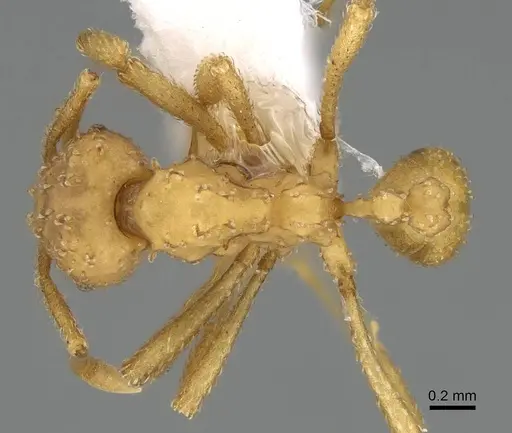
Literature
Loading...Loading products...