

Myrmelachista osa
- Scientific Name
- Myrmelachista osa
- Tribe
- Myrmelachistini
- Subfamily
- Formicinae
- Author
- Longino, 2006
- Distribution
- Found in 1 countries
Myrmelachista osa Overview
Myrmelachista osa is an ant species of the genus Myrmelachista. It is primarily documented in 1 countries , including Costa Rica. Detailed taxonomic data and occurrence records can be further explored via authoritative databases such as AntWeb or the Global Biodiversity Information Facility (GBIF).
Myrmelachista osa
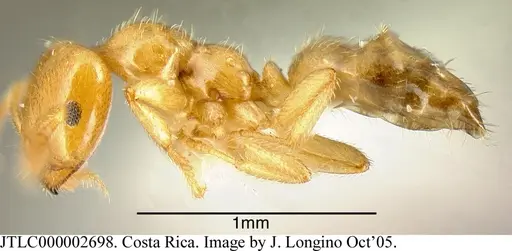
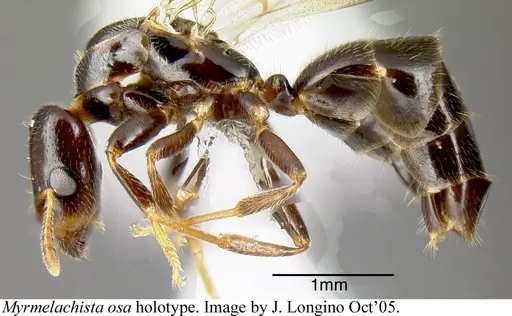
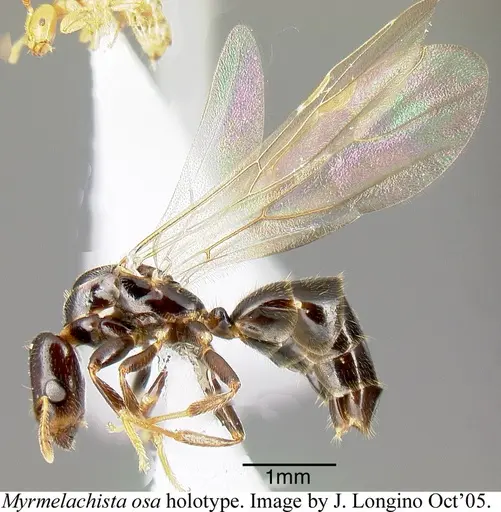
Myrmelachista osa is a tiny yellow arboreal ant native to the Osa Peninsula in Costa Rica. Workers measure just 0.52mm in head length and are distinctive for their 9-segmented antennae and pale yellow coloration with faint dark bands on the abdomen [1]. Queens are dramatically different, large at nearly 1mm head width and solid black, making them one of the most visually striking queen ants in the region [1]. This species is a strict specialist, living almost exclusively inside the stems and branches of specific host plants in the laurel family (Ocotea and Mespilodaphne) and Guarea trees [2]. The workers patrol the entire plant surface, especially new growth, and tend to coccids and pseudococcids that they house in specialized xylem pockets within the plant stems [2].
Quick Summary
- Difficulty: Expert
- Origin & Habitat: Costa Rica, specifically the Osa Peninsula at Rancho Quemado, in mature wet lowland forest at around 200m elevation [1]. They live exclusively inside host plants (Ocotea, Mespilodaphne in Lauraceae, Guarea in Meliaceae) which are dwarf treelets rarely exceeding 4 meters tall [2].
- Colony Type: Colony structure is unconfirmed. Based on related Myrmelachista species that are typically monogyne, likely single-queen colonies. Queens found new colonies by searching for specific host plants [2].
- Size & Growth:
- Queen: HL 1.181-1.226mm, HW 0.971-0.997mm [1], estimated from type specimen measurements
- Worker: HL 0.518-0.521mm, HW 0.479-0.511mm [1], from type specimens
- Colony: Unknown, likely smaller colonies given their specialized plant-dwelling lifestyle, but no published colony size data exists
- Growth: Unknown, no development studies available
- Development: Unconfirmed, no direct development data exists for this species. Based on typical Formicinae patterns, estimate 6-10 weeks at tropical temperatures (Development timeline has not been directly studied. Related Myrmelachista species likely follow similar patterns to other Formicinae ants.)
- Antkeeping:
- Temperature: Keep warm, around 24-28°C. This is a tropical species from lowland Costa Rica where temperatures are consistently warm year-round. A gentle heat gradient allows ants to regulate their temperature.
- Humidity: High humidity is essential, these ants live inside living plant stems where conditions are consistently moist. Aim for 70-85% humidity in the outworld and very high humidity inside the nest area. The host plants naturally provide humid internal conditions [2].
- Diapause: No, this is a tropical species from an area with minimal seasonal temperature variation. They do not require hibernation.
- Nesting: This species is strictly arboreal and cannot be kept in standard soil nests. They require a naturalistic setup with living or dead plant stems (preferably Ocotea, Guarea, or similar wood) that provide internal cavities for nesting. Acrylic or plaster nests with narrow tunnels may work if humidity is kept very high, but they will likely do best in a formicarium that mimics their natural plant-stem habitat [2].
- Behavior: Workers are active and constantly patrol the surfaces of their host plant, especially new growth and buds [2]. They are not aggressive toward keepers but their small size and arboreal nature make them challenging to observe. They have a mutualistic relationship with hemipterans (coccids and pseudococcids) which they farm for honeydew inside specialized xylem pockets within the plant [2]. Escape prevention is critical, workers are extremely tiny at only 0.5mm and can slip through the finest gaps. Use fine mesh barriers and tight-fitting lids [1].
- Common Issues: specialized habitat requirements make captive care extremely difficult, they require living plant stems or very specific artificial nesting conditions, tiny worker size means excellent escape prevention is essential, they can squeeze through gaps smaller than 0.5mm, no established captive breeding protocols exist, this species has never been kept in captivity to our knowledge, host plant availability is a major challenge, they require specific plant species (Ocotea, Guarea, Mespilodaphne) that are difficult to provide, stress from captivity may be fatal, wild-caught colonies likely struggle without their natural host plant ecosystem
Why This Species Is So Challenging
Myrmelachista osa is one of the most difficult ant species to keep in captivity, possibly the most difficult non-parasitic species in the hobby. This is not an exaggeration or a warning to be cautious: there are no documented cases of successful captive breeding, and the fundamental requirements are so specialized that most antkeepers cannot provide them. These ants are obligate ant-plant mutualists that live exclusively inside the stems of specific host plants (Ocotea, Mespilodaphne, and Guarea). They do not nest in soil, dead wood, or artificial nests under normal conditions. The workers tend hemipteran partners inside the plant stems, and the entire colony depends on this complex ecosystem. Attempting to keep this species without their host plant is essentially guaranteed to fail. This species is best appreciated through observation in the wild or by studying the excellent scientific literature rather than attempted captivity. [2][1]
The Ant-Plant Relationship
Myrmelachista osa is part of a specialized mutualistic relationship with specific host plants in the Lauraceae and Meliaceae families. The ants occupy the entire host plant, living inside the stems and branches [2]. Unlike some ant-plants that have obvious domatia (special hollow structures), these host plants have no conspicuous domatia, instead, the ants create their own spaces by inhabiting the natural xylem tissue of the plants [2]. The host plants are dwarf treelets, rarely growing more than 4 meters tall, with thin cortical layers and soft pith that makes them easy for the ants to colonize [2]. The ants protect their host plant from herbivores and likely receive nutrients from the plant while also farming coccids and pseudococcids for honeydew. This is an extremely specialized lifestyle that cannot be easily replicated in captivity.
Housing and Nesting
Standard ant-keeping setups will not work for this species. They cannot be kept in test tubes, Y-tong nests, or typical formicaria. The only theoretically viable approach would be a naturalistic vivarium containing living or recently-dead specimens of their host plants (Ocotea, Mespilodaphne, or Guarea species from Central America). Even this would be extremely challenging because the ants need the specific internal stem structure of these plants. The xylem pockets they use for housing hemipteran partners extend from the nest lumen to the cambium layer [2]. If you somehow obtained a colony, you would need to replicate this exact microhabitat. For all practical purposes, this species should not be attempted by any antkeeper, including experts. It represents a case where the hobby simply cannot meet the biological requirements of the species.
Feeding and Diet
In the wild, Myrmelachista osa workers patrol their host plants and tend to coccids and pseudococcids (scale insects) that live in specialized xylem pockets within the plant stems [2]. These hemipterans produce honeydew, which is the primary sugar source for the ants. The ants also likely feed on small arthropods they find on the plant surface. Replicating this diet in captivity would require maintaining live scale insect colonies inside the plant stems, an extraordinarily complex task. There is no established captive diet for this species, and any attempt would be speculative at best. Do not attempt to keep this species unless you have access to their exact host plants with established hemipteran populations.
Temperature and Environmental Needs
As a tropical lowland species from Costa Rica, Myrmelachista osa requires consistently warm temperatures in the range of 24-28°C. The Osa Peninsula has minimal seasonal temperature variation, with year-round warm and humid conditions. High humidity is equally critical, these ants live inside living plant stems where the environment is very moist. Any captive setup would need to maintain both high temperature and high humidity without causing mold or fungal problems. The combination of being both arboreal AND specialized plant symbionts makes environmental control nearly impossible in standard ant-keeping equipment. [1][2]
Legal and Ethical Considerations
Myrmelachista osa is endemic to the Osa Peninsula in Costa Rica and has a very limited known range [1]. It should never be collected from the wild or exported. The species is not established in the ant-keeping hobby, and there are no captive-bred colonies. If you encounter this species for sale, it is almost certainly wild-caught and dooming the colony to death. Instead of seeking to keep this species, appreciate it through photographs and scientific literature. John Longino's work on Costa Rican Myrmelachista provides excellent documentation of their behavior in the wild [1].
Frequently Asked Questions
Can I keep Myrmelachista osa in a test tube?
No. This species cannot be kept in any standard ant-keeping setup including test tubes, Y-tong nests, or typical formicaria. They are obligate plant-dwelling ants that live exclusively inside the stems of specific host plants (Ocotea, Mespilodaphne, Guarea). There are no documented successful captive colonies.
What do Myrmelachista osa eat?
In the wild, they primarily eat honeydew from coccids and pseudococcids that they farm inside their host plants. They also likely eat small insects they find while patrolling the plant. No captive diet has been established, and replicating their specialized diet is essentially impossible without their host plant ecosystem.
Are Myrmelachista osa good for beginners?
No. This species is not suitable for any antkeeper, including experts. It is arguably the most difficult ant species to keep in captivity due to its obligate relationship with specific host plants. There are no established care protocols, no captive-bred colonies, and no way to replicate their natural habitat.
How big do Myrmelachista osa colonies get?
The maximum colony size is unknown. No published colony size data exists for this species. Based on their specialized plant-dwelling lifestyle and related species, colonies are likely smaller than many common ants, probably under a few hundred workers at most.
Do Myrmelachista osa need hibernation?
No. This is a tropical species from Costa Rica where temperatures remain warm year-round. They do not require any diapause or winter rest period.
When will Myrmelachista osa have first workers?
Unknown, no development studies exist for this species. Related Formicinae ants typically develop from egg to worker in 6-10 weeks at warm temperatures, but this has not been confirmed for M. osa. There are no captive colonies to observe.
Can I keep multiple queens together?
Not recommended and not documented. The colony structure of this species has not been studied. Based on related Myrmelachista species, they likely form single-queen colonies. More importantly, there are no captive colonies to experiment with, and attempting to combine wild-caught queens would almost certainly result in the death of both colonies.
Where does Myrmelachista osa live?
Only known from the Osa Peninsula in Costa Rica, specifically Rancho Quemado at about 200m elevation in mature wet forest. They are endemic to this very small geographic area.
What makes Myrmelachista osa different from other ants?
They are one of the most specialized ant-plant mutualists in the world. Unlike most ants that nest in soil or dead wood, they live exclusively inside living plant stems and have evolved alongside specific plant species. The workers are tiny and yellow while queens are large and solid black, a dramatic size and color dimorphism. They also farm hemipteran partners inside specialized structures in the plant.
References

This caresheet is licensed under CC BY-SA 4.0 .
CASENT0647480
View on AntWeb
JTLC000002698
View on AntWeb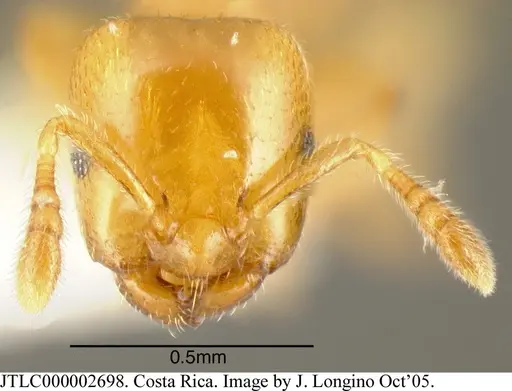
JTLC000002701
View on AntWeb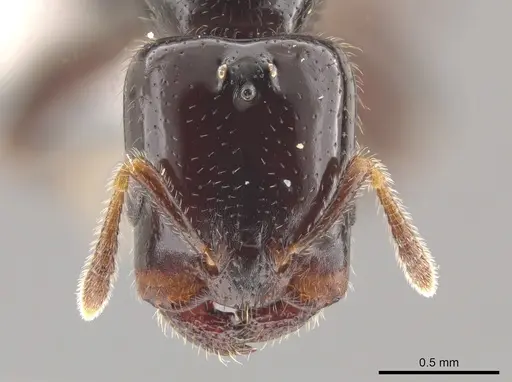
JTLC000006231
View on AntWeb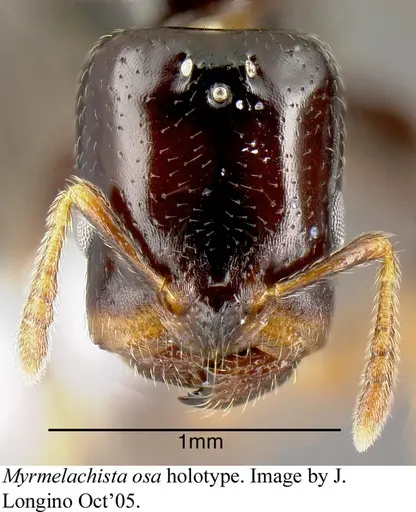
Literature
Loading...Loading products...