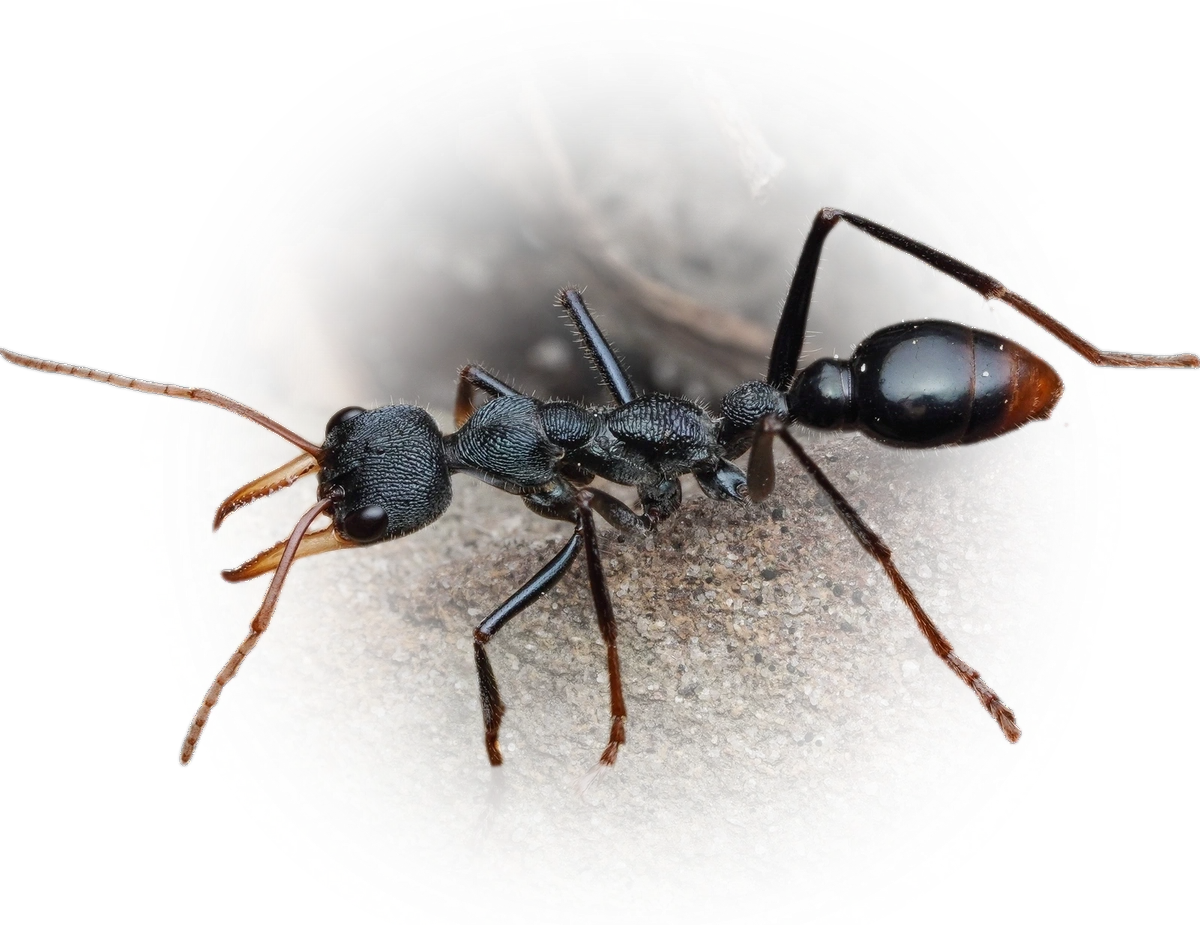

Myrmecia tarsata
- Scientific Name
- Myrmecia tarsata
- Tribe
- Myrmeciini
- Subfamily
- Myrmeciinae
- Author
- Smith, 1858
- Common Name
- Australian Jumper Ant
- Distribution
- Found in 1 countries
Myrmecia tarsata Overview
Myrmecia tarsata (commonly known as the Australian Jumper Ant) is an ant species of the genus Myrmecia. It is primarily documented in 1 countries , including Australia. Detailed taxonomic data and occurrence records can be further explored via authoritative databases such as AntWeb or the Global Biodiversity Information Facility (GBIF).
Myrmecia tarsata - "Australian Jumper Ant"
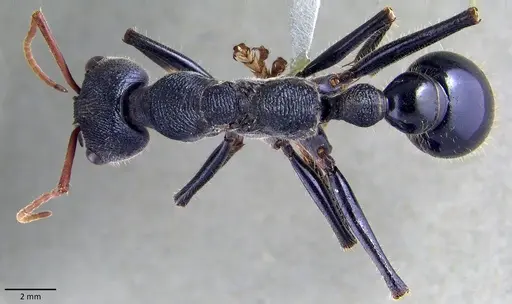
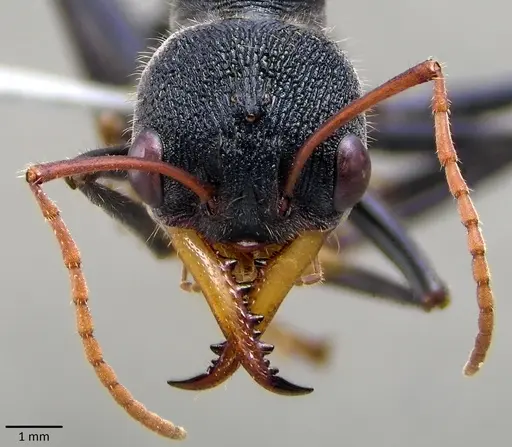
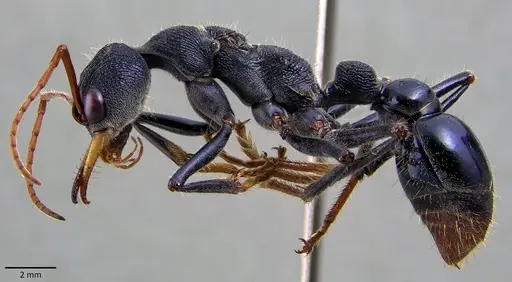
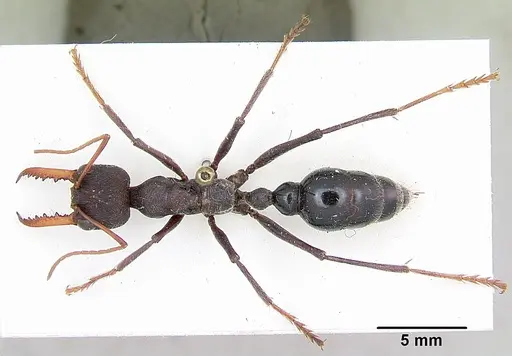
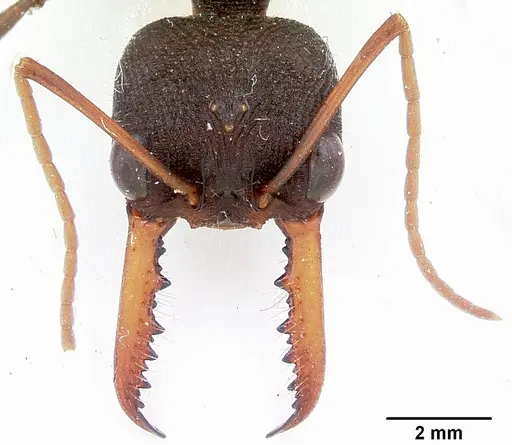
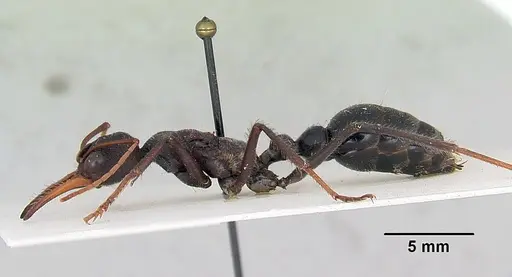
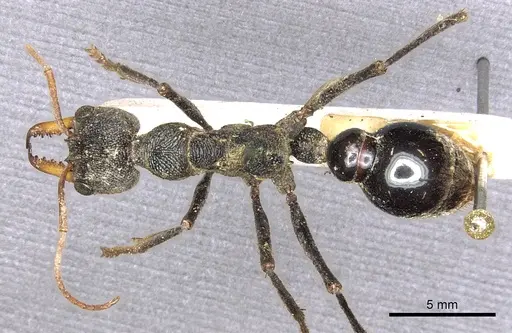
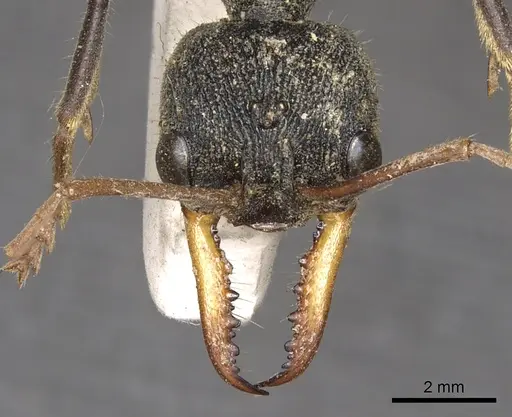
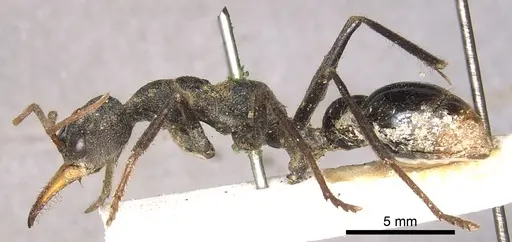
Myrmecia tarsata is a large, striking bulldog ant native to Australia. Workers reach about 27mm in body length with a robust build and powerful mandibles [1]. They belong to the gulosa species group and feature large compound eyes adapted for their diurnal-crepuscular lifestyle [2]. The colony excavated in 2007 near Dorrigo, NSW contained over 500 workers,160 cocoons, and 173 larvae, with some colonies potentially reaching over 1000 workers [3]. This species is notable for its dimorphic queens, both ergatoid (permanently wingless) and brachypterous (short-winged) forms exist [3].
Quick Summary
- Difficulty: Medium
- Origin & Habitat: Australia (New South Wales, Australian Capital Territory, Western Australia). Nests in open woodland habitats characterized by Acacia and Eucalyptus tree species [4]. Subterranean nesting, often polydomous with multiple connected nest chambers [4].
- Colony Type: Polymorphic species with single-queen colonies. Features ergatoid (wingless) and brachypterous (short-winged) replacement queens that can take over if the primary queen dies [3].
- Colony: Monogyne
- Founding: Semi-claustral
- Size & Growth:
- Queen: Ergatoid and brachypterous queens, exact measurements not specified in available literature
- Worker: 27mm body length [1]. Head width 3.21 ± 0.38mm for medium workers [2].
- Colony: Over 500 workers documented in one colony, can exceed 1000 workers [5][3].
- Growth: Moderate, eggs laid in spring emerge before winter [6].
- Development: Approximately 3-4 months (spring to autumn). Eggs laid in spring and emergence complete before following winter [6]. (Development is seasonal, no brood overwinters. Larvae absent during winter months.)
- Antkeeping:
- Temperature: Keep at room temperature (20-25°C). As a diurnal-crepuscular species from temperate Australia, they prefer moderate temperatures with natural light cycles. Avoid excessive heat.
- Humidity: Moderate humidity. Native to open woodland with typical Australian conditions. Keep nest substrate slightly moist but not waterlogged.
- Diapause: Yes, seasonal hibernation. Nest entrances are sealed with soil during winter, and colonies are broodless [6]. Keep colony cool (10-15°C) for 2-3 months during winter. Do not attempt to prevent this rest period.
- Nesting: Subterranean nester. In captivity, provide deep soil setups or acrylic nests with soil chambers. They prefer darker nest conditions and will dig extensively. Provide space for multiple chambers as colonies grow.
- Behavior: Diurnal-crepuscular with two distinct foraging bouts, one shortly after sunrise and another around 5pm [4]. Solitary foragers that hunt small prey individually [7]. Workers are exclusively pedestrian (they walk rather than fly) [8]. They have excellent vision adapted for bright daylight and twilight conditions. This species is defensive and will readily sting, their venom has an LD50 of 0.18 mg/kg and is known to cause anaphylaxis in susceptible individuals [9]. Escape prevention is important as they are large, powerful ants that can climb smooth surfaces.
- Common Issues: Sting risk is significant, these ants have potent venom and will defend aggressively. Handle with extreme caution., Seasonal care is critical, they must hibernate in winter. Forcing activity during this period can kill the colony., Polydomous nature means they may establish satellite chambers, provide adequate space., Slow colony establishment due to seasonal development, don't expect rapid growth., Large size and strong mandibles make them capable of escaping from poorly secured setups.
Housing and Nest Setup
Myrmecia tarsata requires spacious housing due to their large size and tendency to create extensive tunnel systems. In captivity, they do well in formicariums with deep soil chambers or naturalistic setups with multiple connected chambers. Provide a dark nesting area, these ants prefer subdued lighting and will often seal off bright areas. Because they are polydomous in the wild (nesting in multiple connected locations), consider providing multiple chambers connected by tunnels. Outworld space should be generous for foraging. Use escape-proof barriers, these large ants can climb smooth surfaces effectively. [4][3]
Feeding and Diet
Myrmecia tarsata is a predatory species that forages solitarily for small prey [7]. In captivity, offer live insects such as crickets, mealworms, and other appropriately-sized arthropods. They are daytime hunters with excellent vision, so prey presented during their active periods (morning and late afternoon) will be more readily accepted. As a supplement, occasional sugar water or honey can be offered, though protein-rich prey should form the bulk of their diet. Feed every 2-3 days, adjusting based on colony size and appetite.
Temperature and Lighting
These ants are diurnal-crepuscular, meaning they are most active during daylight hours and twilight [2]. They have specialized eye structures adapted for bright conditions with an 'acute zone' providing high spatial resolving power [2]. Keep them at room temperature (20-25°C) with natural light cycles. Avoid keeping them in constant darkness or under artificial lighting 24/7, they need day-night cycles to maintain their natural rhythms. A gradient from room temperature to slightly warmer (up to 28°C) in one area of the nest allows them to choose their preferred temperature.
Seasonal Care and Hibernation
This species has a critical seasonal requirement, they must hibernate in winter. In the wild, eggs laid in spring complete development before winter, and the colony becomes broodless during cold months [6]. Nest entrances are sealed with soil during this period. In captivity, you must simulate this by keeping the colony cool (10-15°C) for 2-3 months during winter. Attempting to keep them active year-round will stress the colony and can lead to colony death. Reduce feeding during hibernation and ensure the nest remains slightly moist but not wet.
Safety and Handling
Myrmecia tarsata has a potent sting that can cause severe allergic reactions in susceptible individuals. The venom LD50 is 0.18 mg/kg, making it one of the more dangerous Australian ants [9]. These ants are highly defensive and will attack perceived threats. Never handle them directly, and use extreme caution when working with the colony. Ensure excellent escape prevention, these large, powerful ants can force their way through gaps that smaller species cannot. If you are stung and experience any allergic symptoms (difficulty breathing, swelling beyond the sting site, dizziness), seek medical attention immediately.
Frequently Asked Questions
How long does it take for Myrmecia tarsata to produce first workers?
First workers typically appear within 3-4 months. Eggs are laid in spring and development completes before winter [6]. This is slower than many tropical ants due to the seasonal breeding cycle.
What do Myrmecia tarsata eat?
They are predatory ants that hunt small prey. Feed live insects like crickets, mealworms, and other arthropods. They are solitary foragers, so present prey during their active periods (morning or late afternoon) [7].
Do Myrmecia tarsata need hibernation?
Yes, they require a winter rest period. In the wild, colonies seal their nests and become broodless during winter [6]. Keep them at 10-15°C for 2-3 months during winter. This rest period is essential for colony health.
How big do Myrmecia tarsata colonies get?
Colonies can exceed 1000 workers. One excavated colony had over 500 workers plus brood, and Gray (1974) documented colonies with more than 1000 workers [5][3].
Are Myrmecia tarsata good for beginners?
No. They are medium-difficulty due to their seasonal care requirements, large size, potent sting, and tendency to escape. They require more experienced keepers who understand hibernation needs and can handle them safely.
When are Myrmecia tarsata most active?
They are diurnal-crepuscular, with two foraging bouts, one shortly after sunrise and another around 5pm [4]. They have excellent daytime vision and are rarely active at night.
Can I keep multiple queens together?
No. This is a monogyne (single-queen) species. While they have ergatoid and brachypterous replacement queens for if the primary queen dies, unrelated queens should not be combined [3].
Why are my Myrmecia tarsata dying?
Common causes include: lack of hibernation (they must rest in winter), incorrect temperature (too hot or too cold), insufficient protein in diet, or stress from excessive disturbance. Also check for escape, they are strong climbers. Review their seasonal care requirements and ensure you're providing appropriate hibernation conditions.
References

This caresheet is licensed under CC BY-SA 4.0 .
Literature
Loading...Loading products...