

Monomorium anderseni
- Scientific Name
- Monomorium anderseni
- Tribe
- Solenopsidini
- Subfamily
- Myrmicinae
- Author
- Heterick, 2001
- Distribution
- Found in 1 countries
Monomorium anderseni Overview
Monomorium anderseni is an ant species of the genus Monomorium. It is primarily documented in 1 countries , including Australia. Detailed taxonomic data and occurrence records can be further explored via authoritative databases such as AntWeb or the Global Biodiversity Information Facility (GBIF).
Monomorium anderseni
Monomorium anderseni is a tiny yellow ant species native to tropical northern Australia, specifically found in the Northern Territory and Western Australia around the Katherine area. Workers measure just 1.24-1.50mm and are a distinctive bright gamboge yellow color, making them one of the smaller and more brightly colored Monomorium species. This species belongs to the monomorium group within the genus and can be identified by its flattened, squamiform petiolar nodes and relatively large propodeal spiracle compared to similar species like M. laeve. [1]
Nothing is known about the biology of this species in the wild, including its colony structure, founding behavior, or specific dietary needs. It has been recorded in both laterite and sandstone habitats in the Mitchell Falls area of tropical northwestern Australia, where it is considered a Generalised Myrmicinae with Eyrean biogeographic affiliations. [2][3]
Quick Summary
- Difficulty: Unknown, likely Easy to Medium based on genus patterns
- Origin & Habitat: Tropical northern Australia (Northern Territory, Western Australia) around Katherine. Found in laterite and sandstone habitats in the Mitchell Falls region. [2][1]
- Colony Type: Unconfirmed colony structure, likely monogyne based on typical Monomorium patterns
- Size & Growth:
- Queen: Not described in original description, estimate 4-5mm based on worker size and genus patterns
- Worker: 1.24-1.50mm [1]
- Colony: Unknown, likely small colony (under 500 workers) based on tiny worker size and typical Monomorium patterns
- Growth: Unknown, likely moderate based on genus patterns
- Development: Estimated 6-8 weeks at optimal temperature based on related Monomorium species (Direct development data unavailable, estimate based on genus-level patterns for small Myrmicinae at tropical temperatures)
- Antkeeping:
- Temperature: Keep at 24-28°C (tropical species from northern Australia). A gentle gradient allows workers to self-regulate.
- Humidity: Moderate humidity, aim for 50-70% relative humidity. Provide a moist test tube setup but allow some drying between water additions.
- Diapause: Likely minimal or no diapause, species from tropical Australia where temperatures remain warm year-round. However, a slight cooling period during winter months may be beneficial.
- Nesting: Use test tube setups or small acrylic nests. Their tiny size requires tight-fitting barriers and narrow chambers scaled to their small body size. Y-tong nests with fine mesh or plaster nests work well.
- Behavior: These are tiny, bright yellow ants that will likely show typical Myrmicinae behavior, moderately active foragers with moderate aggression toward intruders. Escape prevention is critical due to their very small size (under 2mm), they can squeeze through the tiniest gaps. Expect them to be generalist foragers based on their classification as Generalised Myrmicinae. [2]
- Common Issues: escape prevention is critical due to tiny worker size, use fine mesh and tight-fitting lids, colony may be slow to establish given lack of biological data, patience is key, no specific dietary information available, start with standard ant foods and observe acceptance, test tube setups must be properly sealed, these ants can escape through capillary gaps, wild-caught colonies may have unknown parasites or diseases given lack of captive breeding data
Appearance and Identification
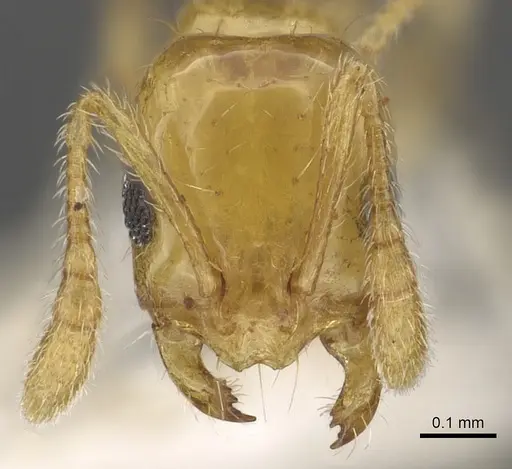
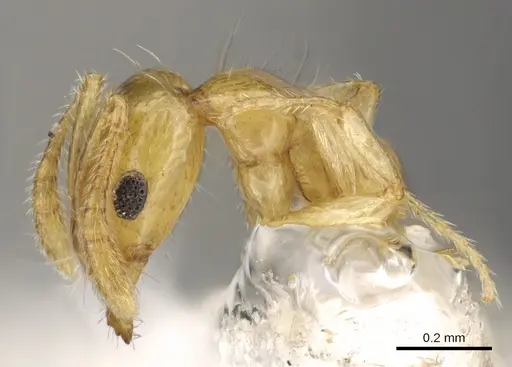
Monomorium anderseni workers are tiny ants measuring just 1.24-1.50mm in total length, making them among the smaller ant species you'll encounter. Their most distinctive feature is their bright gamboge yellow coloration, which stands out compared to many other Monomorium species that tend toward darker browns or reds. The species can be identified by its flattened, squamiform (scale-like) petiolar nodes and a relatively large propodeal spiracle. The eyes are notably large, with eye width greater than 1.5 times the greatest width of the antennal scape. The head capsule is narrow (CeI ≤ 85). Workers are monomorphic, meaning all workers are roughly the same size rather than having major and minor castes. [1]
Natural Habitat and Distribution
This species is endemic to tropical northern Australia, specifically found in the Northern Territory and Western Australia in the Katherine region. Type specimens were collected from Manbulloo (southwest of Katherine) and various sites 10-23km southwest of Katherine between 1977-1978. In the Mitchell Falls area of tropical northwestern Australia, the species has been recorded at both laterite and sandstone sites, with a significant association with laterite habitats. The species is classified as a Generalised Myrmicinae with Eyrean biogeographic affiliations, meaning it's adapted to the arid to semi-arid conditions of inland Australia rather than wet tropical environments. [2][1]
Housing and Nest Setup
Due to their very small size, Monomorium anderseni requires careful housing setup. Test tube setups work well for founding colonies and small established colonies, use a small diameter tube with a tight-fitting cotton plug and water reservoir. For larger colonies, a Y-tong (AAC) nest with narrow chambers or a small plaster/acrylic formicarium scaled to their tiny size is appropriate. Escape prevention is critical, these ants can squeeze through gaps as small as 0.5mm. Use fine mesh on any ventilation holes, ensure lids fit tightly, and consider using Fluon or another barrier coating on the edges of the outworld. Provide a small outworld area connected to the nest via narrow tubing. A layer of substrate in the outworld allows for natural foraging behavior.
Feeding and Diet
As a Generalised Myrmicinae, Monomorium anderseni likely has a generalist diet similar to other Monomorium species. They probably accept sugar sources (honey water, sugar water) and protein sources (small insects, mealworms, fruit flies). In the wild, Generalised Myrmicinae typically forage for both carbohydrates and protein. Start with a drop of honey water or sugar water and small prey items like fruit flies or tiny mealworm pieces. Remove uneaten prey after 24-48 hours to prevent mold. Since nothing is specifically documented about this species' diet, observe what your colony accepts and adjust accordingly. Feed small amounts frequently rather than large prey items that may go uneaten. [2]
Temperature and Humidity
Being a tropical Australian species from the Katherine region, Monomorium anderseni prefers warmer temperatures. Keep the nest area at 24-28°C, with a slight gradient allowing workers to move between warmer and cooler areas. A heating cable on one side of the nest can create this gradient, place it on top of the nest rather than underneath to avoid excessive drying. For humidity, aim for moderate levels (50-70% relative humidity). The test tube water reservoir provides humidity through the cotton, but monitor for condensation and mold. Allow the substrate to dry slightly between water additions rather than keeping it constantly wet. These ants come from a region with distinct wet and dry seasons, so they likely tolerate some variation in moisture levels.
Colony Development and Growth
Since nothing is documented about the colony development of Monomorium anderseni, we must rely on estimates from related species. Based on typical Monomorium patterns for small tropical Myrmicinae, expect the development from egg to worker to take approximately 6-8 weeks at optimal temperature (around 26°C). The first workers (nanitics) will likely be smaller than fully-grown workers. Colonies probably remain small, potentially under 500 workers at maturity given the tiny worker size. Founding colonies should be left undisturbed for the first few months, queens sealed in their founding chamber should not be disturbed until workers emerge. Once workers are present, you can begin offering food and gradually expand the colony's space as the population grows.
Frequently Asked Questions
How long does it take for Monomorium anderseni to produce first workers?
The exact timeline is unknown for this species, but based on related Monomorium species and their small size, expect approximately 6-8 weeks from egg to first worker at optimal temperature (around 26°C). Be patient, founding colonies should not be disturbed until workers appear.
What do Monomorium anderseni ants eat?
As Generalised Myrmicinae, they likely accept both sugar and protein. Start with a drop of honey water or sugar water and small prey like fruit flies, tiny mealworm pieces, or other small insects. Remove uneaten food after 24-48 hours. Since no specific dietary data exists for this species, observe what your colony accepts.
Are Monomorium anderseni good for beginners?
This species is not well-documented in the antkeeping hobby, so it may not be the best choice for complete beginners who need established care guides. However, if you have kept other small Myrmicinae like other Monomorium species, this species would likely be manageable. The main challenges are escape prevention due to their tiny size and the lack of species-specific biological data.
How big do Monomorium anderseni colonies get?
Colony size is not documented for this species, but based on their tiny worker size (1.24-1.50mm), colonies likely remain relatively small, probably under 500 workers at maturity. This is typical for small Myrmicinae species.
Do Monomorium anderseni need hibernation?
Likely no significant hibernation is required. This species comes from tropical northern Australia where temperatures remain warm year-round. A slight cooling during winter months may be beneficial, but a full diapause like temperate species require is probably unnecessary. Keep them at 24-28°C year-round for optimal development.
What temperature should I keep Monomorium anderseni at?
Keep them warm at 24-28°C. A temperature gradient is ideal, place a heating cable on one side of the nest to create a warm zone (around 28°C) and a cooler zone (around 24°C) so workers can self-regulate. This mimics their natural tropical Australian habitat.
Why are my Monomorium anderseni escaping?
Their tiny size (under 2mm) makes them excellent escape artists. Use fine mesh (at least 0.5mm or smaller), ensure all lids fit tightly, and apply barrier coatings like Fluon to the edges of the outworld. Check all tubing connections and any gaps around the nest setup. Tiny ants can squeeze through capillary gaps that larger species cannot.
Can I keep multiple Monomorium anderseni queens together?
The colony structure is unconfirmed for this species. Based on typical Monomorium patterns, they are likely monogyne (single queen), but polygyny (multiple queens) cannot be ruled out. Combining unrelated foundress queens is not recommended since this has not been documented for this specific species. If you catch a queen, house her alone until you confirm she has workers.
Is Monomorium anderseni a difficult species to keep?
The difficulty level is not well-established since this species is rarely kept. Based on genus patterns and their small size, they are likely easy to moderate, they probably adapt well to captive conditions but require excellent escape prevention. The main challenge is the lack of species-specific biological data, so you may need to experiment with care conditions.
References

This caresheet is licensed under CC BY-SA 4.0 .
CASENT0902289
View on AntWeb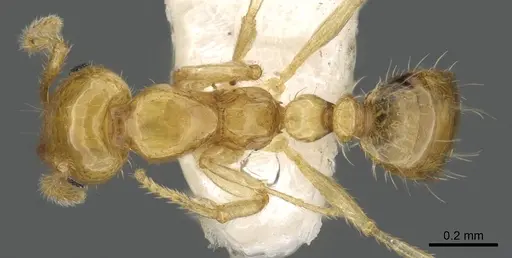
Literature
Loading...Loading products...