

Monomorium aithoderum
- Scientific Name
- Monomorium aithoderum
- Tribe
- Solenopsidini
- Subfamily
- Myrmicinae
- Author
- Heterick, 2001
- Distribution
- Found in 1 countries
Monomorium aithoderum Overview
Monomorium aithoderum is an ant species of the genus Monomorium. It is primarily documented in 1 countries , including Australia. Detailed taxonomic data and occurrence records can be further explored via authoritative databases such as AntWeb or the Global Biodiversity Information Facility (GBIF).
Monomorium aithoderum
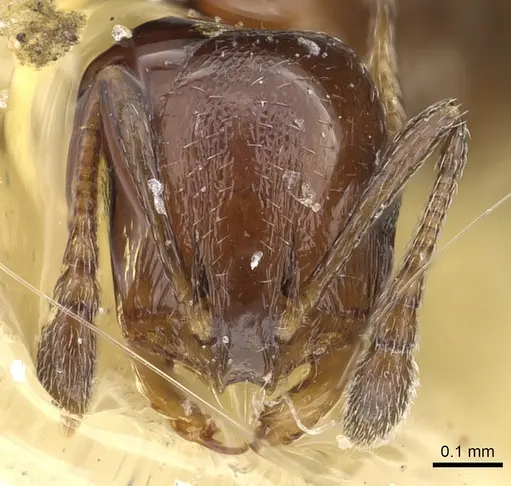
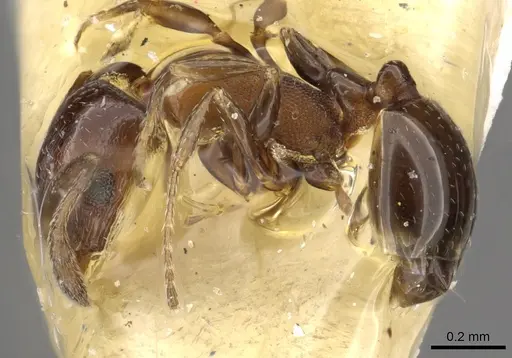
Monomorium aithoderum is a tiny, inconspicuous ant species native to Australia, primarily found in Western Australia and South Australia. Workers are small at just 1.07-1.52mm in total length, with a tawny orange body (sometimes darker on the head), light brown to brown gaster and legs, and distinctive yellow mandibles in some specimens. This species belongs to the Monomorium group and can be identified by its oval eyes, more elongate promesonotum, and compressed propodeum compared to similar species like M. sydneyense. Unlike many related species, M. aithoderum is never yellow [1].
Very little is known about this species' biology in the wild. One specimen was collected on a Conostylis plant (commonly called a trigger plant), suggesting these ants may forage on vegetation. Along with M. nanum and M. stictonotum, this species makes up much of the Monomorium biomass in drier areas of southern Australia [1]. As a true Monomorium (Monomorium s.str.), it belongs to a genus that typically forms moderate-sized colonies with single queens.
Quick Summary
- Difficulty: Unknown, likely Easy to Medium based on genus typical behavior
- Origin & Habitat: Southern Australia, primarily Western Australia and South Australia. Found in drier areas and collected from the Eyre Peninsula region [1].
- Colony Type: Likely monogyne (single queen) based on typical Monomorium patterns, colony structure has not been directly documented for this species.
- Colony: Monogyne
- Founding: Claustral
- Size & Growth:
- Queen: Undocumented, no queen description available. Estimated 4-5mm based on genus typical sizes.
- Worker: 1.07-1.52mm total length (HML) [1].
- Colony: Likely moderate (hundreds of workers) based on genus typical patterns, not directly documented.
- Growth: Unknown, estimated Moderate based on related species.
- Development: Estimated 6-8 weeks at optimal temperature based on typical Monomorium development. (Development timeline is not directly documented for this species. Estimates based on genus-level data.)
- Antkeeping:
- Temperature: Keep at room temperature (20-24°C). This species comes from temperate southern Australia, so moderate warmth is appropriate. A gentle gradient allowing workers to choose their preferred temperature is ideal.
- Humidity: Moderate humidity (50-60%). These ants are found in drier areas of southern Australia, so avoid overly damp conditions. Provide a water tube but keep the nest substrate relatively dry.
- Diapause: Unknown, likely a mild winter rest period (diapause) given the temperate Australian distribution, but this has not been documented.
- Nesting: Small, simple nests work well for these tiny ants. Test tubes or small acrylic nests with tight chambers scaled to their minute size are appropriate. They likely nest in soil or small cavities in nature.
- Behavior: These ants are small and relatively docile. They are not aggressive and unlikely to sting humans due to their tiny size. They are probably generalist foragers, feeding on small insects, honeydew, and nectar based on typical Monomorium diet. Escape prevention is critical, their very small size means they can squeeze through standard barriers easily. Use fine mesh and tight-fitting lids.
- Common Issues: escape prevention is critical due to their very small size, they can slip through tiny gaps, slow growth may frustrate beginners expecting visible progress, limited information means care is based on genus-level inference rather than species-specific data, test tube setups must have very tight connections and fine mesh barriers, wild-caught colonies may have unknown parasites or health issues
Nest Preferences and Housing
Monomorium aithoderum is a tiny ant, so housing must be scaled accordingly. Test tube setups work well, use a small test tube with a cotton ball creating a water reservoir on one end. The tube should be small enough that the ants can easily walk across the diameter. For a growing colony, you can connect multiple test tubes with tubing to create a simple outworld.
Because of their minute size, escape prevention is critical. Standard test tube adapters may have gaps these ants can squeeze through. Use fine mesh (at least 0.5mm or smaller) on any ventilation holes, and check all connections regularly. A thin barrier of fluon around the rim of any outworld container helps prevent escapes.
These ants likely nest in soil or small cavities in nature, so a small amount of moist substrate in part of the test tube (not flooding, just damp) provides appropriate humidity. They come from drier areas of southern Australia, so avoid making the nest too wet. [1]
Feeding and Diet
Based on typical Monomorium behavior, these ants are generalist feeders that likely consume small insects, honeydew from aphids, and nectar. In captivity, you can offer small prey items like fruit flies, pinhead crickets, or small mealworms. Since they are so tiny, prey should be appropriately sized, essentially microscopic arthropods.
Sugar sources are typically accepted by Monomorium species. You can offer a drop of sugar water or honey diluted with water. Replace sugar water every few days to prevent mold. A constant sugar source helps sustain the colony between protein feedings.
Feed small protein items 2-3 times per week for a growing colony. Remove any uneaten prey after 24 hours to prevent mold. Since this species' specific diet has not been documented, start with basic offerings and observe what they accept. [1]
Temperature and Seasonal Care
This species comes from temperate southern Australia, specifically Western Australia and South Australia. These regions experience moderate temperatures, so your colony should do well at typical room temperature (20-24°C). No special heating is required unless your room is significantly cooler.
A temperature gradient is ideal, allow part of the setup to be slightly warmer than the rest so workers can choose their preferred spot. You can achieve this by placing the nest on one side of a shelf while the outworld is on the other, or using a very low-output heating cable on just one side of the nest.
Winter care is not well documented for this species. Based on the temperate Australian distribution, a mild winter rest period (diapause) at around 10-15°C for 2-3 months may be beneficial, but this is an estimate rather than a confirmed requirement. Monitor your colony, if they become less active in winter, reducing temperature slightly is appropriate. [1]
Behavior and Temperament
Monomorium aithoderum is a small, inconspicuous ant that is not aggressive toward keepers. Due to their tiny size, they are unlikely to sting, and any sting would be negligible to humans. They are probably generalist foragers that search for small prey and sugary substances.
The main behavioral concern for keepers is their small size. They are excellent escape artists and can squeeze through gaps that seem impossible. Always use fine mesh, check connections, and consider using fluon barriers. When observing them, do so quickly when the outworld is open, they move fast for their size and will capitalize on any escape opportunity.
Colony activity level is moderate. Workers are likely active throughout the day, foraging and caring for brood. The colony will grow gradually over months to years. [1]
Colony Growth and Development
Monomorium aithoderum colonies likely start with a single claustral queen who seals herself in a small chamber and raises the first workers alone, living off her stored fat reserves. This is typical behavior for the genus, though not directly documented for this species.
First workers (nanitics) will be smaller than mature workers but should emerge within 6-8 weeks under optimal conditions. After the first workers hatch, the queen stops foraging and the workers take over all food collection and brood care.
Colony growth is likely gradual, expect months to reach significant numbers. Mature colonies probably reach several hundred workers based on typical Monomorium colony sizes. Growth rate is moderate, not particularly fast or slow.
Be patient with this species. Their small size means the colony develops more slowly than larger ant species, and visible progress may be slow. Consistent care with appropriate food and temperature will eventually yield a healthy, active colony.
Frequently Asked Questions
How long does it take for Monomorium aithoderum to produce first workers?
Based on typical Monomorium development, expect first workers (nanitics) to emerge in approximately 6-8 weeks after the queen lays her first eggs. This timeline is estimated from genus-level data, as species-specific development has not been documented.
What do Monomorium aithoderum ants eat?
Based on typical Monomorium diet, offer small prey items like fruit flies, tiny crickets, or small mealworms. They also likely accept sugar water or diluted honey. Feed small protein items 2-3 times per week with a constant sugar source available.
Are Monomorium aithoderum good for beginners?
This species is suitable for beginners who understand the critical importance of escape prevention. Their tiny size requires excellent barriers, but otherwise they are relatively forgiving of minor care mistakes. The main challenge is patience, colony growth is gradual.
What temperature do Monomorium aithoderum ants need?
Keep them at typical room temperature (20-24°C). They come from temperate southern Australia and do not require special heating. A gentle temperature gradient is ideal but not required.
How big do Monomorium aithoderum colonies get?
Based on typical Monomorium colony sizes, expect a mature colony of several hundred workers. The exact maximum is not documented for this species, but the genus typically produces moderate-sized colonies.
Do Monomorium aithoderum need hibernation?
Based on the temperate Australian distribution, a mild winter rest period at 10-15°C for 2-3 months may be beneficial, but this is not confirmed. Monitor your colony, if they naturally slow down in winter, reducing temperature slightly is appropriate.
Can I keep multiple Monomorium aithoderum queens together?
Colony structure is not documented for this species, but based on typical Monomorium behavior, they are likely single-queen (monogyne) colonies. Combining unrelated queens is not recommended as it has not been studied and queens may fight.
Why are my Monomorium aithoderum escaping?
Their tiny size (1-1.5mm) makes them excellent escape artists. They can squeeze through impossibly small gaps. Use fine mesh (0.5mm or smaller), check all connections, and apply fluon barriers around any open tops. Escape prevention must be excellent with this species.
When should I move Monomorium aithoderum to a formicarium?
Keep them in a test tube setup for the first year or until the colony reaches 50+ workers. These ants are very small, so even a small formicarium or additional test tubes connected together work well. Move them when the test tube becomes crowded.
What humidity do Monomorium aithoderum ants need?
Moderate humidity (50-60%) is appropriate. They come from drier areas of southern Australia, so avoid overly damp conditions. A water tube provides moisture, keep the substrate damp but not waterlogged.
Is Monomorium aithoderum invasive anywhere?
This species is native to Australia and has not been documented as invasive. It is found primarily in Western Australia and South Australia.
References

This caresheet is licensed under CC BY-SA 4.0 .
CASENT0902287
View on AntWeb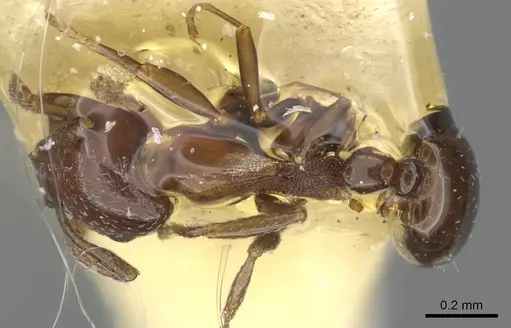
Literature
Loading...Loading products...