

Megalomyrmex reina
- Scientific Name
- Megalomyrmex reina
- Tribe
- Solenopsidini
- Subfamily
- Myrmicinae
- Author
- Longino, 2010
- Distribution
- Found in 1 countries
Megalomyrmex reina Overview
Megalomyrmex reina is an ant species of the genus Megalomyrmex. It is primarily documented in 1 countries , including Costa Rica. Detailed taxonomic data and occurrence records can be further explored via authoritative databases such as AntWeb or the Global Biodiversity Information Facility (GBIF).
Megalomyrmex reina
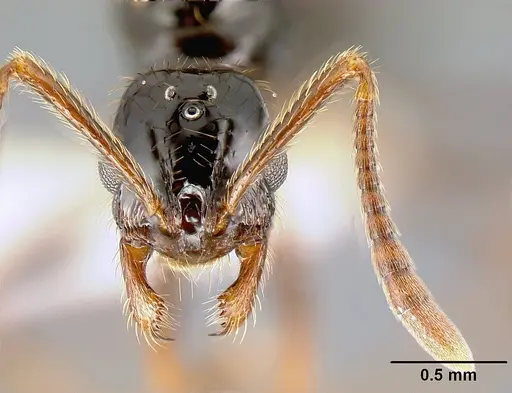
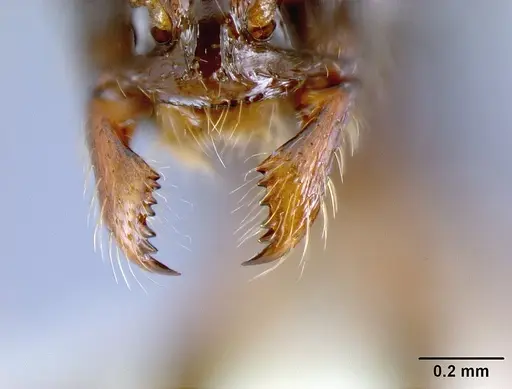
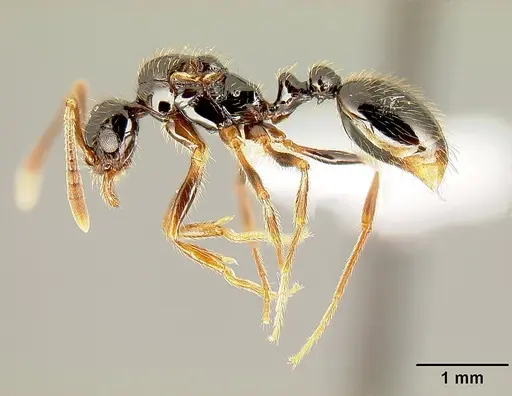
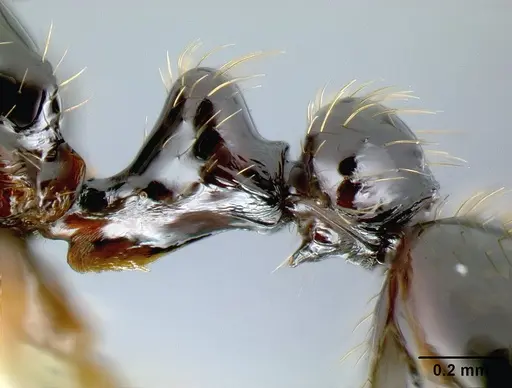
Megalomyrmex reina is a rare ant species known only from queen specimens collected in Costa Rica's mature montane wet forests at 800 meters elevation [1]. The queens are small, measuring approximately 0.83-0.85mm in head width, with a distinctive large apical tooth on the mandible followed by smaller basal teeth, a feature potentially associated with social parasitism [1]. The species name 'reina' (Spanish for 'queen') directly references the fact that only queens have ever been documented, with no workers or males ever collected despite extensive sampling efforts [1][2]. The paratype queen was observed foraging on the ground with rapid, wasp-like behavior and vibrating antennae, suggesting an active, surface-foraging lifestyle [1].
Quick Summary
- Difficulty: Expert
- Origin & Habitat: Costa Rica, mature montane wet forest at 800m elevation [1]
- Colony Type: Unknown, only queens have been documented, workers and males remain unknown. Possibly workerless social parasite or has subterranean worker caste [1]
- Size & Growth:
- Queen: 0.83-0.85mm head width,1.52-1.58mm mesosoma length [1][2]
- Worker: Unknown, workers have never been documented
- Colony: Unknown
- Growth: Unknown
- Development: Unknown, workers have never been documented (This species is known only from queens. No workers have ever been collected, making captive keeping currently impossible.)
- Antkeeping:
- Temperature: Unknown, no captive data available. Based on Costa Rican montane forest location, likely 20-25°C
- Humidity: Unknown, native to wet forest, likely requires high humidity similar to other Neotropical Myrmicinae
- Diapause: Unknown, no captive data available
- Nesting: Unknown, no worker-based nesting observations possible. May be subterranean associate of attine ants or truly workerless [1]
- Behavior: Behavior is poorly documented. The paratype queen showed rapid, wasp-like foraging behavior on the ground with quickly vibrating antennae [1]. Aggression level and defensive capabilities are unknown. Escape risk cannot be assessed without workers.
- Common Issues: This species cannot be kept in captivity, workers have never been documented and no colony has ever been established, If this is a social parasite, it would require a specific host species which is unknown, No information exists on founding behavior, egg development, or worker production, The species may be extinct or extremely rare in the wild with no viable colonies to collect
Why This Species Cannot Be Kept
Megalomyrmex reina represents one of the most challenging ant species for antkeeping because only queen specimens have ever been collected, workers have never been documented despite extensive Winkler sampling and ground-level collecting at the type locality in Costa Rica [1]. This creates an impossible situation for prospective keepers: even if you located this species in the wild and found a queen, there is no established protocol for keeping them, no known host species to provide, and no guarantee that workers would ever develop. The scientific community has only two queen specimens (holotype and paratype) collected in 2004 and 2008,both from the same location at Rio Peñas Blancas, Alajuela Province [1]. Without workers, we cannot determine their dietary needs, nesting preferences, temperature requirements, or any of the basic parameters needed to maintain a healthy colony.
Possible Social Parasitism
The complete absence of workers suggests Megalomyrmex reina may be a workerless social parasite, a species where the queen lives permanently in a host colony and relies on host workers to raise her brood, similar to the genus Teleutomyrmex [1]. This hypothesis is supported by the unusual mandibular dentition: a single large apical tooth followed by smaller teeth, which is characteristic of many socially parasitic ant species that use their mandibles to attack and subdue host queens [1]. However, no host association has ever been documented. An alternative explanation is that workers exist but are subterranean, living in underground chambers associated with attine ant nests (fungus-growing ants) where they would be inaccessible to standard collection methods [1]. Until workers are discovered and described, the species' biology remains speculative.
Taxonomy and Discovery
Megalomyrmex reina was formally described by John T. Longino in 2010 based on two queen specimens collected from Costa Rica's Alajuela Province [1]. The holotype queen was collected on March 2,2004,from a Winkler sample of sifted leaf litter, while the paratype queen was collected on March 4,2008,as a ground-forager [1]. The species belongs to the silvestrii species group within the genus Megalomyrmex, which is part of the Solenopsidini tribe in the Myrmicinae subfamily [1]. The distinctive morphological features include the large apical mandibular tooth, the ventral petiolar flange with jagged teeth, and a prominent anteroventral tooth on the postpetiole, all characters that help distinguish it from other Megalomyrmex species [1][2].
Distribution and Habitat
Megalomyrmex reina is known only from a single locality in Costa Rica: Rio Peñas Blancas in Alajuela Province, at approximately 10°19'N,84°43'W, at 800 meters elevation [1]. This location falls within the mature montane wet forest biome of Costa Rica's northern highlands. The elevation of 800 meters places it in a transitional zone between lowland and highland ant communities. Despite being in a well-collected region with extensive ant biodiversity surveys, no additional specimens have been found since the paratype collection in 2008,suggesting either extreme rarity, very small population sizes, or truly subterranean habits that make detection difficult [1].
Frequently Asked Questions
Can I keep Megalomyrmex reina in captivity?
No. This species cannot be kept because workers have never been documented. Without workers, there is no established care protocol, no known diet, no understood nesting requirements, and no way to maintain a functional colony. Only two queen specimens have ever been collected in the wild.
What does Megalomyrmex reina eat?
Unknown. No feeding observations have been documented, and without workers, we cannot determine their dietary needs or whether they require a host species to survive.
Are there Megalomyrmex reina workers?
Workers have never been documented. Despite extensive sampling at the type locality including many Winkler samples, no workers have ever been collected. This is why the species may be a workerless social parasite or has subterranean habits [1].
Is Megalomyrmex reina a parasite?
Possibly. The lack of workers and the unusual mandibular dentition (large apical tooth) suggest this species may be a social parasite that lives in host ant colonies. However, no host association has ever been documented [1].
Where does Megalomyrmex reina live?
Only known from Costa Rica, Alajuela Province, Rio Peñas Blancas, at 800m elevation in mature montane wet forest [1].
How big are Megalomyrmex reina queens?
Queens measure approximately 0.83-0.85mm in head width and 1.52-1.58mm in mesosoma length, making them relatively small ants [1][2].
What is the colony size of Megalomyrmex reina?
Unknown. No colonies have ever been documented, only individual queens have been collected.
Can I find Megalomyrmex reina in the wild?
Extremely unlikely. Only two specimens have ever been collected despite decades of intensive ant sampling in Costa Rica. The species appears to be either extremely rare or has subterranean habits that make it nearly impossible to find [1].
Does Megalomyrmex reina need hibernation?
Unknown. No captive observations exist. Based on its Costa Rican wet forest habitat, it likely does not require a true hibernation period but may have seasonal activity patterns.
References

This caresheet is licensed under CC BY-SA 4.0 .
JTLC000005356
View on AntWeb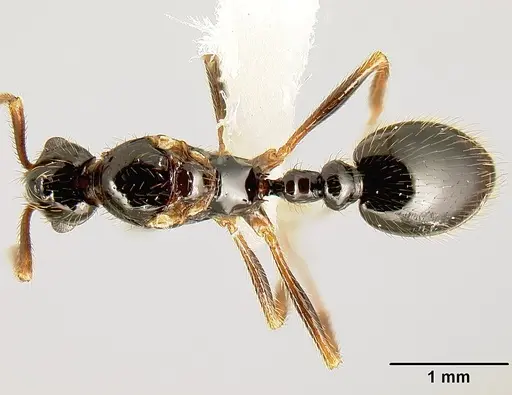
Literature
Loading...Loading products...