

Lordomyrma punctiventris
- Scientific Name
- Lordomyrma punctiventris
- Tribe
- Crematogastrini
- Subfamily
- Myrmicinae
- Author
- Wheeler, 1919
- Distribution
- Found in 1 countries
Lordomyrma punctiventris Overview
Lordomyrma punctiventris is an ant species of the genus Lordomyrma. It is primarily documented in 1 countries , including Australia. Detailed taxonomic data and occurrence records can be further explored via authoritative databases such as AntWeb or the Global Biodiversity Information Facility (GBIF).
Lordomyrma punctiventris
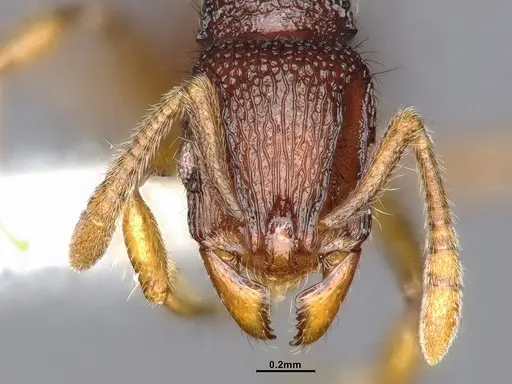
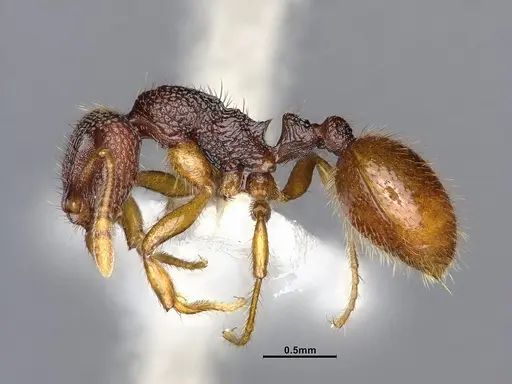
Lordomyrma punctiventris is a tiny ant species native to eastern Australia, found along the east coast and Great Dividing Range from northern Queensland to central New South Wales [1]. Workers are very small, measuring just 0.71mm in head width and about 1.02mm in mesosoma length, making them among the smaller ant species kept in captivity [1]. They belong to the punctiventris species group and inhabit rainforest and wet sclerophyll forests [1]. These ants have a functional sting apparatus, though it is described as weak with reduced sides [2]. As a Myrmicinae species, they can sting if handled roughly, though the sting is not particularly potent.
Quick Summary
- Difficulty: Medium
- Origin & Habitat: Eastern Australia, found in rainforest and wet sclerophyll habitats along the east coast and Great Dividing Range from Iron Range (12°S latitude) to central New South Wales [1]
- Colony Type: Colony structure is unconfirmed, likely monogyne (single queen) based on typical genus patterns, but this has not been directly studied
- Size & Growth:
- Queen: Unconfirmed, likely 4-5mm based on related Lordomyrma species
- Worker: 0.71mm HW, approximately 2.5-3mm total length [1]
- Colony: Unknown, likely under 500 workers based on typical litter ant colony sizes
- Growth: Moderate, estimated 6-10 weeks from egg to first worker based on similar Myrmicinae
- Development: 6-10 weeks (estimated based on related Myrmicinae) (Development time is estimated, no specific data available for this species. Temperature will significantly affect development speed.)
- Antkeeping:
- Temperature: Keep at 20-24°C. They inhabit temperate to subtropical regions of eastern Australia, so room temperature or slight warming is appropriate. A gentle gradient allowing workers to choose their preferred temperature works well.
- Humidity: High humidity required, think damp rainforest floor. Keep the nest substrate consistently moist but not waterlogged. Provide a water tube and ensure the nest area stays humid.
- Diapause: Likely minimal or no strong diapause, their Australian range is relatively warm, though they may slow down slightly in cooler months. A slight cooling period (15-18°C for 4-6 weeks) may be beneficial but is not required.
- Nesting: In nature they likely nest in rotting wood, leaf litter, or under stones in damp forest floor habitats. In captivity, a Y-tong (AAC) nest or plaster nest with good moisture retention works well. Keep the nest humid and provide a water source.
- Behavior: These are small, docile ants that are not aggressive. Workers forage quietly through the substrate and are not known for biting or stinging unless directly threatened. Their tiny size means they can easily escape through small gaps, escape prevention is critical. They are likely nocturnal or crepuscular foragers, searching for small prey and honeydew in the leaf litter layer.
- Common Issues: escape prevention is critical due to their very small size, use fine mesh and tight-fitting lids, colonies may be slow to establish due to small colony size and modest growth rates, high humidity requirements can lead to mold if ventilation is poor, wild-caught colonies may contain parasites that can devastate captive colonies, they need very small prey items, fruit flies, springtails, and tiny insects are appropriate
Housing and Escape Prevention
Because Lordomyrma punctiventris workers are extremely small (around 3mm total length), escape prevention is your top priority. These ants can squeeze through gaps that seem impossibly small. Use test tubes with cotton plugs that are firmly packed, or better yet, switch to a proper formicarium with tight-fitting connections. If using a Y-tong (AAC) nest, ensure all joints are sealed with fluon or another barrier. Fine mesh (at least 0.5mm or smaller) is essential for any ventilation holes. A water test tube connected to the nest provides humidity and drinking water, use a small diameter tube so the ants can reach the water column. Given their small size, even a tiny gap at the edge of a lid can become an escape route. Check all connections daily until you understand their behavior, then check every few days. [1]
Feeding and Diet
In the wild, these tiny ants are likely omnivorous, feeding on small insects, honeydew from aphids, and nectar. In captivity, offer small live prey such as fruit flies (Drosophila), springtails, or tiny crickets. They can also accept sugar water or honey diluted with water, though acceptance varies. Feed small amounts of protein (prey) 2-3 times per week, and keep a sugar source available at all times. Because of their small size, prey items should be no larger than themselves, a fruit fly or small springtail is perfect. Remove any uneaten prey after 24-48 hours to prevent mold. Their small size means they can't take down large prey, so adjust your feeding expectations accordingly.
Temperature and Humidity
Lordomyrma punctiventris comes from eastern Australia, ranging from subtropical Queensland to temperate New South Wales. They tolerate a range from about 18°C to 26°C, with 20-24°C being ideal. Room temperature (around 20-22°C) is often suitable for this species. If your room is cooler, a heating cable on one side of the nest can create a temperature gradient, place it on top of the nest, not underneath, to avoid drying out the substrate. Humidity is more critical than temperature, these rainforest and wet sclerophyll ants need consistently damp conditions. The nest substrate should feel moist to the touch, and you should see condensation on the nest walls periodically. However, avoid standing water and ensure some drier areas exist so the ants can choose their preferred humidity zone. [1]
Colony Establishment and Growth
Starting a colony from a single queen requires patience. The queen will seal herself in a small chamber (likely claustral founding) and lay eggs. She will not leave to forage during this time, surviving on her stored fat reserves. After 4-8 weeks (temperature dependent), the first nanitic workers will emerge, these will be smaller than normal workers. The colony will grow slowly at first, with each generation taking 6-10 weeks to develop. Expect the first year to produce perhaps 10-30 workers. Growth accelerates in subsequent years as the colony reaches 50-100+ workers. Do not disturb the founding queen unnecessarily, she needs peace and stability to succeed. Avoid checking the nest too frequently during the founding stage. Once workers are established, you can slowly expand their space by connecting additional foraging areas.
Behavior and Temperament
These are gentle, non-aggressive ants that prefer to avoid confrontation. Workers are active foragers but not particularly bold or aggressive. They will retreat rather than fight when threatened. Their sting apparatus exists but is described as weak, and they are unlikely to use it unless directly handled or their nest is attacked. In captivity, they are interesting to watch as workers methodically search for food and tend to brood. They are not known for any unusual behaviors like slave-making or tandem running, they are straightforward, quiet little ants that go about their business. Their small size and docile nature make them suitable for observation but less exciting than some larger, more active species. [2]
Frequently Asked Questions
How long does it take for Lordomyrma punctiventris to produce first workers?
Expect 6-10 weeks from egg to first worker at optimal temperature (around 20-24°C). This is an estimate based on related Myrmicinae species, as specific development data for this species is not available. Cooler temperatures will slow development significantly.
Can I keep Lordomyrma punctiventris in a test tube?
Yes, test tubes work well for founding colonies. Use a small diameter tube and ensure the cotton is firmly packed to prevent escapes. Keep the water section small to avoid flooding. Once the colony reaches 30-50 workers, consider moving to a proper formicarium with more space.
Do Lordomyrma punctiventris ants sting?
Yes, they have a sting apparatus, but it is described as weak with reduced sides [2]. They are not aggressive and unlikely to sting unless directly handled or their nest is threatened. The sting is not considered dangerous to humans.
What do Lordomyrma punctiventris eat?
They are omnivorous. Feed small live prey like fruit flies, springtails, or tiny crickets 2-3 times per week. Keep a sugar source (honey or sugar water diluted with water) available at all times. Prey should be appropriately sized, no larger than the ants themselves.
Are Lordomyrma punctiventris good for beginners?
They are rated as medium difficulty. The main challenges are escape prevention (due to their tiny size) and maintaining high humidity. If you can handle small ants and are diligent about escape prevention, they can be rewarding. They are docile and interesting to observe.
Do Lordomyrma punctiventris need hibernation?
Likely not required. Their Australian range experiences relatively mild winters, and they may only need a slight slow-down period (15-18°C for 4-6 weeks) during the coolest months. Strong diapause is not necessary, but a slight temperature reduction can be beneficial.
How big do Lordomyrma punctiventris colonies get?
Colony size is not well documented, but based on typical litter ant sizes, they likely reach several hundred workers at most. Expect slow growth, the first year may produce only 10-30 workers, with growth accelerating in subsequent years.
When should I move Lordomyrma punctiventris to a formicarium?
Move them when the test tube becomes crowded or the water reservoir runs low. This is typically when the colony reaches 30-50 workers. Use a formicarium with small chambers and passages scaled to their tiny size, with good humidity retention.
Why are my Lordomyrma punctiventris escaping?
Their tiny size allows them to squeeze through almost any gap. Check all connections, lids, and tube junctions. Apply fluon or similar barriers to any potential escape routes. Use fine mesh for ventilation, standard mesh is often too coarse. Check daily until you identify and seal all gaps.
Can I keep multiple queens together?
This has not been studied for this species. Based on typical Lordomyrma patterns, they likely form single-queen colonies. Combining unrelated queens is not recommended as they may fight. If you have multiple foundresses, house them separately.
References

This caresheet is licensed under CC BY-SA 4.0 .
CASENT4032455
View on AntWeb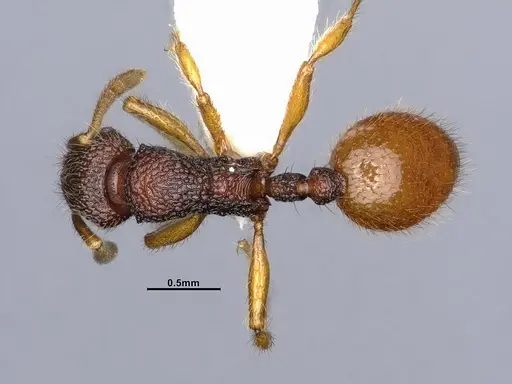
Literature
Loading...Loading products...