

Leptomyrmex aitchisoni
- Scientific Name
- Leptomyrmex aitchisoni
- Tribe
- Leptomyrmecini
- Subfamily
- Dolichoderinae
- Author
- Smith & Shattuck, 2009
- Distribution
- Found in 1 countries
Leptomyrmex aitchisoni Overview
Leptomyrmex aitchisoni is an ant species of the genus Leptomyrmex. It is primarily documented in 1 countries , including Australia. Detailed taxonomic data and occurrence records can be further explored via authoritative databases such as AntWeb or the Global Biodiversity Information Facility (GBIF).
Leptomyrmex aitchisoni
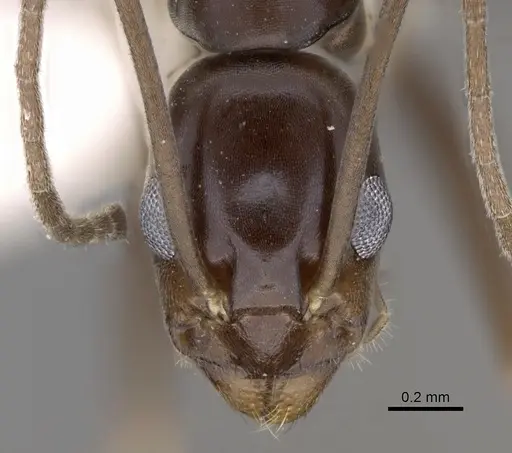
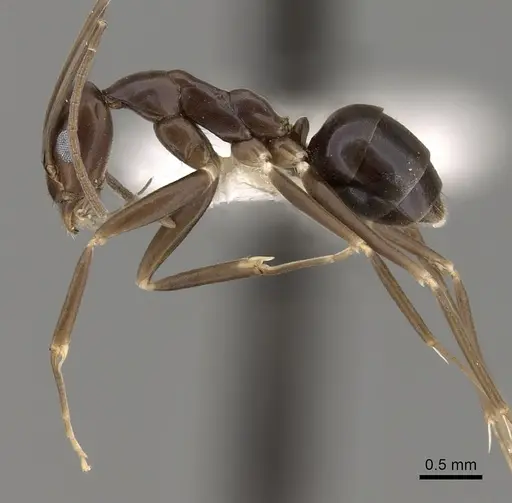
Leptomyrmex aitchisoni is a tiny Australian ant species belonging to the Dolichoderinae subfamily, commonly known as spider ants due to their remarkably long legs. Workers measure just 0.56-0.65mm in head width, making them unusually small compared to most other Leptomyrmex species which are typically larger and more brightly colored [1]. The head is relatively elongate with very long antennal scapes that extend well beyond the vertex, and the body is uniformly light to dark brown with paler legs and antennae and a darker gaster [1]. This species was formally described in 2009 and was previously misidentified as belonging to the genus Iridomyrmex due to its small size and coloration [2].
This species is relatively common and widespread across its limited range in north-eastern New South Wales and south-eastern Queensland, where it inhabits forest habitats ranging from wet sclerophyll to rainforest [1][2]. It nests under stones on the forest floor, which is typical behavior for this species. What makes L. aitchisoni particularly interesting is its status as one of the smallest Leptomyrmex species, part of the informally designated 'micro-Leptomyrmex' group, and it represents a significant range extension for these tiny ants into more southern latitudes than previously documented [2][1].
Quick Summary
- Difficulty: Unknown, no captive care literature exists
- Origin & Habitat: North-eastern NSW and south-eastern Queensland, Australia. Found in wet sclerophyll to rainforest forest habitats, nesting under stones [1][2].
- Colony Type: Colony structure is unconfirmed. Based on typical Leptomyrmex patterns, likely single-queen colonies.
- Size & Growth:
- Queen: Unconfirmed, queens have not been described in the original research [1].
- Worker: 0.56-0.65mm head width,0.79-0.96mm head length [1].
- Colony: Unknown, no colony size data available.
- Growth: Unknown, no development data available.
- Development: Unconfirmed, no direct development data exists for this species. Based on typical Dolichoderinae patterns, estimate 6-10 weeks at optimal temperature. (Development timeline is unconfirmed. Related Leptomyrmex species typically develop in 6-10 weeks, but this species' small size may affect timing.)
- Antkeeping:
- Temperature: Unconfirmed, no thermal studies exist for this species. Based on its habitat in wet sclerophyll and rainforest of eastern Australia (temperate to subtropical), aim for roughly 20-24°C with a gentle gradient. Monitor colony activity for preferences.
- Humidity: Unconfirmed, no humidity data exists. Based on its rainforest and wet sclerophyll habitat, likely requires higher humidity (60-80%). Keep the nest substrate consistently moist but not waterlogged.
- Diapause: Unknown, no seasonal studies exist. Australian temperate ants typically require a mild winter rest period. Consider a brief cooling period (2-3 months at 10-15°C) during winter months if the colony shows reduced activity.
- Nesting: In nature, nests under stones in forest habitats [1]. For captivity, a naturalistic setup with stones or a Y-tong/plaster nest with moisture retention would likely work well. The small worker size suggests narrow chambers are appropriate.
- Behavior: Temperament and detailed behavior are unconfirmed. Based on typical Leptomyrmex behavior, these ants are likely moderately active foragers with long legs enabling quick movement. Their small size (under 0.65mm) means escape prevention must be excellent, use fine mesh barriers and tight-fitting lids. They are not known to be aggressive but may have typical Dolichoderine defensive responses. Foraging style likely involves ground foraging for honeydew and small prey.
- Common Issues: no captive care literature exists, this is a species with essentially unknown husbandry requirements, tiny worker size means escape prevention is critical, they can squeeze through standard mesh, nesting preferences in captivity are unconfirmed, may need experimentation, humidity requirements are unknown, monitor for desiccation stress, colony founding behavior is unconfirmed, claustral vs semi-claustr unknown
Species Identification and Distinction
- [1]. The pilosity consists of short, adpressed hairs, and the palps are relatively short, failing to reach the posterior of the head capsule with a formula of 6:4 [1]. The petiolar scale is ridged with a distinct angle dorsally and is strongly inclined anteriorly. In coloration, the head, mandibles and mesosoma are uniformly light to dark brown, while the legs and antennae are paler and the gaster is darker [1]. This species is readily separated from sympatric L. burwelli and L. ramorniensis by these key characters [3]. The species was previously misidentified as Iridomyrmex due to its small size and yellow-brown to brown coloration, which lacks the large size and bright orange colour common in other Leptomyrmex species [2].
Natural History and Habitat
Leptomyrmex aitchisoni is restricted to rainforests and wet sclerophyll forests in two relatively small regions of eastern Australia, specifically north-eastern NSW and south-eastern Queensland [2][1]. This represents a significant southern range extension for the 'micro-Leptomyrmex' group, which had previously been known only from more northern locations [2]. The species is relatively common and widespread within its limited range [1]. Nests are found under stones in these forest habitats, which provides insight into their humidity requirements, wet sclerophyll and rainforest environments are characterized by consistently high moisture levels and shaded conditions [1]. The forest floor microhabitat where they nest would experience moderate temperature fluctuations and high relative humidity year-round.
Known Biology and Research Gaps
Despite being relatively common in its native habitat, Leptomyrmex aitchisoni remains one of the least studied ant species in captivity. The original species description in 2009 provided detailed morphological measurements of workers but did not document queen morphology, colony structure, or behavior [1]. The molecular phylogeny study in 2011 was unable to include this species because fresh material was unavailable, leaving gaps in our understanding of its evolutionary relationships [4]. What we do know is that it belongs to the informally designated 'micro-Leptomyrmex' group, characterized by workers with head width less than 0.80mm, which distinguishes them from larger Leptomyrmex species [2]. This species represents an opportunity for antkeepers to contribute to our knowledge of this group, as captive colonies could provide the first detailed observations of their behavior, colony development, and husbandry requirements.
Housing and Nesting Recommendations
Based on the natural nesting behavior under stones in forest habitats, a naturalistic setup would likely be most appropriate for this species. The small worker size (under 0.65mm) means chambers and passages should be scaled accordingly, narrow and tight-fitting rather than spacious. Y-tong (acrylic) nests or plaster nests with good moisture retention would help maintain the humidity levels likely required. Given their rainforest and wet sclerophyll origins, the nest should have areas of consistent moisture without becoming waterlogged. A water reservoir or moisture gradient allows the ants to self-regulate their humidity exposure. Escape prevention is critical due to their tiny size, standard mesh may be insufficient, and fine mesh barriers should be used. The outworld should provide foraging space with access to typical ant food sources.
Feeding and Diet
Feeding requirements are unconfirmed for this species, but based on typical Dolichoderinae behavior and their small size, they likely forage for honeydew from aphids and scale insects, plus small insects and other protein sources. Offer sugar water or honey water as a constant energy source, and protein sources such as small fruit flies, pinhead crickets, or other appropriately-sized live prey. Given their tiny worker size, prey items should be very small. Start with small amounts and observe acceptance. The long legs suggest they are active foragers, so they likely benefit from regular feeding schedules. Remove uneaten prey after 24-48 hours to prevent mold.
Frequently Asked Questions
How do I keep Leptomyrmex aitchisoni ants?
This species has no established captive care literature, making it a species for experienced keepers willing to experiment. Based on its natural habitat (wet sclerophyll to rainforest in eastern Australia), provide a naturalistic or plaster nest with good humidity retention, maintain temperatures around 20-24°C, and use excellent escape prevention due to their tiny worker size (under 0.65mm).
What do Leptomyrmex aitchisoni ants eat?
Diet is unconfirmed, but likely similar to other Dolichoderines, they probably accept sugar sources (honey water, sugar water) and small protein prey. Start with tiny prey items appropriate to their small worker size.
How big do Leptomyrmex aitchisoni colonies get?
Colony size is unknown, no colony size data exists in the scientific literature. Based on their small worker size and limited range, colonies are likely smaller than typical Leptomyrmex species.
What is the difficulty level for keeping Leptomyrmex aitchisoni?
Difficulty is unknown, this species has no captive care history. It is recommended only for experienced antkeepers who can document and share their observations, as keeping this species contributes to our knowledge of the species.
How long does it take for Leptomyrmex aitchisoni to develop from egg to worker?
Development timeline is unconfirmed. Based on typical Dolichoderinae patterns, estimate 6-10 weeks at optimal temperature, but this is a rough guess.
Do Leptomyrmex aitchisoni ants need hibernation?
Diapause requirements are unknown. Based on their Australian temperate to subtropical origin, consider a mild winter rest period (2-3 months at 10-15°C) if the colony shows reduced activity during winter months.
Can I keep multiple Leptomyrmex aitchisoni queens together?
Colony structure is unconfirmed. Combining unrelated queens has not been documented for this species and is not recommended until more is known about their natural colony structure.
Where is Leptomyrmex aitchisoni found in the wild?
This species is found in north-eastern New South Wales and south-eastern Queensland, Australia, in wet sclerophyll to rainforest forest habitats where it nests under stones [1][2].
Why was Leptomyrmex aitchisoni previously misidentified?
This species was previously misidentified as belonging to the genus Iridomyrmex because of its unusually small size (head width less than 0.80mm) and yellow-brown to brown coloration, which lacks the large size and bright orange colour common in other Leptomyrmex species [2].
References

This caresheet is licensed under CC BY-SA 4.0 .
CASENT0012033
View on AntWeb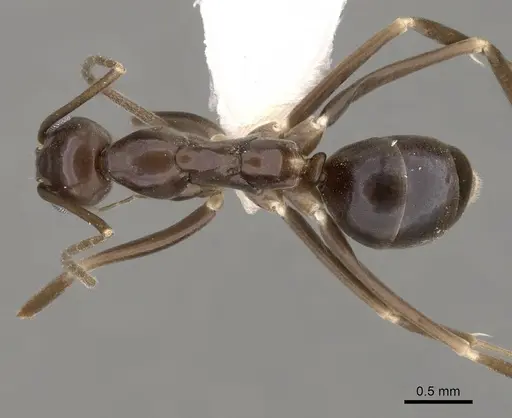
Literature
Loading...Loading products...