

Leptogenys antillana
- Scientific Name
- Leptogenys antillana
- Tribe
- Ponerini
- Subfamily
- Ponerinae
- Author
- Wheeler & Mann, 1914
- Distribution
- Found in 3 countries
Leptogenys antillana Overview
Leptogenys antillana is an ant species of the genus Leptogenys. It is primarily documented in 3 countries , including Dominican Republic, Guadeloupe, Haiti. Detailed taxonomic data and occurrence records can be further explored via authoritative databases such as AntWeb or the Global Biodiversity Information Facility (GBIF).
Leptogenys antillana
Leptogenys antillana is a slender predatory ant endemic to the island of Hispaniola, found only in the Dominican Republic and Haiti. Workers measure 4.5-5.5mm with a distinctive dark brown to black body and reddish-brown accents on the mandibles, antennae, legs, and the tip of the abdomen. The head is slightly broader at the front than the back, and the eyes are small and positioned on the sides of the head. This species belongs to the antillana species group and is closely related to Leptogenys reggae from Jamaica, sharing similar head and eye shape characteristics. The queen and male remain unknown to science, making this one of the more mysterious Caribbean ant species. Specimens have been collected from under rocks in disturbed areas, including coffee plantations and secondary scrub adjacent to roads, at elevations between 74 and 1,100 meters.
Quick Summary
- Difficulty: Unknown
- Origin & Habitat: Endemic to Hispaniola, found only in the Dominican Republic and Haiti. Workers have been collected from coffee plantations and secondary scrub adjacent to roads, at elevations of 74-1,100 meters [1][2].
- Colony Type: Unknown, queen and male remain undescribed. The colony structure has not been documented in scientific literature.
- Size & Growth:
- Queen: Unknown, queens have not been described [3]
- Worker: 4.5-5.5mm [3], more precise metrics: HL 0.65-0.68mm, HW 0.67-0.70mm [4]
- Colony: Unknown, colony size has not been documented
- Growth: Unknown, no development data available
- Development: Unknown, this species has not been studied for development times (No data exists on egg-to-worker development. Related Leptogenys species typically take 2-3 months, but this is unconfirmed for L. antillana)
- Antkeeping:
- Temperature: Unknown, no thermal studies exist for this species. Based on its Caribbean island habitat and elevation range (74-1,100m), it likely tolerates a range from roughly 20°C to 28°C. Start around 24°C and observe colony activity.
- Humidity: Unknown, no humidity data exists. The species has been found in coffee plantations and secondary scrub, suggesting it prefers moderately humid conditions. Keep nest substrate lightly moist.
- Diapause: Unknown, no seasonal studies exist for this species. Hispaniola has a mild tropical climate with no harsh winters, so a diapause may not be required.
- Nesting: In the wild, workers have been found under rocks in disturbed ground. In captivity, a naturalistic setup with moist substrate and flat stones or a Y-tong/plaster nest would likely work well. The species is small enough that tight-fitting escape prevention is important.
- Behavior: Behavior is unstudied. As a Leptogenys species, it is likely a predator that hunts other small arthropods. The genus is known for active foraging and relatively non-aggressive colonies compared to some other Ponerines. Escape risk is moderate given the 4.5-5.5mm worker size, standard escape prevention measures should suffice.
- Common Issues: this species is extremely rare in captivity and may not be available to hobbyists, no established care protocols exist, keepers would be pioneering husbandry methods, queen and male are unknown, making colony founding impossible from wild-caught specimens, very limited distribution means specimens are difficult to obtain, lack of basic biological data makes proper care challenging
Species Discovery and Taxonomy
Leptogenys antillana was first described by Wheeler and Mann in 1914 from specimens collected in Haiti. The original type series consisted of seven workers collected from three locations: Milot, Diquini, and Petionville. The species was later revised by John Lattke in 2011,who provided more detailed measurements and morphological descriptions. Lattke noted that L. antillana is likely most closely related to Leptogenys reggae, another Caribbean endemic found in Jamaica, due to similarities in head shape, eye shape and position, and the broad median clypeal lobe with a setae at the apex. However, this clypeal setae may be absent in some specimens. The species remains poorly known, with queens and males still undescribed to this day. [4][3]
Distribution and Habitat
This species is endemic to Hispaniola, making it a true island endemic with a very restricted range. In the Dominican Republic, workers have been recorded from Barahona province. In Haiti, specimens come from the type localities of Milot, Diquini, and Petionville. The elevation range spans from 74 to 1,100 meters above sea level. The habitat data is limited, but workers have been sampled from an area planted with coffee and from secondary scrub adjacent to a road, both disturbed habitats rather than pristine forest. This suggests the species can tolerate some human disturbance, though the extent of its true habitat preferences remains unknown. [1][2]
Morphology and Identification
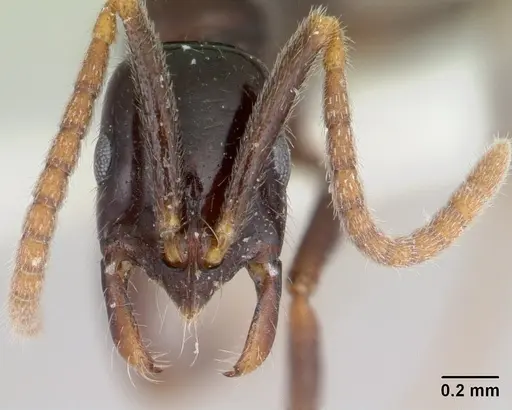
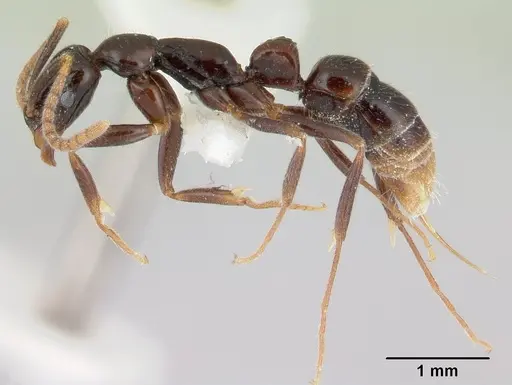
Workers of Leptogenys antillana measure 4.5-5.5mm in length, making them small to medium-sized ants. The body is slender with a distinctive color pattern: the head and mesosoma are dark brown to black, while the mandibles, antennae (except for darker portions), leg joints, and the tip of the abdomen are reddish to reddish-brown. The head is slightly broader at the front than the back, with weakly convex sides and posterior margin. The compound eyes are small, weakly convex, and positioned laterally at roughly the mid-point of the head length. The mandibles are elongate with parallel margins. The median clypeal lobe is broadly triangular with a bluntly pointed apex that may have a median seta. The mesosoma is relatively flat dorsally, and the propodeum (the rear portion of the mesosoma) lacks any teeth or lobes. The petiole is subquadrate when viewed from the side. [4][3]
Keeping an Undescribed Species
Leptogenys antillana presents a unique challenge for antkeepers: it is one of the least studied ant species in the hobby, with no established care protocols, no described queen, and no information on colony founding or development. The species is essentially unknown in captivity. If you were to obtain specimens, you would be pioneering the husbandry of a species that has never been kept before. This makes L. antillana unsuitable for beginners, you would need extensive experience with Ponerine ants and a willingness to experiment. The primary interest in this species comes from its extreme rarity and the scientific novelty of working with an essentially undescribed biology. Any successful captive husbandry would represent a genuine contribution to antkeeping knowledge.
Related Species and Care Inferences
While specific care information for L. antillana does not exist, we can make educated guesses based on the genus Leptogenys as a whole. Most Leptogenys species are predatory, hunting other small arthropods including other ants, springtails, and isopods. They tend to be more docile than many other Ponerine ants and do not have painful stings. Most Leptogenys species practice claustral founding, where the queen seals herself in a chamber and lives off stored fat reserves until her first workers emerge. However, this specific behavior has not been documented for L. antillana. The elevation range (74-1,100m) and Caribbean location suggest the species prefers warm, moderately humid conditions without a true winter diapause.
Frequently Asked Questions
Is Leptogenys antillana available for purchase?
This species is extremely rare in the antkeeping hobby. It is endemic to Hispaniola and has never been commercially available as far as documented records show. The queen and male remain undescribed by science, making captive breeding from wild-caught specimens impossible.
How do I care for Leptogenys antillana?
No established care protocol exists for this species. It would require experimental husbandry based on related Leptogenys species. If you obtained workers, a naturalistic setup with moist substrate and small live prey would be a reasonable starting point. This species is not recommended for anyone except advanced antkeepers interested in pioneering new species care.
What does Leptogenys antillana eat?
The diet is unstudied. As a Leptogenys species, it is almost certainly predatory on small arthropods. Related species hunt other ants, springtails, and tiny invertebrates. In captivity, small live prey like fruit flies, pinhead crickets, and aphids would be logical first attempts.
What is the colony size of Leptogenys antillana?
Unknown, no colony size data exists in scientific literature. The species has only been collected as individual workers, and the maximum colony size has never been documented.
Does Leptogenys antillana need hibernation?
Unknown, no seasonal data exists. Hispaniola has a tropical climate without harsh winters, so a diapause is likely not required. However, this has not been studied.
Can I keep multiple Leptogenys antillana queens together?
Unknown, the colony structure has never been documented. Queens have not been described, so there is no information on whether the species is single-queen or multi-queen.
How long does it take for Leptogenys antillana to develop from egg to worker?
Unknown, this species has never been studied for development times. No eggs, larvae, or pupae have been documented in scientific literature.
Are Leptogenys antillana good for beginners?
No. This species is completely unsuitable for beginners. No care protocols exist, the queen is unknown (making founding impossible), and the species is essentially unavailable. Even experienced antkeepers would find this species challenging due to the complete lack of biological data.
References

This caresheet is licensed under CC BY-SA 4.0 .
CASENT0178832
View on AntWeb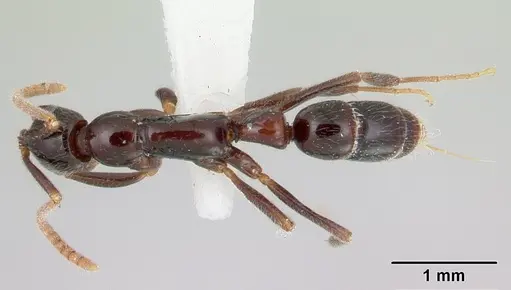
Literature
Loading...Loading products...