

Leptanilloides caracola
- Scientific Name
- Leptanilloides caracola
- Subfamily
- Dorylinae
- Author
- Donoso <i>et al.</i>, 2006
- Distribution
- Found in 1 countries
Leptanilloides caracola Overview
Leptanilloides caracola is an ant species of the genus Leptanilloides. It is primarily documented in 1 countries , including Ecuador. Detailed taxonomic data and occurrence records can be further explored via authoritative databases such as AntWeb or the Global Biodiversity Information Facility (GBIF).
Leptanilloides caracola
Leptanilloides caracola is an extremely rare Neotropical ant species known from a single worker specimen collected in the cloud forests of Ecuador. Workers are minute, among the smallest ants in the world at just 0.40mm head length, with a slender, flattened body and distinctive light yellowish-brown coloration. This species lacks eyes entirely, suggesting a subterranean or cave-dwelling lifestyle. The genus Leptanilloides belongs to the Dorylinae subfamily, which includes army ants and other predatory species, though the specific biology of this species remains completely unknown since only one specimen has ever been collected [1][2]. The name references a popular character in local Ecuadorian folklore [1].
Quick Summary
- Difficulty: Expert
- Origin & Habitat: Ecuador, Cotopaxi Province, Bosque Integral Otonga at 2200m elevation in second growth cloud forest [1][2][3]
- Colony Type: Unknown, only a single worker has ever been collected. Colony structure, queen morphology, and reproductive biology are completely unstudied.
- Size & Growth:
- Queen: Unknown, queen has never been described [1]
- Worker: 0.40mm head length,0.47mm Weber's length [1][2]
- Colony: Unknown, no colony data exists
- Growth: Unknown
- Development: Unknown, no development data exists for this species (This species is known from a single specimen, no colony-level observations exist)
- Antkeeping:
- Temperature: Unconfirmed, based on the highland cloud forest habitat (2200m elevation in Ecuador), likely requires cool, stable conditions in the range of 15-22°C. Avoid overheating.
- Humidity: Unconfirmed, cloud forest environments are typically humid (60-80%). Keep nest substrate consistently moist but not waterlogged.
- Diapause: Unknown, no seasonal data exists. The highland Ecuadorian habitat may experience mild temperature fluctuations, but specific overwintering requirements are unstudied.
- Nesting: Unconfirmed, the absence of eyes strongly suggests subterranean or cryptic nesting. In captivity, provide a naturalistic setup with deep, moist substrate or a Y-tong/plaster nest with tight chambers scaled to their tiny size.
- Behavior: Behavior is completely unstudied. As a Dorylinae member, they likely exhibit predatory behavior similar to other army ants, possibly hunting small soil micro-arthropods. The absence of eyes indicates they probably rely on chemical cues rather than vision. Escape risk is likely high given their minute size, use fine mesh barriers. Aggression level is unknown.
- Common Issues: this species has never been kept in captivity, no husbandry information exists, only one specimen has ever been collected, making even genus-level inferences uncertain, no queen or colony has been documented, so captive breeding is not possible, the extremely small size makes escape prevention critical, they can squeeze through standard barrier materials, no food acceptance data exists, diet must be inferred from related species
Why This Species Is Extremely Challenging
Leptanilloides caracola presents perhaps the greatest challenge of any ant species in the hobby because virtually nothing is known about it. Only a single worker specimen has ever been collected, in 1997,from a pitfall trap in Ecuador's cloud forests [1]. No queen, no male, no colony, no behavioral observations, no development data, the scientific literature contains almost no biological information. This is not a species you can purchase or keep, it exists only in museum collections as a single preserved specimen. Even genus-level inferences are difficult because Leptanilloides is one of the rarest ant genera in the Neotropics, with most species known from just one or a few specimens. If you are seeking an ant to keep, this species is not available and likely not suitable for captive husbandry.
What We Know From the Single Specimen
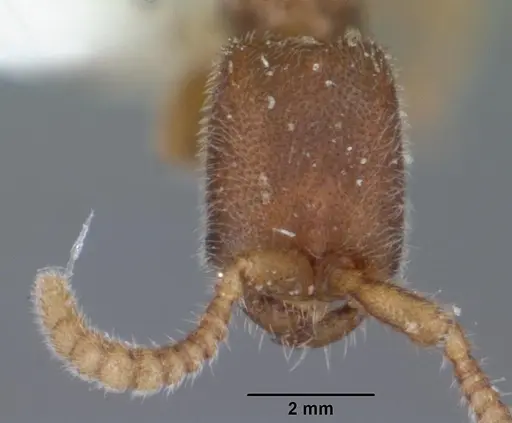
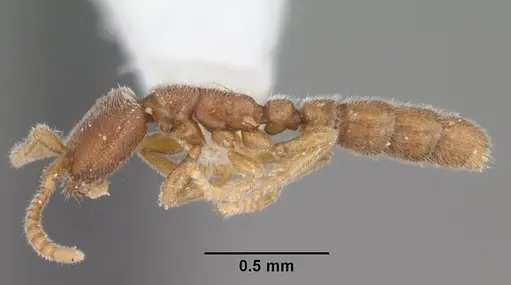
The holotype worker provides our only window into this species. At just 0.40mm head length and 0.47mm Weber's length, they are among the smallest ants in the world [1]. The worker is a shining light yellowish-brown color with abundant coarse hairs covering the body. Most notably, they completely lack eyes, a trait shared with other subterranean ant species that navigate entirely through chemical and tactile cues [1][2]. The antennae are 12-segmented with a short, clavate scape. The mesosoma is long, slender, and flattened. The propodeum is unarmed (no spines). The postpetiole is notably large compared to the petiole, which is distinctive for identification [1]. The masticatory margin of the mandibles is edentate (toothless), and the tibial spur on the foreleg is long and pectinate (comb-like) [1].
Habitat and Distribution
This species is known only from the type locality in Cotopaxi Province, Ecuador, at an elevation of 2200 meters in the Bosque Integral Otonga, a cloud forest reserve in the Andes [1][2]. The specimen was collected in a pitfall trap in second-growth forest, indicating they are ground-dwelling and likely subterranean. The high elevation means the environment is cool and perpetually humid, typical of Andean cloud forests. The elevation of 2200m also means temperatures are relatively cool year-round, likely ranging from 12-20°C depending on season. This is not a tropical lowland species, they come from a cool, moist, highland environment where temperature fluctuations are minimal [1].
Inferred Care From Related Species
Since no direct husbandry data exists, we can only make educated guesses based on the genus and subfamily. Leptanilloides belongs to Dorylinae, which includes army ants and other primarily predatory ants that hunt and raid for prey [3]. However, the absence of eyes suggests they are not active surface foragers like army ants, instead, they likely hunt small soil-dwelling invertebrates in underground tunnels. Based on this, a naturalistic setup with deep, moist substrate would be most appropriate. Temperature should be kept cool, perhaps 15-22°C, reflecting their highland origin. Humidity should be high, mimicking the cloud forest environment. Food would likely consist of small live prey such as springtails, but this is entirely speculative. For now, this species remains a scientific curiosity rather than a viable option for antkeepers.
Taxonomic Context
Leptanilloides is a rare genus of Neotropical ants placed in the subfamily Dorylinae (army ants and their relatives) [3]. The genus was originally classified in its own subfamily Leptanilloidinae, but recent taxonomic revisions have moved it into Dorylinae based on morphological and molecular evidence. The Leptanilloides biconstrictus species-group, which includes L. caracola, is characterized by specific morphological traits including the large postpetiole and absence of genal teeth [1]. The genus is known from only a handful of species, most described from single specimens, making this one of the most poorly known ant genera in the world.
Frequently Asked Questions
Can I keep Leptanilloides caracola as a pet?
No. This species has never been kept in captivity and is not available in the antkeeping hobby. Only a single worker specimen has ever been collected, making captive breeding impossible. There is no biological or husbandry information available for this species.
Where does Leptanilloides caracola live?
Only known from a single location in Ecuador's Cotopaxi Province at 2200m elevation in the Bosque Integral Otonga cloud forest [1][2].
How big is Leptanilloides caracola?
Workers are extremely minute, the holotype measures just 0.40mm head length and 0.47mm Weber's length [1]. This makes them among the smallest ants in the world.
Does Leptanilloides caracola have eyes?
No, this species completely lacks eyes, suggesting a subterranean or cave-dwelling lifestyle [1][2].
What does Leptanilloides caracola look like?
Workers are a shining light yellowish-brown color with abundant coarse brownish hairs. They have a large postpetiole, a slender flattened mesosoma,12-segmented antennae, and no eyes or genal teeth [1][2].
How many queens does Leptanilloides caracola have?
Unknown, no queen has ever been described. Only a single worker specimen exists in scientific collections [1].
What do Leptanilloides caracola ants eat?
Unknown, no feeding observations exist. As Dorylinae members, they likely prey on small soil invertebrates, but this is entirely speculative.
Are Leptanilloides caracola colonies large?
Unknown, no colony has ever been documented. Only a single worker specimen exists.
Is Leptanilloides caracola a good species for beginners?
No. This species is not available, has never been kept in captivity, and no husbandry information exists. It is known only from a single museum specimen.
What temperature does Leptanilloides caracola need?
Unconfirmed, based on the highland cloud forest habitat (2200m in Ecuador), they likely prefer cool conditions around 15-22°C, but no captive data exists.
Does Leptanilloides caracola need hibernation?
Unknown, no seasonal data exists. The highland Ecuadorian habitat may have mild temperature fluctuations, but specific diapause requirements are unstudied.
References

This caresheet is licensed under CC BY-SA 4.0 .
CASENT0103064
View on AntWeb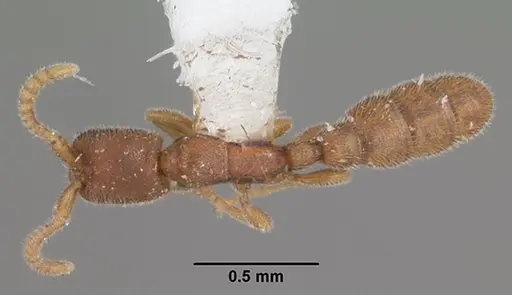
Literature
Loading...Loading products...