

Leptanilla japonica
- Scientific Name
- Leptanilla japonica
- Tribe
- Leptanillini
- Subfamily
- Leptanillinae
- Author
- Baroni Urbani, 1977
- Distribution
- Found in 1 countries
Leptanilla japonica Overview
Leptanilla japonica is an ant species of the genus Leptanilla. It is primarily documented in 1 countries , including Japan. Detailed taxonomic data and occurrence records can be further explored via authoritative databases such as AntWeb or the Global Biodiversity Information Facility (GBIF).
Leptanilla japonica
Leptanilla japonica is one of the smallest ants you can keep, with workers measuring just 1.2mm and queens reaching 1.8mm [1]. These tiny ants are pale yellow to light reddish-yellow in color and belong to the subfamily Leptanillinae, a group of rare subterranean ants found primarily in Asia [2]. Originally described from Honshu Island, Japan, they have since been found in Hong Kong, making them one of the most widespread Leptanilla species [3][2].
What makes L. japonica truly extraordinary is their queen's unique feeding method. The queen cannot eat on her own, she survives entirely by drinking hemolymph (blood fluid) directly from her larvae through specialized duct organs on the 4th abdominal segment [1]. This behavior, called larval hemolymph feeding (LHF), is also performed by workers. The colony produces brood in strict cycles: all larvae develop in unison, and when they mature, the queen feeds heavily on them, becoming physogastric (her abdomen swells dramatically) within days before laying 100-200 eggs [1]. This synchronized breeding is more similar to army ants than typical ants.
Quick Summary
- Difficulty: Expert
- Origin & Habitat: Japan (Honshu Island) with records from Hong Kong. Nests in small hollows in soil in broadleaf forests [4].
- Colony Type: Monogyne (single-queen colonies). Queens are dichthadiiform (ergatoid/wingless) and permanently cannot feed themselves, relying entirely on larval hemolymph [5][6].
- Colony: Monogyne
- Size & Growth:
- Queen: 1.8 mm [1]
- Worker: 1.2 mm [1]
- Colony: 100-200 workers [1][3]
- Growth: Moderate, synchronized brood development means colony grows in distinct pulses rather than continuously
- Development: Unknown, specific development time not documented in research (Brood development is strictly synchronized, all larvae develop together and pupate together. This phasic pattern differs from typical ants.)
- Antkeeping:
- Temperature: Keep at room temperature around 20-24°C. No specific thermal studies exist for this species, but related Leptanilla from Japan suggest moderate temperatures work well. A gentle gradient allows ants to choose their preferred zone.
- Humidity: High humidity required, these are subterranean ants from damp forest soils. Keep nest substrate consistently moist but not waterlogged. Provide a water tube for drinking access.
- Diapause: Likely required. Masuko (1990) notes larvae overwinter in some Leptanilla species, suggesting a winter rest period [7]. Provide 2-3 months at reduced temperatures (10-15°C) during winter.
- Nesting: Very small ants requiring tight chambers. Test tubes work for founding colonies, but established colonies need custom setups with narrow passages scaled to their tiny 1.2mm workers. Naturalistic setups with soil or plaster nests work well, they naturally nest in small soil cavities.
- Behavior: Workers are active hunters that specialize in capturing geophilomorph centipedes (small soil-dwelling centipedes). They forage in groups using trail systems, similar to miniature army ants [1]. They are not aggressive toward humans and cannot sting effectively due to their tiny size. Escape prevention is critical, at 1.2mm, they can squeeze through remarkably small gaps. Colonies exhibit regular nest emigration when local food supplies deplete [1].
- Common Issues: specialized diet makes feeding extremely difficult, they require live geophilomorph centipedes, which are hard to obtain and culture, tiny size means escape prevention must be excellent, even standard test tube cotton can have gaps, queen cannot feed herself, colony will fail if all larvae die, as she depends entirely on larval hemolymph, synchronized brood development means any disruption to larvae can collapse the colony's reproductive cycle, subterranean lifestyle makes them sensitive to drying, humidity must be consistently maintained, wild-caught colonies are extremely rare and may have been damaged during collection
The Unique Larval Hemolymph Feeding System
This is the most unusual aspect of L. japonica biology. The queen cannot eat normal food, she has never been observed feeding on prey even when it was provided [1]. Instead, she survives by drinking hemolymph directly from her larvae through specialized duct organs called 'larval hemolymph taps' located on the 4th abdominal segment [1]. When larvae mature, the queen performs extensive LHF, stroking and nipping the larvae before attaching her mouthparts to this specific spot. She uses her pharyngeal pump to lap up hemolymph, sometimes pressing the larva with her legs to increase flow [1]. This feeding triggers her physogastry (abdomen swelling), after which she lays 100-200 eggs within days [1]. Workers also perform LHF, making larvae a central 'caste' in the colony, they function as both brood and a food source for adults [1]. For keepers, this means: you MUST maintain healthy larvae at all times for the queen to survive.
Feeding and Diet - The Centipede Challenge
Leptanilla japonica are specialized predators of geophilomorph centipedes (small soil-dwelling centipedes, typically 1-2cm) [1][9]. Workers hunt in groups using trail systems, attacking prey cooperatively [1]. In laboratory settings, they readily accept geophilomorph centipedes but reject other prey like Strigamia centipedes [10]. This specialized diet is the biggest challenge for keepers. You will need to culture or regularly obtain small live centipedes, this is far more difficult than feeding typical ants. Workers are approximately 1.2mm vs 4-5mm in related Amblyopone species, and with only 100-200 workers in a colony, their hunting success is limited [1]. Unlike most ants, they lack oral trophallaxis (food sharing mouth-to-mouth), so all feeding happens at the prey location or through LHF [1]. Sugar sources are NOT accepted, these are strict carnivores.
Cyclical Brood Production
Unlike most ants that produce brood continuously, L. japonica has strictly synchronized (phasic) brood development [1]. All larvae develop together through their entire larval and pupal stages, then emerge as workers in a single cohort [1]. This 'army ant syndrome' means the colony has distinct growth pulses rather than continuous development [11]. After workers emerge, the cycle begins again. Colony 83-14 studied by Masuko contained approximately 130 workers and 100 larvae, with all larvae at the same developmental stage [1]. This system allows the queen to time her egg-laying precisely when larvae mature, maximizing the LHF opportunity [1]. For keepers: expect periods of no visible brood, then sudden appearance of many larvae that all develop together.
Temperature and Seasonal Care
As a Japanese species from broadleaf forests, L. japonica likely requires a winter dormancy period. Masuko (1990) noted that larvae of some Leptanilla species overwinter [7], suggesting diapause is part of their natural cycle. Keep colonies at moderate temperatures (20-24°C) during the active season, then provide 2-3 months at 10-15°C in winter. These are subterranean ants, so they prefer stable, cool, humid conditions rather than warmth. Avoid temperature extremes. A small heating cable on one side of the nest can create a gradient, but ensure the rest stays cool.
Housing and Escape Prevention
At just 1.2mm worker length, L. japonica is among the smallest ants in captivity. Escape prevention is absolutely critical, they can squeeze through gaps you wouldn't believe. Use tight-fitting test tube stoppers, fine mesh on any ventilation, and consider coating edges with fluon. Standard cotton in test tubes may not be sufficient, use tightly wound cotton or rubber septa. For established colonies, custom acrylic nests or plaster nests with chambers scaled to their tiny size work best. They naturally nest in small soil cavities, so a naturalistic setup with moist substrate can encourage natural behavior. Keep the nest dark and undisturbed, these are shy, subterranean ants.
Colony Dynamics and Behavior
L. japonica colonies show army ant-like behaviors including group foraging and regular nest emigration [1][2]. Workers use trail systems to hunt centipedes cooperatively, then carry prey back to the nest [1]. When food becomes locally depleted, the entire colony relocates, this nomadism is rare in non-army ants [1]. Colonies are monogynous with a single ergatoid (wingless) queen [8][5]. Workers cannot produce eggs due to absent ovaries [1], so reproduction depends entirely on the queen. The colony's small size (100-200 workers) and specialized lifestyle make them vulnerable to disturbance. Handle minimally and keep in quiet, dark locations.
References

This caresheet is licensed under CC BY-SA 4.0 .
CASENT0902775
View on AntWeb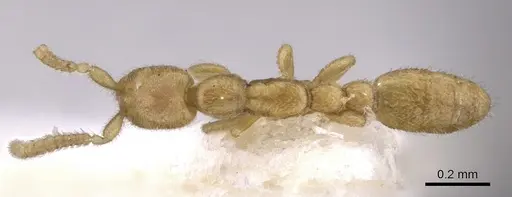
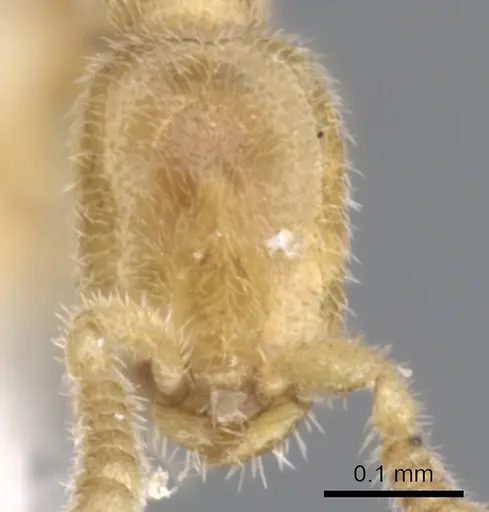
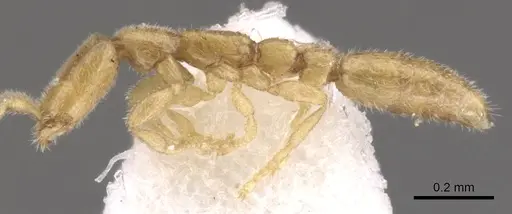
Literature
Loading...Loading products...