

Lepisiota omanensis
- Scientific Name
- Lepisiota omanensis
- Tribe
- Plagiolepidini
- Subfamily
- Formicinae
- Author
- Sharaf & Monks, 2016
- Distribution
- Found in 2 countries
Lepisiota omanensis Overview
Lepisiota omanensis is an ant species of the genus Lepisiota. It is primarily documented in 2 countries , including United Arab Emirates, Oman. Detailed taxonomic data and occurrence records can be further explored via authoritative databases such as AntWeb or the Global Biodiversity Information Facility (GBIF).
Lepisiota omanensis
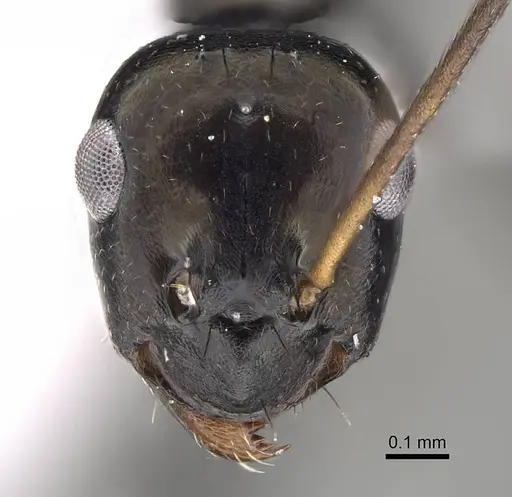
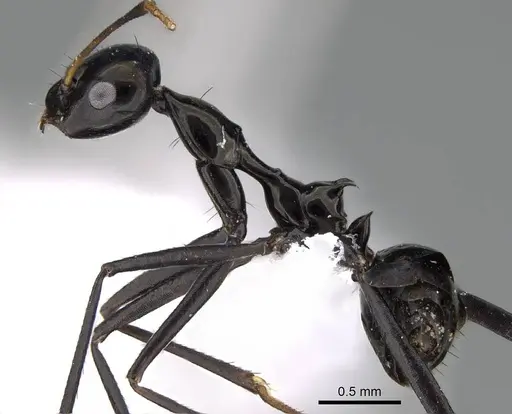
Lepisiota omanensis is a small, striking ant species native to the Hajar Mountains of Oman and the United Arab Emirates. Workers measure 2.25-3.50mm and are uniformly black with purple reflections on the face and gaster, while their antennae and mandibles are yellow-brown. The most distinctive feature is their exceptionally long, acute, and strongly curved propodeal spines, these spines appear much higher than the petiolar spines when viewed from the side, making this species easy to identify among Arabian Lepisiota species. Their body surface is smooth and shining with very little pubescence.
This is a recently described species (2016) known from only a handful of specimens, making it one of the rarest ants in the Arabian Peninsula. Found in rocky mountain habitats with semi-permanent pools, they appear to associate with specific plants and have been observed carrying leaf material, suggesting they may be generalist foragers. Their rarity and limited distribution make them an unusual choice for antkeeping.
Quick Summary
- Difficulty: Hard
- Origin & Habitat: Eastern Hajar Mountains of Oman and UAE, found at elevations 305-619m. Habitat features rocky areas with boulders surrounding semi-permanent pools near dams. Associated with plants including Ochradenus arabicus, Aerva javanica, and Tephrosia apollinea. Nests typically found near the base of Lycium shawii plants [1][2][3].
- Colony Type: Colony structure is unconfirmed. This is a newly described species with limited specimens (approximately 5 known). No data on queen number or colony size in the wild.
- Size & Growth:
- Queen: Unknown, no queen has been described in scientific literature [1].
- Worker: 2.25-3.50mm total length [1].
- Colony: Unknown, only approximately 5 specimens have been collected [2].
- Growth: Unknown, no colony development data exists.
- Development: Unconfirmed, no development data exists for this species. (Based on related Lepisiota species from similar habitats, expect development of several months. More data needed.)
- Antkeeping:
- Temperature: Likely warm-adapted given the Arabian origin. Based on similar Lepisiota species from hot climates, aim for 24-30°C with a gradient. Monitor colony activity and adjust accordingly.
- Humidity: Likely prefers moderate to dry conditions typical of rocky mountain habitats. Provide a moisture gradient with a dry area and a slightly damp section. Avoid overly humid conditions.
- Diapause: Unknown, no seasonal data exists. Based on the hot origin, likely minimal or no winter dormancy. Consider a slight cooling period (15-18°C) during winter months rather than true hibernation.
- Nesting: In the wild, nests are found near plant bases in rocky areas. Provide a naturalistic setup with a mix of干燥 and damp substrate areas. Y-tong or plaster nests with narrow chambers work well. Ensure some vertical space for their long spines.
- Behavior: Workers are small and likely fast-moving. Observed carrying leaf material suggests generalist foraging behavior. Escape prevention is critical due to their small size, use fine mesh and tight-fitting barriers. Temperament is unknown but likely similar to other Lepisiota, moderately defensive. Their long spines may serve as a defense mechanism.
- Common Issues: very limited availability, only known from a handful of wild specimens, no established captive breeding, this species is not commercially available, escape prevention is critical due to tiny worker size, no development data makes timing predictions impossible, unknown colony structure complicates care approach
Discovery and Rarity
Lepisiota omanensis was only described in 2016 by Sharaf and Monks, making it one of the newest ant species discoveries in the Arabian Peninsula. The species is remarkably rare, only about 5 specimens have ever been collected, all from specific locations in the Hajar Mountains of Oman and UAE. The type locality is Jebel Qahwan in eastern Oman, at 305m elevation. Additional specimens were found near the base of Jebel Akhdar and at Ain Al Waal at the foot of Jebel Hafeet in the UAE. This rarity makes the species particularly unusual for antkeeping, as virtually no captive colonies exist. [1][2]
Identification and Appearance
This species is a member of the Lepisiota gracilicornis group and can be immediately distinguished from all other Arabian and Afrotropical Lepisiota species by its exceptionally long, acute, and strongly curved propodeal spines. In profile, these spines appear much higher than the petiolar spines, a key identification feature. Workers are uniformly black with purple reflections on the face and gaster, while their antennae and mandibles are yellow-brown. The body is smooth and shining with very little pubescence, unlike the similar L. spinisquama which is brown, slightly shining, and has abundant pubescence. Workers measure 2.25-3.50mm total length. [1][2]
Natural Habitat
L. omanensis inhabits the Eastern Hajar Mountains, an area of substantial floral and faunal biodiversity. The habitat is characterized by rocky areas with boulders surrounding semi-permanent pools near dams, water that is also used by the endangered Arabian tahr. The species shows association with specific plants, particularly Ochradenus arabicus, though Aerva javanica and Tephrosia apollinea are also present. Nests have been observed about one metre from the base of Lycium shawii plants. Workers have been collected from sifted litter in areas cultivated with roses, suggesting they can adapt to modified habitats. [1][3]
Feeding Observations
In the wild, workers have been observed carrying leaf material, suggesting they are generalist foragers that collect plant matter. This differs from some Lepisiota species that are primarily predatory or honeydew-feeding. Based on this observation and related species, they likely accept a variety of foods including small insects, honeydew, and plant materials. In captivity, offer a varied diet including small live prey (fruit flies, pinhead crickets), sugar water or honey, and observe what they accept. Their small size means prey should be appropriately sized. [1]
Temperature and Care Considerations
As a species from the hot Arabian Peninsula, L. omanensis likely tolerates warm conditions well. Based on similar Lepisiota species from hot climates, aim for temperatures in the 24-30°C range, providing a gradient so ants can self-regulate. The rocky mountain habitat suggests they prefer drier conditions with some moisture available, provide a moisture gradient with both dry and slightly damp areas in the nest. Since this species has never been kept in captivity before, start with conditions matching its natural habitat and observe colony response. Watch for signs of stress (workers clustering, avoiding certain areas) and adjust accordingly.
Challenges for Antkeepers
This species presents significant challenges for antkeepers. First, it is extremely rare in the wild and not commercially available, no established captive breeding exists. Second, almost no biological data exists: we don't know colony structure, founding behavior, development timeline, or specific care requirements. Third, their very small size (under 3.5mm) makes escape prevention critical. For these reasons, L. omanensis is recommended only for experienced antkeepers willing to experiment and document their findings. If you obtain specimens, careful documentation of behavior and care success would contribute valuable knowledge to the antkeeping community. [2]
Frequently Asked Questions
Is Lepisiota omanensis available for purchase?
No. This is one of the rarest ant species in the Arabian Peninsula, known from only about 5 specimens ever collected. It is not commercially available and should not be sought after in the wild given its protected status and extremely limited distribution.
How long does it take for Lepisiota omanensis to develop from egg to worker?
This is unknown. No development data exists for this species. Based on related Lepisiota species from similar hot climates, expect several months (likely 2-4 months at optimal temperature), but this is only an estimate.
What do Lepisiota omanensis ants eat?
In the wild, workers have been observed carrying leaf material, suggesting generalist foraging. They likely accept small insects, honeydew, and plant materials. In captivity, offer small live prey (fruit flies, springtails), sugar water or honey, and observe their preferences.
What temperature should I keep Lepisiota omanensis at?
Based on their Arabian origin, aim for 24-30°C with a temperature gradient. Start in the mid-to-high 20s and observe colony activity. If workers cluster consistently in warmer areas, increase temperature slightly, if they avoid heated areas, reduce temperature.
Are Lepisiota omanensis good for beginners?
No. This is a newly described species (2016) with virtually no captive care data. It is extremely rare, not commercially available, and requires experimental care approaches. This species is recommended only for expert antkeepers willing to document their findings.
Do Lepisiota omanensis need hibernation?
Unknown. Based on their hot Arabian origin, they likely do not require true hibernation. A slight cooling period during winter months (15-18°C) may be appropriate, but this is speculative.
How big do Lepisiota omanensis colonies get?
Unknown. Only about 5 specimens have ever been collected, so colony size in the wild is unrecorded. Expect moderate-sized colonies based on related species, but this is an estimate.
What type of nest is best for Lepisiota omanensis?
Based on their natural habitat (rocky areas near plants), a naturalistic setup with a mix of substrate conditions works well. Y-tong or plaster nests with appropriately scaled chambers for their small size (under 3.5mm) are suitable. Provide both dry and slightly damp areas.
Can I keep multiple Lepisiota omanensis queens together?
Unknown. No data exists on colony structure or queen behavior for this species. Do not attempt combining unrelated queens without evidence they tolerate this.
Why is Lepisiota omanensis so hard to find?
This species is endemic to a very limited range in the Hajar Mountains of Oman and UAE, and is exceptionally rare, only about 5 specimens have ever been collected since its description in 2016. It is not a species that can be sustainably collected for the antkeeping hobby.
What makes Lepisiota omanensis different from other Lepisiota?
Their most distinctive feature is the exceptionally long, acute, and strongly curved propodeal spines that appear much higher than the petiolar spines in profile. They are also uniformly black with purple reflections, and are one of the rarest ant species described in recent years.
References

This caresheet is licensed under CC BY-SA 4.0 .
CASENT0922278
View on AntWeb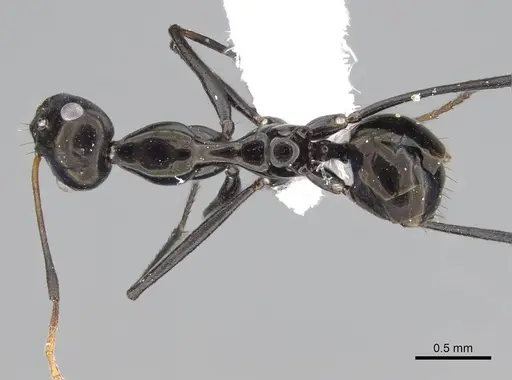
Literature
Loading...Loading products...