

Lepisiota lunaris
- Scientific Name
- Lepisiota lunaris
- Tribe
- Plagiolepidini
- Subfamily
- Formicinae
- Author
- Emery, 1893
- Distribution
- Found in 1 countries
Lepisiota lunaris Overview
Lepisiota lunaris is an ant species of the genus Lepisiota. It is primarily documented in 1 countries , including India. Detailed taxonomic data and occurrence records can be further explored via authoritative databases such as AntWeb or the Global Biodiversity Information Facility (GBIF).
Lepisiota lunaris
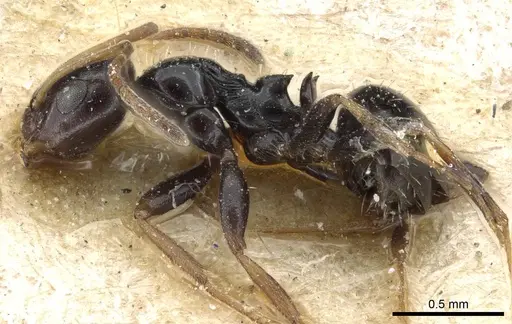
Lepisiota lunaris is a small ant with a sleek black body and light brown antennae, mandibles, and feet [1]. Workers have distinctive spines: a pair of straight upward-pointing spines on the petiole (the narrow waist segment) and thick blunt spines on the propodeum (the segment just behind the thorax) [1][2]. You can tell them apart from their hairy cousin Lepisiota mayri because L. lunaris has sparse erect hairs across the body, while L. mayri looks covered in fur [1][3].
These ants live across the Himalayan region and South Asia, including India, Nepal, Pakistan, and Sri Lanka [1][2]. They are mountain specialists in Nepal, where collectors have found them at elevations from 1,690 meters up to 2,900 meters [4][5]. They nest in dry soil and forage in both forests and open areas, readily visiting honey baits placed by researchers [1][3].
Quick Summary
- Difficulty: Medium
- Origin & Habitat: Himalayan region and South Asia (India, Nepal, Pakistan, Sri Lanka), found in dry soil at mountain elevations of 1,690-2,900m and in forested and non-forested lowland areas [4][5][1]
- Colony Type: Unknown, colony structure has not been documented for this species
- Size & Growth:
- Queen: Unknown, not documented in available research
- Worker: Small, head length 0.56-0.63mm, width 0.51-0.57mm [1]
- Colony: Unknown
- Growth: Unknown, estimated moderate
- Development: Unknown, estimated 6-10 weeks based on similar small Formicinae, but this is speculative (Development time likely depends on temperature, no direct studies available)
- Antkeeping:
- Temperature: Likely prefers cooler conditions given their mountain habitat, start around 20-24°C and observe colony response[5]
- Humidity: Moderate, they nest in dry soil but require some moisture. Keep nest material damp but not waterlogged [1]
- Diapause: Likely yes, or at least reduced winter activity, given their Himalayan distribution at high elevations[5]
- Nesting: Dry soil nests, use Y-tong, plaster, or naturalistic setups with well-draining sandy soil [1]
- Behavior: Generalist foragers that visit sugar sources, small size means excellent escape prevention is essential [1][3]
- Common Issues: tiny workers can squeeze through the smallest gaps in mesh or lids., high elevation populations may suffer in hot conditions above 25°C., overly wet nests can cause problems since they naturally inhabit dry soil., slow growth rates may test beginner patience if development takes longer than expected.
Identification and Similar Species
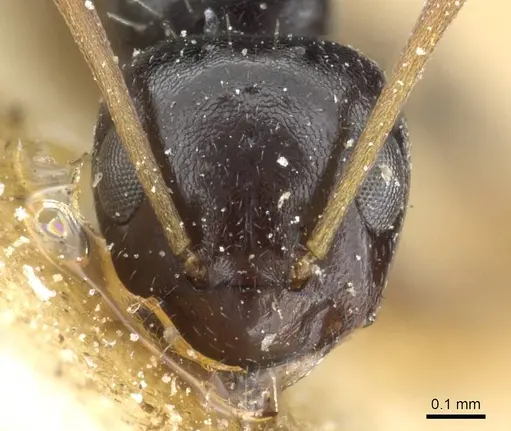
Lepisiota lunaris belongs to a group of small black ants that can confuse beginners. The key is to look at the hair density and body texture. Workers have a dull, microreticulate (finely netted) surface on the head and thorax, with a polished shiny abdomen [1]. The petiole bears a pair of straight spines pointing upward, and the propodeum has thick blunt spines that diverge toward the rear [1][2].
You can separate them from Lepisiota mayri by looking at the hairs. L. lunaris has sparse erect hairs on the body, while L. mayri is covered with abundant erect hairs and looks very hairy overall [1][3]. They also differ from L. annandalei by having a dull microreticulate body surface and the specific spine arrangement on the petiole [1].
Workers have three small simple eyes (ocelli) on the top of the head, and their antennae scapes extend past the back of the head by about one-third of their length [1]. The head is slightly longer than wide, with rounded corners [1].
Nest Setup and Substrate
In nature, these ants nest in dry soil, often in mountainous areas with good drainage [1][3]. In captivity, replicate these conditions by using well-draining nest materials.
Y-tong (autoclaved aerated concrete) nests work well because they hold moisture without becoming waterlogged. Plaster nests are also suitable if you allow them to dry slightly between waterings. Naturalistic setups with a mix of sand and clay soil can encourage natural digging behaviors [1].
Provide moderate humidity. The nest material should feel damp to the touch but not soggy. Because they come from dry soil habitats, they are prone to drowning in overly wet conditions [1]. Use a water tower or hydration chamber that allows gradual moisture release rather than direct water pooling.
Ventilation is important. While they need humidity, stagnant air promotes mold. Ensure your outworld has some airflow, and avoid completely sealed containers.
Feeding and Diet
Research shows these ants readily accept honey baits in the field, indicating a strong preference for sugar sources [1][3]. In captivity, offer sugar water, honey diluted with water, or ant nectar.
They are likely generalist predators and scavengers like other Lepisiota species. Provide small live or dead insects such as fruit flies, springtails, or tiny pieces of mealworms. Prey should be appropriately sized for their small workers.
Feed protein twice weekly and keep sugar water available constantly. Remove uneaten food within 24-48 hours to prevent mold growth in the nest. Because they are small, they do not need large prey items, a single fruit fly can feed several workers.
Temperature and Seasonal Care
These ants present a temperature challenge because they naturally occur at high elevations. Specimens have been collected between 1,690 meters and 2,900 meters in Nepal, where temperatures are cooler than lowland tropical regions [4][5].
Start with temperatures around 20-24°C. You can create a gradient by placing a heating cable on one side of the nest, but avoid overheating. If workers cluster away from the heat source, the temperature is too high. If they pile on the warm side, they need more warmth.
Given their mountain distribution, they likely experience seasonal changes and may require a winter rest period (diapause)[5]. If your colony slows down or stops laying eggs in winter, reduce temperatures to 15-18°C for 2-3 months and decrease feeding. Resume normal temperatures in spring.
Avoid keeping them above 26-27°C consistently, as high elevation species often suffer in tropical heat.
Behavior and Temperament
Lepisiota lunaris appears to be a generalist forager that exploits both natural food sources and human-provided baits [1][3]. They are not known for aggressive behavior like some larger ants, but their small size presents its own challenges.
Because workers are tiny, they can squeeze through gaps that larger ants cannot. You must use excellent escape prevention. Fluon (PTFE) barriers on the outworld walls, tight-fitting lids with fine mesh ventilation, and careful sealing of all connections are essential [1].
Their small size also means they cannot handle large prey. They likely recruit nestmates to food sources using chemical trails, though specific recruitment behaviors have not been documented for this species. They are active foragers and will explore their outworld readily.
Frequently Asked Questions
Can I keep Lepisiota lunaris in a test tube?
Yes, a standard test tube setup works well for founding colonies. Use a small test tube (16mm diameter or smaller) with a water reservoir blocked with cotton. Because they prefer drier conditions, do not use an overly large water reservoir, and ensure the tube has some ventilation to prevent mold.
How long until first workers for Lepisiota lunaris?
The egg-to-worker timeline is unknown for this species. Based on similar small Formicinae ants, expect roughly 6-10 weeks at 24-25°C, but this is an estimate. Development may take longer at cooler temperatures consistent with their mountain habitat.
Do Lepisiota lunaris need hibernation?
They likely need a winter rest period (diapause) or at least reduced activity in winter. They naturally live at high elevations up to 2,900 meters where winters are cold [4][5]. If your colony slows down in winter, cool them to 15-18°C for 2-3 months.
What do Lepisiota lunaris eat?
They readily accept sugar sources like honey or sugar water, as shown by their attraction to honey baits in the field [1][3]. They also need protein from small insects such as fruit flies, springtails, or tiny pieces of mealworms.
How do I identify Lepisiota lunaris?
Look for a small black ant with light brown antennae and feet, sparse body hairs (unlike the very hairy L. mayri), and distinctive upward-pointing spines on the petiole [1][3]. The head and thorax have a dull, finely netted texture while the abdomen is shiny [1].
Are Lepisiota lunaris good for beginners?
They present medium difficulty. While they are not aggressive and accept a range of foods, their small size requires excellent escape prevention, and their high-elevation origin means they may need cooler temperatures and seasonal care that beginners might find challenging.
How big do Lepisiota lunaris colonies get?
Maximum colony size is unknown for this species. Based on related Lepisiota species, they may reach moderate sizes of several hundred to a few thousand workers, but this is speculative.
Can I keep multiple Lepisiota lunaris queens together?
Not recommended. While some Lepisiota species are polygynous (multiple queens), the colony structure of L. lunaris is unknown. Combining unrelated queens risks fighting and death. Only attempt if you observe natural multi-queen colonies in the wild.
Why are my Lepisiota lunaris dying?
Common causes include overheating (they come from cool mountain elevations), drowning in overly wet nests (they prefer dry soil), or escape attempts leading to desiccation. Check your temperature stays below 25°C and ensure the nest has good drainage.
References

This caresheet is licensed under CC BY-SA 4.0 .
CASENT0905157
View on AntWeb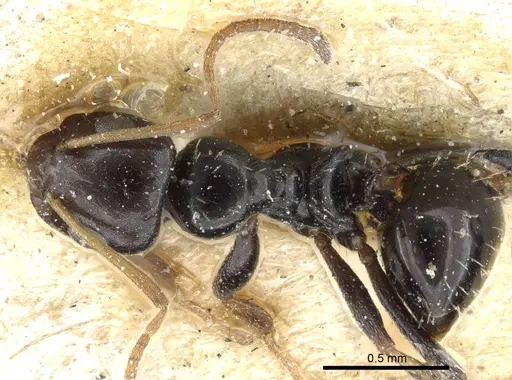
Literature
Loading...Loading products...