

Kartidris nyos
- Scientific Name
- Kartidris nyos
- Tribe
- Crematogastrini
- Subfamily
- Myrmicinae
- Author
- Bolton, 1991
- Distribution
- Found in 1 countries
Kartidris nyos Overview
Kartidris nyos is an ant species of the genus Kartidris. It is primarily documented in 1 countries , including India. Detailed taxonomic data and occurrence records can be further explored via authoritative databases such as AntWeb or the Global Biodiversity Information Facility (GBIF).
Kartidris nyos
Kartidris nyos is a small Myrmicinae ant native to the forests of India and southern China. Workers measure 4.2-4.6mm with a distinctive light yellowish-brown coloration and notably dense, erect pilosity (short hairs) covering their bodies. The species was formally described by Bolton in 1991 based on specimens collected from the Khasi Hills of Meghalaya, India. These ants are habitat specialists restricted to primary forest ecosystems at higher elevations (around 1484m), and they have never been found in secondary forest or rubber plantations [1]. This makes them one of the more specialized ants in the Kartidris genus, with specific ecological requirements that differ from many common ant species.
Quick Summary
- Difficulty: Medium
- Origin & Habitat: Kartidris nyos originates from the primary forests of northeastern India (Meghalaya, Sikkim, West Bengal) and southern China (Yunnan, Hengduan Mountains). They are true forest specialists found at elevations around 1484 meters, living in pristine primary forest rather than disturbed habitats [1][2].
- Colony Type: Colony structure is unconfirmed. The species has not been studied in detail regarding queen number or colony organization.
- Size & Growth:
- Queen: Unknown, no queen specimens have been described in scientific literature
- Worker: 4.2-4.6mm
- Colony: Unknown, no colony size data available
- Growth: Unknown, no development data exists for this species
- Development: Unknown, no direct measurements exist. Based on typical Myrmicinae patterns and their high-altitude forest habitat, estimates suggest 8-12 weeks at optimal temperature, but this is speculative. (No development studies exist for this species. Related Kartidris species and typical Myrmicinae development patterns suggest a moderate growth rate, but this cannot be confirmed.)
- Antkeeping:
- Temperature: Based on their high-altitude forest habitat (1484m), they likely prefer cooler temperatures than typical tropical ants. Start around 18-22°C and observe colony activity. Avoid overheating, they come from temperate mountain forests, not tropical lowlands.
- Humidity: As forest-floor ants from humid primary forest, they need moderate to high humidity. Keep the nest substrate consistently moist but not waterlogged, with some drier areas available for regulation.
- Diapause: Likely yes, based on their distribution in temperate-to-subtropical mountain forests of India and China, they probably require a winter rest period. However, specific diapause requirements have not been documented.
- Nesting: No direct nesting observations exist. As typical Myrmicinae, they likely nest in soil or rotting wood in forest habitats. In captivity, a test tube setup with moist substrate or a Y-tong/plaster nest works well for their size.
- Behavior: Behavior is unstudied. Based on their Myrmicinae classification and forest habitat, they are likely generalist foragers. Workers are small (4-4.6mm) so escape prevention should be adequate, though they are not extremely tiny. They have not been documented as aggressive or particularly defensive. The dense pilosity may serve as a defensive adaptation.
- Common Issues: habitat specialist stress, wild-caught colonies may struggle in captivity if their specific forest conditions cannot be replicated, escape prevention is still important, while not tiny, their small size means they can slip through loose connections, no available care benchmarks, without species-specific data, keepers must adjust conditions based on colony response, humidity management is critical, forest specialists often fail in dry captive environments, limited availability, this species is rarely available in the antkeeping hobby
Natural History and Distribution
Kartidris nyos is a rare ant species known only from primary forest habitats in northeastern India and southern China. In India, they have been recorded from Meghalaya (including the Khasi Hills where the type specimens were collected), Sikkim, and West Bengal [3]. In China, they are found in Yunnan province, particularly in the Xishuangbanna region and the Hengduan Mountains [4]. The species appears to be a true habitat specialist, they occupy only primary forest environments and have never been recorded from secondary forest or human-modified landscapes like rubber plantations [1]. This specialization makes them ecologically sensitive and potentially difficult to maintain in captivity if their specific habitat requirements cannot be met. They have been collected at altitudes around 1484 meters in the West Khasi Hills and are active throughout all seasons [2].
Identification and Morphology
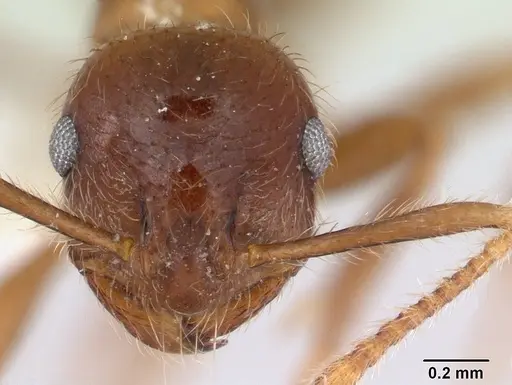
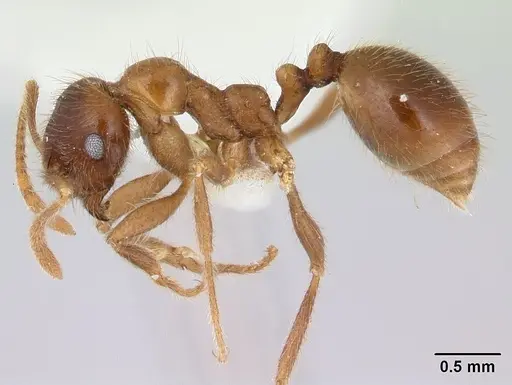
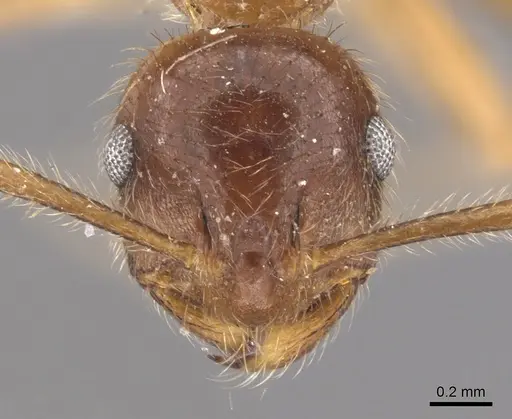
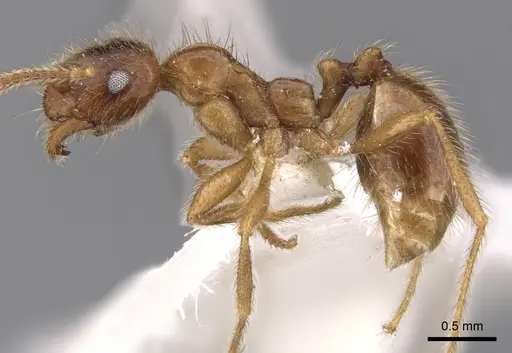
Workers of Kartidris nyos are small ants measuring 4.2-4.6mm in total length. They have a light yellowish-brown coloration that helps distinguish them from related species. The most distinctive morphological feature is the dense pilosity, short erect to suberect hairs covering all dorsal surfaces of the body, including the head, alitrunk (middle body section), and gaster (abdomen). The scapes (antennal segments) and tibiae (leg segments) also bear numerous suberect to subdecumbent hairs. The eyes are relatively small, with a maximum diameter of 0.20-0.22mm and 10-11 ommatidia (individual eye lenses) in the longest row. The mandibles are finely longitudinally rugulose (have fine ridges). The median portion of the clypeus (face plate) is conspicuously biconvex without longitudinal carinae. These morphological details are important for distinguishing K. nyos from related Kartidris species in the region.
Housing and Nesting
Since no specific nesting observations exist for this species, care recommendations must be based on inference from their forest habitat and Myrmicinae biology. They likely nest in soil or rotting wood on the forest floor in nature. For captivity, a test tube setup with a moist cotton reservoir works well as a founding setup. Once established, a Y-tong (acrylic) nest or plaster nest with good humidity retention is appropriate. The key is maintaining forest-like conditions, moderate humidity, stable temperatures on the cooler side (18-22°C), and minimal disturbance. Their small size (4-4.6mm) means they can escape through small gaps, so ensure all connections are secure. Avoid dry, room-temperature setups that work for desert species, these are forest ants that need moisture and cooler conditions.
Feeding and Diet
Diet preferences have not been documented for Kartidris nyos. As Myrmicinae ants, they likely have a generalist diet similar to most ants in this subfamily, accepting both protein sources (small insects) and sugar sources (honey, sugar water). Based on typical Myrmicinae behavior, they probably forage for small arthropods and tend aphids for honeydew. In captivity, offer a varied diet: small live or frozen insects (fruit flies, pinhead crickets, mealworms) as protein, and sugar water or honey as carbohydrates. Start with small offerings and observe what the colony accepts. Avoid overfeeding, excess food can mold and cause problems in humid setups.
Temperature and Seasonal Care
This is one of the most important aspects of keeping Kartidris nyos successfully. Their natural habitat in high-altitude primary forests of India and China suggests they prefer cooler temperatures than typical tropical ants. Aim for 18-22°C in the nest area, this is cooler than most ant species and reflects their mountain forest origin. A heating cable on one side of the nest can create a temperature gradient, allowing the ants to regulate their own temperature by moving between warmer and cooler areas. Regarding winter rest, their distribution in temperate mountain regions strongly suggests they need a diapause (winter rest) period. Reduce temperatures to around 10-15°C for 2-3 months during winter, mimicking their natural seasonal cycle. This is critical for long-term colony health and reproduction.
Challenges and Considerations
Kartidris nyos is not a beginner species, primarily because so little is known about their specific care requirements. The biggest challenge is the lack of species-specific data, keepers must adjust conditions based on observation and inference from related species. They are habitat specialists restricted to primary forest [1], which means wild-caught colonies may be particularly sensitive to captive conditions. Expect a learning curve as you figure out what works for your colony. Additionally, this species is rarely available in the antkeeping hobby, so acquiring a colony may be difficult. If you obtain them, be prepared to experiment with temperature, humidity, and feeding to find the optimal conditions. Document your observations carefully, this species needs dedicated keepers who can help build knowledge for others.
Frequently Asked Questions
How long does it take for Kartidris nyos to develop from egg to worker?
This is unknown, no development studies exist for this species. Based on typical Myrmicinae patterns and their cooler habitat, estimate 8-12 weeks at optimal temperature (around 20°C), but this is a rough guess.
What temperature do Kartidris nyos ants need?
Based on their high-altitude forest habitat, they prefer cooler temperatures than most ants, around 18-22°C. Avoid overheating. A gentle temperature gradient allowing them to move between warmer and cooler areas is ideal.
Do Kartidris nyos ants need hibernation?
Likely yes, their distribution in temperate mountain forests of India and China strongly suggests they need a winter rest period. Reduce temperatures to 10-15°C for 2-3 months during winter.
Are Kartidris nyos good for beginners?
No, this is not a beginner species. There is almost no species-specific care information available, and they are habitat specialists that may be sensitive to captive conditions. They are also rarely available in the hobby.
How big do Kartidris nyos colonies get?
Unknown, no colony size data exists for this species. Related Kartidris species typically have moderate-sized colonies, but K. nyos specifically has not been studied.
Do Kartidris nyos ants sting?
Unknown, Myrmicinae ants have stingers, but they are often too small to penetrate human skin. No documented stings or pain reports exist for this species.
What do Kartidris nyos ants eat?
Undocumented, they are likely generalist foragers like most Myrmicinae. Offer small insects (protein) and sugar sources (honey, sugar water), then observe what they accept.
Can I keep multiple Kartidris nyos queens together?
Unknown, colony structure has not been studied for this species. Do not attempt combining unrelated queens without documented evidence that they can form multi-queen colonies.
Why can't I find Kartidris nyos for sale?
This species is rarely available in the antkeeping hobby. They are habitat specialists with specific requirements, and their limited distribution in primary forests makes them difficult to collect and culture. They remain a rare species in cultivation.
References

This caresheet is licensed under CC BY-SA 4.0 .
CASENT0178538
View on AntWeb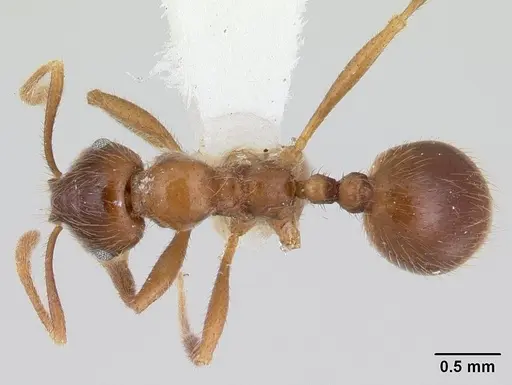
CASENT0901255
View on AntWeb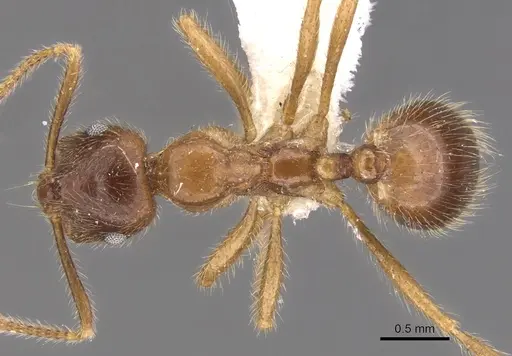
Literature
Loading...Loading products...