

Iridomyrmex anteroinclinus
- Scientific Name
- Iridomyrmex anteroinclinus
- Tribe
- Leptomyrmecini
- Subfamily
- Dolichoderinae
- Author
- Shattuck, 1993
- Distribution
- Found in 1 countries
Iridomyrmex anteroinclinus Overview
Iridomyrmex anteroinclinus is an ant species of the genus Iridomyrmex. It is primarily documented in 1 countries , including Australia. Detailed taxonomic data and occurrence records can be further explored via authoritative databases such as AntWeb or the Global Biodiversity Information Facility (GBIF).
Iridomyrmex anteroinclinus
Iridomyrmex anteroinclinus is a small to medium-sized ant species native to northern Australia. Workers measure 1.22-1.38mm in head width with a distinctive appearance featuring a brown head, gaster, and front legs, contrasted with bright orange mandibles, most of the mesosoma, and middle-to-hind legs. The pronotum shows a cloudy brown-orange coloration. This species is identified by its markedly flattened petiolar node with a reduced anterior face and short, concave frontal carinae. It was described by Shattuck in 1993 and is restricted to the northern Kimberley region of far northern Western Australia. Like many Australian Iridomyrmex species, they are likely generalist foragers, though their exact biology remains unstudied.
Quick Summary
- Difficulty: Unknown, biology unstudied
- Origin & Habitat: Restricted to the northern Kimberley region of far northern Western Australia [1]. As an Australian arid-zone species, they likely inhabit hot, dry to semi-arid environments with access to ground-level moisture sources.
- Colony Type: Colony structure is unconfirmed. Most Iridomyrmex species are monogyne (single-queen) colonies, though some can be polygynous. No data exists for this specific species.
- Size & Growth:
- Queen: Undescribed, no queen measurements available
- Worker: 1.22-1.38mm head width [2]
- Colony: Unknown, no colony size data exists
- Growth: Unknown, no development data available
- Development: Unknown, no development data exists for this species. Based on typical Iridomyrmex patterns, expect 6-10 weeks at warm temperatures, but this is an estimate. (Development timeline has not been studied. Estimates based on genus-level patterns for related Australian Iridomyrmex species.)
- Antkeeping:
- Temperature: Likely tolerates warm to hot conditions given their arid Australian distribution. Start around 24-30°C and observe colony activity. Provide a temperature gradient allowing workers to self-regulate.
- Humidity: Likely prefers dry to moderate conditions typical of arid Australia. Keep nest substrate relatively dry with a small water chamber for humidity control. Avoid overly damp conditions.
- Diapause: Unknown, no seasonal data exists. Many Australian ants reduce activity during dry seasons rather than true cold hibernation. Monitor for natural slow periods.
- Nesting: Nesting preferences are unconfirmed. Most Iridomyrmex nest in soil, under stones, or in shallow ground cavities. A test tube setup with a dry to moderately moist cotton end works as a starting point. Y-tong or acrylic nests with minimal moisture are likely appropriate.
- Behavior: Behavior is unstudied, but Iridomyrmex species are typically active foragers, moderately aggressive when defending the nest, and known for their rapid movement. They likely forage for nectar, honeydew, and small insects. Escape prevention should be moderate, workers are small enough to escape through small gaps but not extremely tiny. Use standard barrier methods.
- Common Issues: biology completely unknown, keepers must experiment with care conditions, no development data means slow growth or colony failure may be difficult to diagnose, likely sensitive to over-moisture given arid origin, avoid damp nest conditions, no hibernation data available, unclear how to handle seasonal slow periods, limited availability, this is not a common species in the antkeeping hobby
Species Identification and Appearance
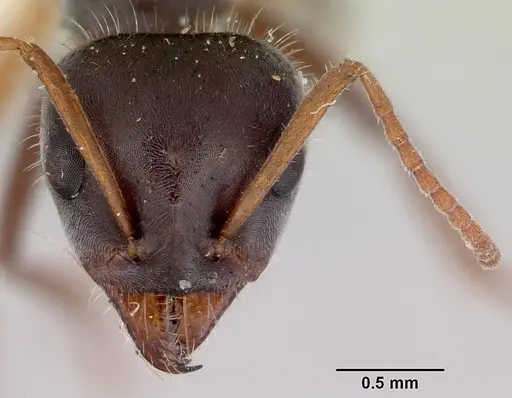
Iridomyrmex anteroinclinus is a distinctive small ant with a bicolored appearance. The head capsule and gaster are brown, as are the coxae and front femora and tibiae. In contrast, most of the mandibles, part of the clypeus, the middle and hind legs (except the coxae), and most of the mesosoma are bright orange. The pronotum shows a cloudy brown-orange coloration. Workers measure 1.22-1.38mm in head width with a cephalic index of 100-102,meaning the head is nearly square. The scapes (antennal segments) extend 1-2 times their diameter beyond the posterior margin of the head. The petiolar node is markedly flattened with a reduced anterior face, a key identifying feature of this species. [2]
Distribution and Habitat
This species is known only from the northern Kimberley region of far northern Western Australia [1]. The Kimberley is a remote, arid to semi-arid tropical region with distinct wet and dry seasons. The habitat consists of savanna woodlands, rocky outcrops, and seasonal watercourses. This distribution suggests the species is adapted to hot, relatively dry conditions with seasonal rainfall. Nothing is known about their specific microhabitat preferences or nesting sites in the wild.
What We Don't Know
Honesty requires acknowledging that almost nothing is known about the biology of Iridomyrmex anteroinclinus. The original species description (Shattuck,1993) covers only morphological identification. No papers have documented their colony structure, founding behavior, development timeline, diet preferences, or seasonal patterns. This makes them a challenging species for antkeepers since there are no established care guidelines. You will essentially be pioneering their husbandry. Monitor your colony closely and document your observations, your experience could contribute to future knowledge of this species. [2]
Care Recommendations Based on Genus Patterns
Since species-specific data is unavailable, care recommendations must be based on what we know about Iridomyrmex as a genus. Australian Iridomyrmex species are typically generalist foragers that accept sugar sources (honey, sugar water) and protein (insects, small prey). They are active foragers and likely need regular feeding. Nesting is typically in soil or under stones in relatively dry conditions. Start with a standard test tube setup with moderate humidity, temperatures around 24-30°C, and a varied diet. Observe your colony's preferences and adjust accordingly. This species is not recommended for beginners due to the complete lack of biological data.
Frequently Asked Questions
How do I care for Iridomyrmex anteroinclinus ants?
Since their biology is completely unknown, you will need to experiment. Start with a test tube setup, temperatures around 24-30°C, and relatively dry nest conditions. Feed a varied diet of sugar sources (honey, sugar water) and protein (small insects). Monitor your colony closely and adjust conditions based on their behavior and health.
What do Iridomyrmex anteroinclinus eat?
Diet is unconfirmed for this species. Based on typical Iridomyrmex behavior, they likely accept sugar sources (honeydew, nectar, sugar water) and small insects. Offer both and observe what they accept.
What temperature do Iridomyrmex anteroinclinus need?
Exact requirements are unknown. Based on their arid Australian distribution, they likely tolerate warm to hot conditions. Start around 24-30°C with a gradient so workers can choose their preferred temperature.
How big do Iridomyrmex anteroinclinus colonies get?
Colony size is unknown, no colony data exists for this species. Related Iridomyrmex species can form colonies of several hundred to a few thousand workers.
Is Iridomyrmex anteroinclinus good for beginners?
No. This species is not recommended for beginners because their biology is completely unstudied. There are no established care guidelines, making successful husbandry difficult. Choose a species with documented care requirements instead.
Where is Iridomyrmex anteroinclinus found?
This species is restricted to the northern Kimberley region of far northern Western Australia [1].
How long does it take for Iridomyrmex anteroinclinus to develop from egg to worker?
Development timeline is completely unknown, no research exists on their development. Based on typical Iridomyrmex patterns, expect 6-10 weeks at warm temperatures, but this is a rough estimate.
Do Iridomyrmex anteroinclinus need hibernation?
Diapause requirements are unknown. Many Australian ants reduce activity during the dry season rather than undergoing true cold hibernation. Monitor your colony for natural slow periods and adjust care accordingly.
Can I keep multiple Iridomyrmex anteroinclinus queens together?
Colony structure is unconfirmed. Most Iridomyrmex are monogyne (single-queen), but some species can be polygynous. No data exists for this specific species, so combining queens is not recommended.
What does Iridomyrmex anteroinclinus look like?
Workers are 1.22-1.38mm with a brown head, gaster, and front legs. The mandibles, clypeus, middle and hind legs, and most of the mesosoma are bright orange. The pronotum is cloudy brown-orange. They have a distinctly flattened petiolar node.
Is Iridomyrmex anteroinclinus available in the antkeeping hobby?
This species is rarely available. It was described in 1993 and has very limited distribution in remote northern Western Australia. Most antkeepers working with this species would likely have obtained them from specialized Australian suppliers.
References

This caresheet is licensed under CC BY-SA 4.0 .
CASENT0172045
View on AntWeb

Literature
Loading...Loading products...