

Hypoponera rigida
- Scientific Name
- Hypoponera rigida
- Tribe
- Ponerini
- Subfamily
- Ponerinae
- Author
- Bolton & Fisher, 2011
- Distribution
- Found in 1 countries
Hypoponera rigida Overview
Hypoponera rigida is an ant species of the genus Hypoponera. It is primarily documented in 1 countries , including Costa Rica. Detailed taxonomic data and occurrence records can be further explored via authoritative databases such as AntWeb or the Global Biodiversity Information Facility (GBIF).
Hypoponera rigida
Hypoponera rigida is an extremely rare African ant species known only from two specimens collected in Uganda. Workers are tiny at just 0.46mm head length, making them among the smallest ants you could keep [1]. They are uniformly brown with no eyes, which is typical for this genus. The species was only formally described in 2011 and belongs to the Hypoponera abeillei group, which is characterized by the vertical anterior face of the petiole node [1]. Nothing is known about their biology, colony structure, or captive care requirements, this is essentially a mystery species that has never been kept in captivity.
Quick Summary
- Difficulty: Expert
- Origin & Habitat: Uganda, near Queen Elizabeth National Park, primary forest habitat [1]
- Colony Type: Unknown, only two specimens (one worker, one queen) have ever been collected [1]
- Size & Growth:
- Queen: Unknown, only a single alate queen has been collected but not fully measured [1]
- Worker: 0.46mm head length,0.34mm head width [1]
- Colony: Unknown, colony size has never been documented
- Growth: Unknown
- Development: Unknown, no development data exists for this species (No brood development has ever been observed)
- Antkeeping:
- Temperature: Unknown, no temperature data exists. Related Hypoponera species typically prefer tropical to subtropical conditions.
- Humidity: Unknown, collected in primary forest, suggesting moderate to high humidity preferences
- Diapause: Unknown, no seasonal data available
- Nesting: Unknown, no nesting observations. Most Hypoponera are ground-nesting ants that prefer moist soil environments.
- Behavior: Unknown, no behavioral observations have been recorded for this species. The genus Hypoponera typically contains cryptic, ground-dwelling ants that are predatory on small invertebrates.
- Common Issues: This species has never been kept in captivity, there is no established care protocol, Only two specimens have ever been collected, making wild colonies essentially unavailable, No information on founding behavior (claustral vs semi-claustral), No diet information, cannot confirm what they eat, Extremely small size may require specialized escape prevention
Why Hypoponera rigida Is an Expert-Only Species
This species is NOT recommended for any keeper, beginner or experienced, for one critical reason: there is absolutely no biological or husbandry information available. Hypoponera rigida was described in 2011 from two specimens collected in a pitfall trap in Uganda's primary forest [1]. That means no one has ever observed their colony structure, founding behavior, diet, temperature preferences, or any other aspect of their biology. Even the queen has only been collected once (an alate queen, not a dealate founding queen). Keeping this species would essentially be experimental husbandry with no guidance available. For keepers interested in Hypoponera, consider starting with better-documented species in the genus that have established care protocols.
What We Know About Their Anatomy
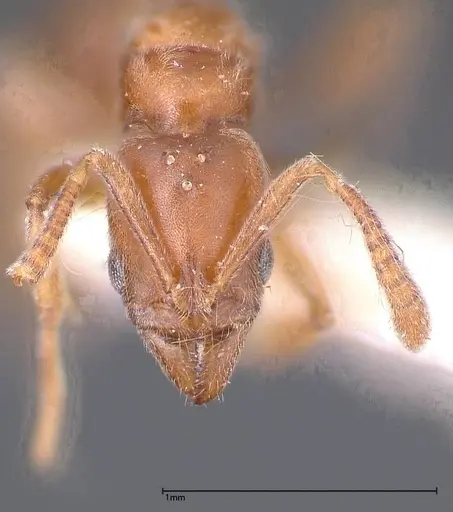
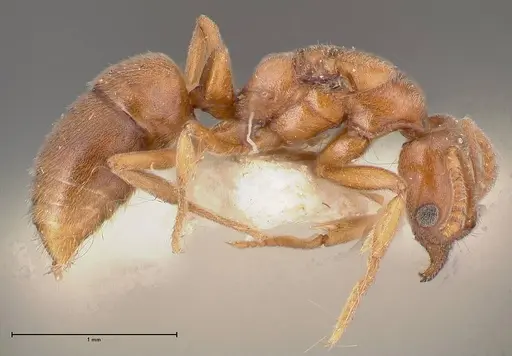
From the two known specimens, we have detailed measurements of the worker and some information about the queen. Workers are tiny, just 0.46mm head length and 0.34mm head width [1]. They are completely blind (eyes absent) and uniformly brown in color [1]. The petiole (the narrow waist segment) has a distinctive shape: the anterior face is vertical while the posterior face slopes very slightly toward it, giving the node a nearly columnar appearance [1]. The scapes (antennal segments) are short, when laid back they fail to reach the midpoint of the head by about 25% of their length [1]. This tiny, blind, ground-dwelling morphology is typical of cryptic Hypoponera species that hunt small prey in leaf litter and soil.
Taxonomic Context
Hypoponera rigida belongs to the Hypoponera abeillei species group, which includes a handful of closely related African species [1]. Within this group, it is most closely related to Hypoponera meridia and Hypoponera abeillei, but can be distinguished by its distinctly darker brown coloration [1]. The genus Hypoponera contains around 150 species worldwide, mostly tropical. They are predatory ants in the subfamily Ponerinae, characterized by their sting-equipped abdomens and generally cryptic, ground-nesting habits. However, within this genus there is enormous variation in biology, some species are predators, others are scavengers, and colony structures vary widely. Assuming anything about rigida based on other Hypoponera species would be speculative at best.
The Challenge of Rarely Collected Species
Hypoponera rigida represents a broader challenge in ant keeping: the gap between described species and species that can actually be kept successfully. Most ant species have never been studied in captivity, and many are known from only a handful of specimens. This species sits at the extreme end of that spectrum, two specimens, one description paper, zero biological data. For the ant keeping hobby to progress, someone would need to either locate a wild colony (which has never been done despite multiple surveys in the region) or maintain a founding queen obtained through very lucky field work. Even then, the learning curve would be steep with no established protocols to fall back on. This is the reality of keeping rarely collected tropical species. [1]
Frequently Asked Questions
Can I keep Hypoponera rigida as a pet ant?
No. This species has never been kept in captivity and there is no biological data available to guide care. It is not available through any known ant breeder or supplier. Even if you obtained a queen, there would be no established protocol to keep her alive or raise her brood.
How big do Hypoponera rigida colonies get?
Unknown, no colony has ever been documented. The largest colony size is completely unknown.
What do Hypoponera rigida ants eat?
Unknown, no feeding observations exist. Most Hypoponera species are predatory on small invertebrates, but this species' diet has never been studied.
Do Hypoponera rigida ants sting?
Likely yes, Hypoponera belongs to the Ponerinae subfamily, whose members typically have functional stingers. However, this species is so small (workers under 0.5mm) that any sting would be negligible to humans.
Are Hypoponera rigida good for beginners?
Absolutely not. This is an expert-only species in name only, in practice, it cannot be kept at all due to complete lack of availability and biological data. Even experienced antkeepers would have no guidance for this species.
Where does Hypoponera rigida live?
Only known from Uganda, near Queen Elizabeth National Park, collected in primary forest [1]. No other populations have ever been found.
How long do Hypoponera rigida queens live?
Unknown, no founding queen has ever been observed, let alone documented in captivity.
Do Hypoponera rigida need hibernation?
Unknown, no seasonal data exists. Uganda is near the equator, so related species may not enter dormancy, but this is purely speculative.
What temperature should I keep Hypoponera rigida at?
No temperature requirements have been established. There is no data to base any recommendation on.
Is Hypoponera rigida aggressive?
Unknown, no behavioral observations have been recorded. Most Hypoponera are not particularly aggressive, but this cannot be confirmed for this species.
Can I buy Hypoponera rigida queens or colonies?
No. This species is not available through any known ant supplier. It is known from only two specimens collected in 2006 and has never been found again.
What makes Hypoponera rigida different from other Hypoponera?
It is one of the smallest Hypoponera species known, completely blind, and belongs to the distinct abeillei group characterized by the vertical anterior face of the petiole node. However, its biology remains completely unknown, making it impossible to identify any unique captive care requirements.
References

This caresheet is licensed under CC BY-SA 4.0 .
FOCOL0355
View on AntWeb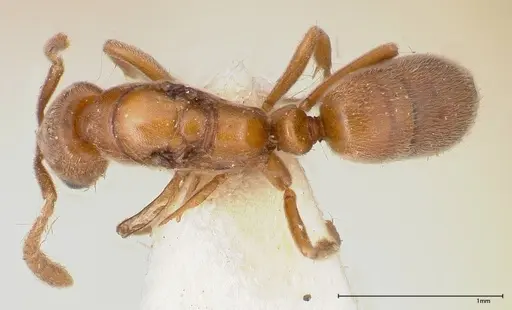
Literature
Loading...Loading products...