

Dorymyrmex tuberosus
- Scientific Name
- Dorymyrmex tuberosus
- Tribe
- Leptomyrmecini
- Subfamily
- Dolichoderinae
- Author
- Cuezzo & Guerrero, 2012
- Distribution
- Found in 1 countries
Dorymyrmex tuberosus Overview
Dorymyrmex tuberosus is an ant species of the genus Dorymyrmex. It is primarily documented in 1 countries , including Colombia. Detailed taxonomic data and occurrence records can be further explored via authoritative databases such as AntWeb or the Global Biodiversity Information Facility (GBIF).
Dorymyrmex tuberosus
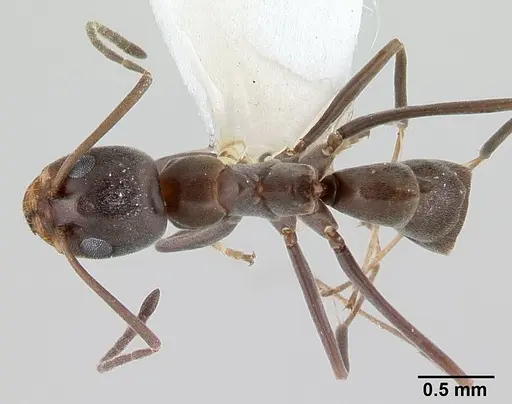
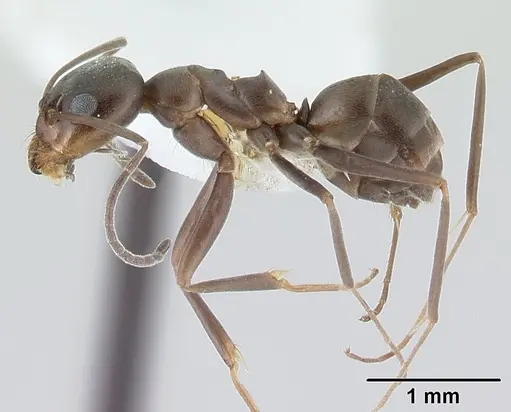
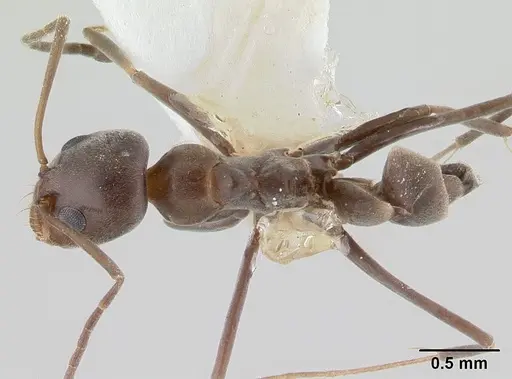
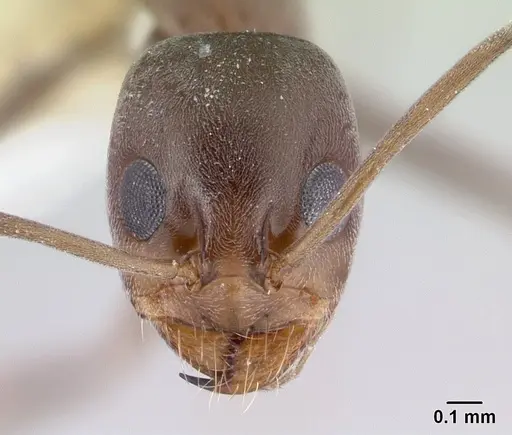
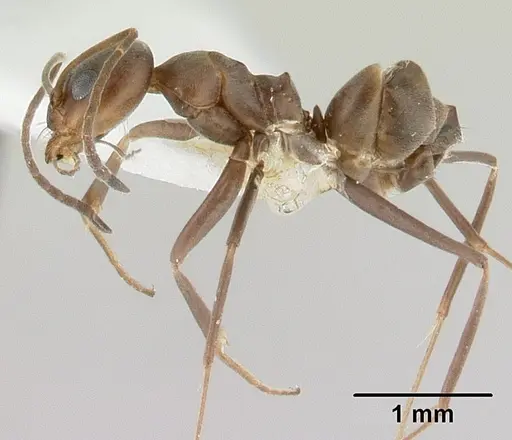
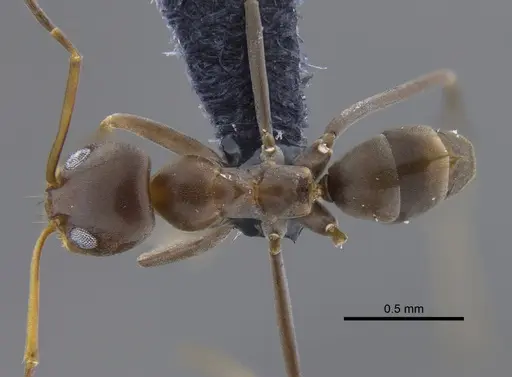
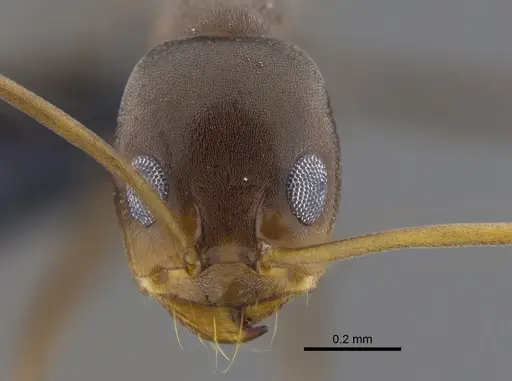
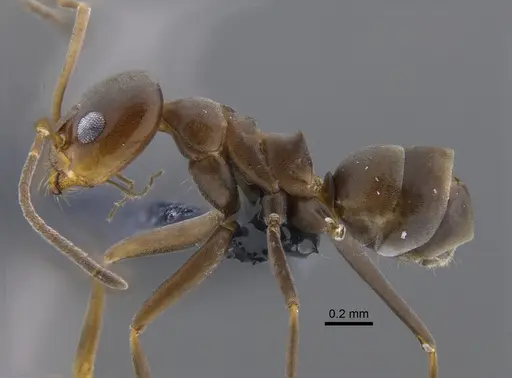
Dorymyrmex tuberosus is a tiny ant species described in 2011 from Colombia. Workers are dark brown with distinctive whitish pubescence covering their entire body, and they get their name 'tuberosus' from the two prominent tubercles on their mesosoma, one on the mesonotum and another between the dorsal and declivous faces of the propodeum [1]. They are among the smallest ants in the genus, with workers measuring just 0.80-0.88mm in head width and 1.18-1.20mm in mesosoma length [1]. This species is known only from a handful of museum specimens collected in the Colombian departments of Bolívar, Santander, and Sucre at elevations around 906 meters [1][2][3].
This is one of the least-studied ant species in existence, it has only been observed in museum collections, and no live colonies have ever been documented. All we know is that they prefer disturbed habitats like other Dorymyrmex species, and specimens have been collected from agricultural areas [1]. This makes them a true mystery ant for antkeepers, a chance to potentially establish the first captive colony of a species that exists only in museum drawers.
Quick Summary
- Difficulty: Unknown
- Origin & Habitat: Colombia (Bolívar, Santander, Sucre departments) at approximately 906m elevation. Found in disturbed habitats, including agricultural areas where specimens were collected from cassava plants (Manihot esculenta) [1][2][3].
- Colony Type: Unknown, only worker specimens have been collected. No queen or male specimens have been documented, so colony structure is completely unconfirmed.
- Size & Growth:
- Queen: Unknown, no queen specimens have been collected or described [1]
- Worker: 0.80-0.88mm head width,1.18-1.20mm mesosoma length [1]
- Colony: Unknown, no live colonies have ever been observed [1]
- Growth: Unknown
- Development: Unknown, no development data exists for this species (No biological observations have been published. All information comes from preserved museum specimens.)
- Antkeeping:
- Temperature: Unknown, no thermal data exists. Based on genus patterns for tropical Dorymyrmex, aim for roughly 24-28°C with a gradient. Adjust based on colony activity.
- Humidity: Unknown, no humidity data exists. Dorymyrmex species typically prefer drier conditions than many ants. Start with moderate humidity and observe colony behavior.
- Diapause: Unknown, no seasonal data exists for this species. Colombian ants from this elevation may not require strong diapause.
- Nesting: Unknown, no natural nesting observations exist. Dorymyrmex species typically nest in soil under stones or in small cavities in disturbed ground. A test tube setup or small acrylic nest would be appropriate starting points.
- Behavior: Completely unobserved in captivity. Based on genus patterns, Dorymyrmex ants are typically ground-nesting, fast-moving, and may form moderate-sized colonies. They are likely diurnal foragers. Escape prevention is critical given their tiny size, they can squeeze through the smallest gaps. No data exists on sting potency, but Dorymyrmex species generally have minimal stingers.
- Common Issues: this species has never been kept in captivity, all care recommendations are speculative, no biological or behavioral data exists beyond museum specimens, colony structure (monogyne/polygyne) is completely unknown, founding behavior is unconfirmed, may be claustral or semi-claustralthrough genus inference, temperature and humidity requirements are unknown, keepers must experiment
Discovery and Taxonomy
Dorymyrmex tuberosus was formally described in 2011 by Fabiana Cuezzo and Roberto Guerrero in their comprehensive revision of Dorymyrmex species in Colombia [1]. The species name 'tuberosus' refers to the two well-developed tubercles on the dorsal face of the mesosoma, one on the mesonotum and another between the dorsal and declivous faces of the propodeum [1]. These tubercles, combined with dense whitish pubescence covering the entire dark brown body, help distinguish this species from similar Colombian Dorymyrmex like D. brunneus [1]. The type locality is Bucaramanga, Santander, at 906 meters elevation, where specimens were collected from the campus of the Industrial University of Santander [1]. This species remains known only from worker caste specimens, no queens or males have ever been collected or described [1].
Distribution and Habitat
This species is known only from three departments in northern Colombia: Bolívar (San Juan Nepomuceno), Santander (Bucaramanga), and Sucre [2][3]. The type locality at Bucaramanga sits at approximately 906 meters elevation [1]. Specimens labeled 'ex-Manihot' suggest collection in cultivated areas, specifically from cassava plants (Manihot esculenta) [1]. Like other Dorymyrmex species, this ant appears to prefer disturbed habitats, a pattern consistent with the genus, which often thrives in human-altered landscapes, agricultural areas, and open ground [1]. No specimens have been collected from primary forest or undisturbed natural habitats.
Identification in the Field
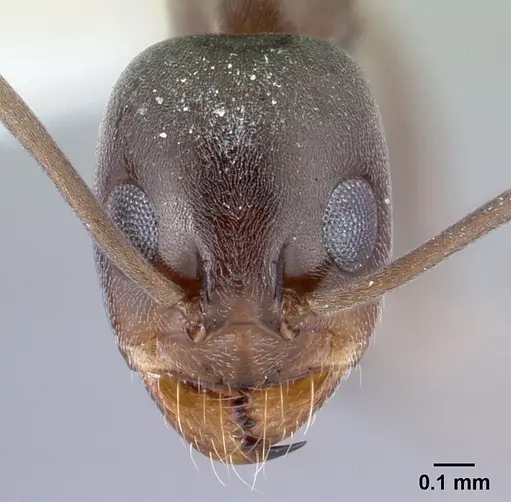
Identifying Dorymyrmex tuberosus requires careful examination under magnification. Workers are dark brown overall with reddish-brown coloration on the lateral corners of the clypeus [1]. The entire body is covered in dense whitish pubescence, giving them a dusty or frosted appearance [1]. The head is longer than wide, with the compound eye placed in the middle of the lateral part of the head capsule [1]. The posterior margin of the head has a slight emargination in the middle [1]. The scape (first antennal segment) is notably long, surpassing the posterior margin of the head [1]. Most distinctive are the two tubercles on the mesosoma visible in profile, one at the posterior end of the mesonotum and another between the dorsal and declivous faces of the propodeum [1]. These features separate it from the similar D. brunneus, which lacks the mesonotal tubercle and has a different head shape [1].
Keeping This Species - What We Don't Know
This is perhaps the most challenging ant species to provide care guidance for, because absolutely no captive husbandry information exists. Dorymyrmex tuberosus has never been kept in captivity, we only have a handful of museum specimens collected decades ago. Every aspect of their care must be inferred from genus-level knowledge and related species. Dorymyrmex ants are typically small, ground-nesting ants that prefer open, disturbed habitats. They often form colonies of moderate size and are diurnal foragers. For housing, start with a standard test tube setup or small acrylic nest. For temperature, aim for 24-28°C based on typical tropical Dorymyrmex preferences. For humidity, begin with moderate levels and observe. The most important advice for this species is experimental: keep detailed notes on any conditions you try, and be prepared to adjust based on colony response. This is truly a species for advanced antkeepers who enjoy experimentation.
Related Species and Genus Context
Dorymyrmex is a genus of small ants in the subfamily Dolichoderinae, commonly known as 'cone ants' due to the conical shape of their propodeum. The genus is widespread throughout the Americas, with the highest diversity in tropical and subtropical regions. Many Dorymyrmex species prefer disturbed, open habitats and are commonly found in agricultural areas, lawns, and urban environments. They are typically fast-moving, diurnal foragers that nest in soil under stones or in small ground cavities. While D. tuberosus remains poorly known, other Colombian Dorymyrmex species have been more thoroughly studied and can provide general guidance. The genus is not considered aggressive, and most species have minimal stingers that are too small to penetrate human skin effectively.
Frequently Asked Questions
Has Dorymyrmex tuberosus ever been kept in captivity?
No, this species has never been documented in captivity. All known specimens come from museum collections, making this potentially the first ant species of its kind to be kept by antkeepers.
What do Dorymyrmex tuberosus ants look like?
Workers are tiny (under 1mm body length) with dark brown coloration and distinctive whitish pubescence covering their entire body. They have two prominent tubercles on their mesosoma and a long scape that extends past the back of their head. The posterior margin of the head has a slight notch in the middle [1].
Where does Dorymyrmex tuberosus live?
This species is known only from northern Colombia, specifically the departments of Bolívar, Santander, and Sucre, at elevations around 906 meters [1][2][3].
What temperature should I keep Dorymyrmex tuberosus at?
No specific temperature data exists for this species. Based on typical Dorymyrmex preferences for tropical regions, start around 24-28°C with a temperature gradient and adjust based on colony activity.
How big do Dorymyrmex tuberosus colonies get?
Unknown, no live colonies have ever been observed. Related Dorymyrmex species typically form colonies ranging from dozens to a few hundred workers.
Is Dorymyrmex tuberosus a good species for beginners?
No, this species is not recommended for beginners. It has never been kept in captivity, and all care requirements are speculative. This is a species for advanced antkeepers interested in pioneering captive husbandry of an essentially unknown species.
What do Dorymyrmex tuberosus eat?
Unknown, no feeding observations exist. Based on genus patterns, they likely forage for small insects and tend aphids for honeydew. Offer standard ant foods like sugar water, small insects, and honey as a starting point.
How long does it take for Dorymyrmex tuberosus to develop from egg to worker?
Unknown, no development data exists for this species. Related tropical Dorymyrmex species typically develop from egg to worker in 4-8 weeks at warm temperatures.
Can I keep multiple Dorymyrmex tuberosus queens together?
Unknown, colony structure has never been documented for this species. No information exists on whether they are single-queen (monogyne) or multi-queen (polygyne) colonies.
Does Dorymyrmex tuberosus need hibernation?
Unknown, no seasonal data exists. Being from tropical Colombia at 906m elevation, they may not require strong diapause. Monitor colony activity and adjust seasonal care accordingly.
Where can I find Dorymyrmex tuberosus queens to start a colony?
This species has only been collected in Colombia, and no queen specimens have ever been documented. Starting a colony would require field collection in the Bolívar, Santander, or Sucre departments of Colombia, a significant undertaking with no guarantee of success.
References

This caresheet is licensed under CC BY-SA 4.0 .
Literature
Loading...Loading products...