

Discothyrea berlita
- Scientific Name
- Discothyrea berlita
- Tribe
- Proceratiini
- Subfamily
- Proceratiinae
- Author
- Fisher, 2005
- Distribution
- Found in 1 countries
Discothyrea berlita Overview
Discothyrea berlita is an ant species of the genus Discothyrea. It is primarily documented in 1 countries , including Mauritius. Detailed taxonomic data and occurrence records can be further explored via authoritative databases such as AntWeb or the Global Biodiversity Information Facility (GBIF).
Discothyrea berlita
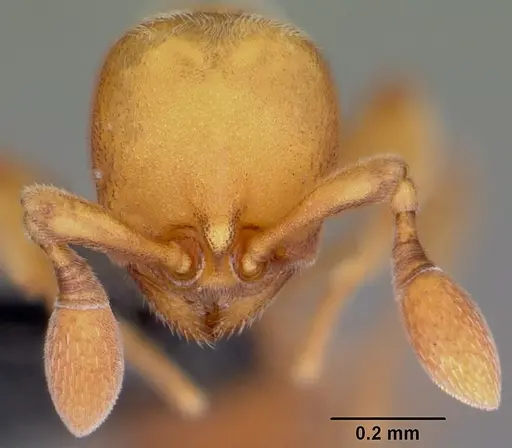
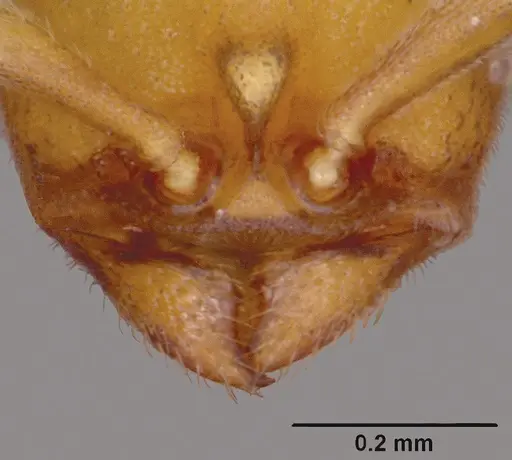
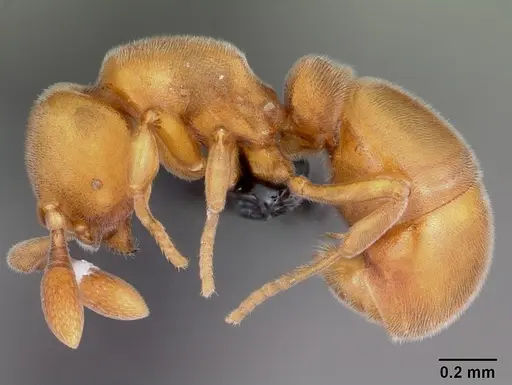
Discothyrea berlita is an extraordinarily rare miniature ant species endemic to the island of Mauritius. Workers measure just 0.5-0.6mm in head length, making them among the smallest ants in the world [1]. They are a reddish-testaceous color with a distinctive appearance featuring fused frontal carinae that project perpendicularly from the clypeus and expand at the tip, and a thick petiole with a concave anterior margin when viewed from above [1][2]. The species is known from a single specimen collected in 2005 from leaf litter in the only remaining patch of dense native vegetation near the summit of Le Pouce mountain at 750m elevation [1][2]. This makes D. berlita not only extremely rare but also the first and only record of the genus Discothyrea from Mauritius [2].
Quick Summary
- Difficulty: Expert
- Origin & Habitat: Endemic to Mauritius, found only at Le Pouce mountain in the Moka Range at 750m elevation in closed native vegetation/leaf litter [1][2].
- Colony Type: Unknown colony structure, only a single worker has ever been documented. Based on related Discothyrea species, likely single-queen colonies with tiny colony sizes.
- Size & Growth:
- Queen: Unknown, only worker described [1]
- Worker: HL 0.57mm, HW 0.52mm, WL 0.64mm, SL 0.36mm [1]
- Colony: Unknown, likely very small colonies based on related species
- Growth: Unknown
- Development: Unknown, no development data exists for this species (No published data on colony development. Related Discothyrea species typically develop from egg to worker in 4-8 weeks at warm temperatures.)
- Antkeeping:
- Temperature: Based on Mauritius climate (tropical island), keep at 24-28°C. Provide a gentle temperature gradient.
- Humidity: High humidity required, they live in leaf litter in closed vegetation. Keep substrate consistently moist but not waterlogged.
- Diapause: Unlikely, Mauritius has mild year-round temperatures. No documented winter rest period.
- Nesting: Litter-dwelling ants that likely nest in tiny cavities in rotting wood, under stones, or in dense leaf litter. In captivity, use very small test tubes or acrylic nests with fine chambers scaled to their tiny size. Provide a thin layer of moist substrate.
- Behavior: These ants are extremely small with only 2-3 eye facets, indicating very limited vision [1]. They are likely predaceous, hunting small arthropod eggs and micro-prey like their relatives in the genus Discothyrea. Their tiny size means escape prevention is critical, they can squeeze through gaps invisible to the human eye. Use fine mesh barriers and seal all openings. Likely nocturnal or crepuscular foragers based on their reduced eyes.
- Common Issues: extreme rarity means no captive-bred colonies exist, wild collection would be ecologically damaging, tiny size makes escape likely without fine mesh barriers and sealed edges, no established feeding protocols, must experiment with micro-prey, extremely limited distribution makes conservation concern real, do not collect from wild, no colony development data makes successful captive breeding highly uncertain
Discovery and Rarity
Discothyrea berlita represents one of the rarest ant species in the world, known from a single specimen collected in May 2005 during a biodiversity survey on Le Pouce mountain in Mauritius [1]. This tiny ant was found in a leaf litter sample from the last remaining patch of dense native vegetation near the mountain's summit [1]. The discovery was significant because it represented the first record of the entire genus Discothyrea from Mauritius [2]. Despite surveys of nearby mountain peaks including Pieter Both (823m) and Calebasses (c.600m), no other Proceratiinae were found [1]. This extreme rarity makes D. berlita a conservation priority and means that captive colonies do not exist in the antkeeping hobby. Any specimens in captivity would likely be wild-caught, which would be ecologically damaging to this endemic species.
Identification and Morphology
The worker of D. berlita is among the smallest ants in the world, measuring just 0.57mm in head length and 0.64mm in mesosoma length [1]. Several features distinguish it from related species: the fused frontal carinae project perpendicularly to the plane of the clypeus and expand apically rather than forming a thin lamella, there is no scrobe (the groove behind the eye), the propodeal angle lacks teeth or spines, and the anterior margin of the petiole is concave when viewed from above [1][2]. The antennae have 10 segments with extremely short medium segments that are not distinct under 100x magnification [1]. The eyes are highly reduced with only 2-3 facets, indicating very limited vision [1]. The body is a reddish-testaceous color and covered with dense, fine, short whitish pubescence [1]. These morphological features place D. berlita in the sauteri group based on recent examination [3].
Natural History and Biology
Almost nothing is known about the natural history of Discothyrea berlita in the wild. The single known specimen was collected from leaf litter in closed (dense) native vegetation at 750m elevation on Le Pouce mountain [1]. Based on what is known about related Discothyrea species, these ants are likely predaceous, hunting small arthropod eggs and other micro-prey in the leaf litter layer [1]. The genus Discothyrea belongs to the subfamily Proceratiinae, which includes other specialized predators. The presence of novel exocrine glands in the foreleg coxae has been documented in this species, though their exact function is unclear, they may produce chemical signals used in prey capture or colony communication [3]. The extreme reduction in eye size (only 2-3 facets) suggests they rely more on chemical than visual cues [1]. No information exists on colony size, reproductive behavior, or development.
Housing and Care Challenges
Keeping Discothyrea berlita in captivity presents extreme challenges. First, no captive-bred colonies exist, any specimens would need to be wild-caught, which would be ecologically irresponsible given the species is only known from a single location. Second, their tiny size (under 1mm) requires specialized housing with chambers scaled to their miniature dimensions. Third, no established feeding protocols exist, you would need to experiment with micro-prey such as springtails, fruit fly larvae, and other tiny arthropods. Fourth, escape prevention is critical since they can slip through gaps invisible to the naked eye. Use fine mesh (at least 0.5mm or finer) on all openings and consider using fluon on container edges. Fifth, they likely require high humidity consistent with their leaf litter habitat. Given these challenges and the conservation concern, Discothyrea berlita should not be kept by hobbyists, it is a species to appreciate in scientific context rather than in captivity. [1][2]
Related Species and Context
The genus Discothyrea contains around 30 species distributed primarily in the Old World tropics and subtropics. They are among the smallest of all ants, with workers typically measuring 1-2mm. The genus is part of the subfamily Proceratiinae, which includes the well-known trap-jaw ants (Odontomachus) but also includes specialized predators like Proceratium. Discothyrea species are sometimes called 'scarab ants' due to their compact, rounded appearance. The sauteri group, to which D. berlita belongs, is characterized by specific morphological features including the structure of the frontal carinae and lack of a depressed scrobe area [1][3]. The discovery of D. berlita on Mauritius is significant because it extends the known range of the genus and highlights the island's unique and endangered endemic ant fauna.
Frequently Asked Questions
Can I keep Discothyrea berlita as a pet?
No. Discothyrea berlita should not be kept in captivity. It is known from a single specimen collected in 2005 and is endemic to Mauritius. No captive-bred colonies exist, and wild collection would be ecologically damaging to this extremely rare species. This is a species to appreciate in scientific publications, not in ant farms.
How big are Discothyrea berlita ants?
Workers are among the smallest ants in the world, measuring just 0.57mm in head length and 0.64mm in mesosoma length [1]. To put this in perspective, several workers could fit comfortably on a single fingertip.
Where does Discothyrea berlita live?
Only known from Le Pouce mountain in the Moka Range of Mauritius at 750m elevation, in closed (dense) native vegetation [1]. This makes it endemic to a single mountain peak on a small island.
What do Discothyrea berlita eat?
Feeding is unconfirmed for this specific species, but related Discothyrea are predaceous, hunting small arthropod eggs and micro-prey in leaf litter. They likely accept tiny live prey like springtails, micro- mites, and fruit fly larvae.
Do Discothyrea berlita ants sting?
Unknown for this specific species. However, Proceratiinae ants have stingers, though they are typically too small to penetrate human skin. Given their tiny size (under 1mm), any sting would likely be imperceptible to humans.
How many queens does Discothyrea berlita have?
Unknown. Only a single worker has ever been documented, so colony structure has not been studied. Based on related species, they likely form small single-queen colonies.
What temperature should I keep Discothyrea berlita at?
No specific data exists. Based on Mauritius being a tropical island, aim for 24-28°C with a gentle gradient. Do not attempt to keep this species, it should not be kept in captivity.
Why is Discothyrea berlita so rare?
It is only known from a single specimen collected in 2005 from the last remaining patch of dense native vegetation on Le Pouce mountain [1]. The species appears to have an extremely restricted range and may always have been rare. Habitat loss on Mauritius has eliminated much of the native vegetation where it would likely be found.
Can I breed Discothyrea berlita in captivity?
No breeding programs exist for this species. There are no captive-bred colonies, and attempting to establish one would require wild collection from an already critically small population. This species should not be kept by hobbyists.
What makes Discothyrea berlita different from other ants?
Several features make it unique: it belongs to the sauteri group with distinctive frontal carinae that expand apically, it has only 2-3 eye facets (extremely reduced vision), it lacks a scrobe, and it has a concave anterior margin to the petiole [1][3]. Most importantly, it is one of the rarest ant species in the world, known from a single specimen.
Do Discothyrea berlita need hibernation?
Unlikely. Mauritius has mild year-round temperatures with no true winter. No diapause or hibernation behavior has been documented, and none would be expected based on the tropical climate of their native habitat.
Are Discothyrea berlita dangerous to handle?
No. At just 0.5-0.6mm, these ants are far too small to bite or sting humans in any meaningful way. However, you should not handle this species, it should not be kept in captivity due to its extreme rarity and conservation status.
References

This caresheet is licensed under CC BY-SA 4.0 .
CASENT0007016
View on AntWeb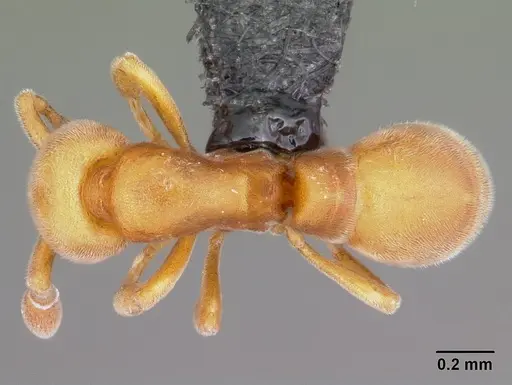
Literature
Loading...Loading products...