

Diacamma cyaneiventre
- Scientific Name
- Diacamma cyaneiventre
- Tribe
- Ponerini
- Subfamily
- Ponerinae
- Author
- André, 1887
- Distribution
- Found in 1 countries
Diacamma cyaneiventre Overview
Diacamma cyaneiventre is an ant species of the genus Diacamma. It is primarily documented in 1 countries , including India. Detailed taxonomic data and occurrence records can be further explored via authoritative databases such as AntWeb or the Global Biodiversity Information Facility (GBIF).
Diacamma cyaneiventre
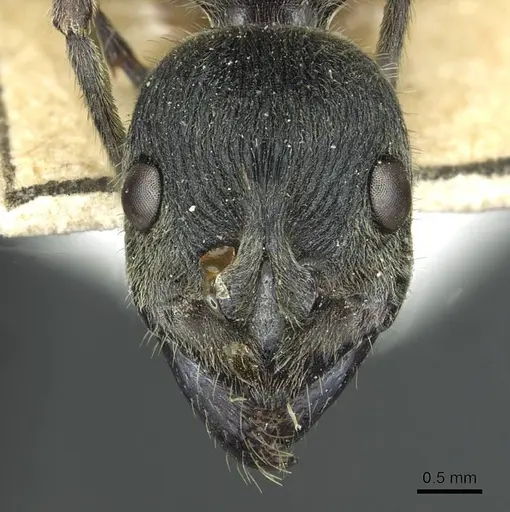
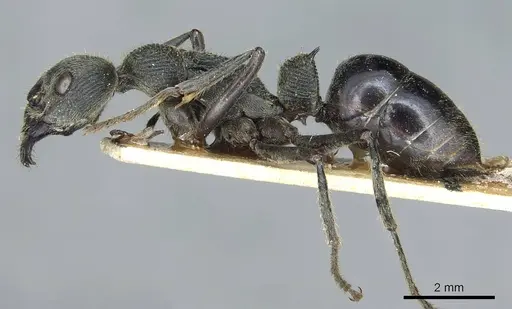
Diacamma cyaneiventre is a small Ponerine ant native to southern India and Sri Lanka. Workers are around 7-10mm with a distinctive dark metallic blue-black coloration. This species is remarkable because it has completely lost the queen caste, instead, one worker mates and becomes the reproductive (called a gamergate), producing all the colony's offspring [1][2]. Colonies are small, typically containing around 200-300 workers living in deep underground nests up to 50cm deep with multiple chambers [1][3]. The nest entrance is marked by a conspicuous mound of soil and pebbles, making them relatively easy to locate in the wild [1]. This species is one of the most studied ant systems for understanding how eusociality can evolve without winged queens.
Quick Summary
- Difficulty: Medium
- Origin & Habitat: Southern India (Karnataka, Kerala, Tamil Nadu, West Bengal) and Sri Lanka. Inhabits open areas with deep underground nests in soil [1][4].
- Colony Type: Queenless, single gamergate (reproductive worker) per colony. This is a gamergate species where workers compete to become the replacement reproductive when the current gamergate dies or the colony splits. Strictly monogynous (one reproductive per colony) and monoandrous (gamergate mates only once) [1][2].
- Colony: Monogyne
- Special: Gamergates
- Size & Growth:
- Queen: N/A, queen caste lost. Gamergate (reproductive worker) is the functional queen [1].
- Worker: 7-10mm (estimated based on genus) [5].
- Colony: Up to 300 workers (average 214 ± 80 workers) [1][6].
- Growth: Moderate, development from egg to adult takes 65 days [1].
- Development: 9-10 weeks (65 days) at optimal temperature [1]. (Development is relatively slow compared to many ants. First workers (nanitics) emerge and the colony grows gradually through the gamergate's continuous egg production.)
- Antkeeping:
- Temperature: Keep at 24-28°C. This is a tropical species from southern India that benefits from warm conditions. A heating cable on one side of the nest creates a gradient allowing workers to regulate brood temperature by moving them between chambers [1].
- Humidity: Moderate to high. Native to open areas in southern India with seasonal monsoons. Keep nest substrate moist but not waterlogged. Provide a water tube for drinking water.
- Diapause: No, this is a tropical species that does not hibernate. However, activity may slow during cooler periods.
- Nesting: Deep underground nests work best. In captivity, use a vertical setup with multiple connected chambers (like a Y-tong or plaster formicarium) allowing workers to move brood between warmer and cooler areas for thermoregulation. Provide deep soil or substrate for tunneling.
- Behavior: Generally peaceful but defensive of their gamergate. Workers are active foragers that hunt small invertebrates. They readily carry brood to different nest chambers for temperature regulation, a behavior called thermoregulation [1]. Unlike many ants, they do not have nuptial flights since there are no winged queens. Instead, new reproductives are produced internally and mating occurs inside the nest with males from other colonies [2]. Workers can recognize and will attack unfamiliar conspecifics. Escape prevention is standard, they are moderate-sized ants but good climbers.
- Common Issues: queenless colonies require special care, you must ensure the gamergate survives as the colony depends entirely on her reproduction, colonies are small and slow-growing compared to many ants, don't expect rapid expansion, no queen means no claustral founding, colonies can only grow through the gamergate's continuous egg-laying, mutilation behavior means only one worker reproduces, if gamergate dies and no replacement establishes, the colony will fail, deep nesting requirement means they need more vertical space than typical surface-nesting ants
Understanding the Queenless System
Diacamma cyaneiventre is one of the few ant species that has completely lost the queen caste. Instead, reproduction is handled by a gamergate, a worker that has mated and taken on the role of egg-production [1]. This is fundamentally different from typical ant colonies where a winged queen founds the colony alone. Here, colonies can only be founded through fission: when a colony becomes large enough, it splits, with a group of workers and a new gamergate establishing a separate nest [7][3]. The gamergate maintains dominance by mutilating newly emerged workers, she bites off a pair of small appendages called gemmae on their thorax, which prevents them from mating and becoming reproductives themselves [1][2]. When the gamergate dies or the colony undergoes fission, the first worker to emerge retains its gemmae, mates with a male from another colony, and becomes the new gamergate [1]. This system creates interesting dynamics where colonies go through brief periods with two matrilines (the old gamergate's daughters and the new gamergate's daughters) before one lineage fades out, called serial polygyny [2].
Nest Construction and Thermoregulation
In the wild, D. cyaneiventre builds elaborate underground nests extending 50cm to 1m deep, composed of many connected chambers [3][1]. The nest entrance is marked by a conspicuous mound of soil and pebbles, making these nests relatively easy to locate, a useful tip if you're ever searching for colonies in the field [1]. Perhaps most fascinating is their behavior of thermoregulation: workers actively carry brood (eggs, larvae, and pupae) between different chambers depending on temperature [1]. During cooler periods, they move brood deeper underground where it's warmer. When conditions are favorable near the surface, they bring brood up to the upper chambers next to the nest entrance [1]. This behavior was first noted by Wheeler in 1915 and demonstrates sophisticated colony-level temperature management without needing external heat sources. In captivity, you can replicate this by providing a vertical nest with multiple chambers at different heights, allowing the ants to naturally regulate brood temperature.
Colony Genetics and Reproduction
Genetic studies have revealed remarkably high relatedness within D. cyaneiventre colonies, averaging 0.73-0.75,which is exactly what you'd expect for full sisters (0.75) from a singly-mated mother [1][8]. This confirms the species is strictly monogynous (one reproductive) and monoandrous (the gamergate mates only once) [1]. The gamergate's tenure lasts approximately 200 days, about three times longer than worker lifespan (around 60 days) [1]. When a gamergate is replaced, there's a temporary period where two matrilines coexist (aunts and nieces), which has been documented in about 15-19% of colonies at any given time [2][8]. Males mate only once and lose part of their abdomen during copulation [3]. New sites are colonized through a process called colony budding, a single migration event from an adjacent population followed by successive fissions [3]. This explains why there's such strong genetic differentiation between even nearby populations.
Feeding and Care
As Ponerine ants, D. cyaneiventre are predators that hunt small invertebrates. Feed them small live prey like fruit flies, pinhead crickets, or small mealworms. They also likely accept sugar sources (honey water, sugar water) though this isn't directly documented. Provide a constant water source. Because colonies are relatively small (max ~300 workers) and grow slowly, avoid overfeeding, uneaten prey can mold and cause problems. The deep nesting preference means they need more vertical space than typical ants. A Y-tong nest or plaster formicarium with multiple chambers works well. Keep temperatures in the 24-28°C range and maintain moderate humidity. Since they naturally move brood between chambers for thermoregulation, providing a vertical temperature gradient (warmer at top, cooler at bottom) mimics their natural behavior. [1][5]
Frequently Asked Questions
How is Diacamma cyaneiventre different from regular ants?
Unlike most ants that have a queen, D. cyaneiventre has no queen caste at all. Instead, one worker (called a gamergate) mates and becomes the reproductive, laying all the eggs. This is a gamergate species, the workers themselves compete to become the replacement reproductive when needed [1].
How do I start a Diacamma cyaneiventre colony?
You cannot start a colony from a founding queen like most ants. Colonies can only be founded through fission, when an existing colony splits, a group of workers leaves with a new gamergate. If acquiring a colony, you must get an established colony with an established gamergate [7][3].
How long does it take for workers to develop?
Development from egg to adult takes approximately 65 days (about 9-10 weeks) [1]. This is slower than many common ant species. After that, the gamergate continuously produces more workers, but colony growth is gradual, expect months to reach significant numbers.
How big do Diacamma cyaneiventre colonies get?
Colonies are relatively small compared to many ants. Maximum size is around 200-300 workers, with an average of 214 ± 80 workers in wild colonies [1][6]. This is typical for Ponerine ants.
What do Diacamma cyaneiventre eat?
They are predators that hunt small invertebrates. Feed small live prey like fruit flies, small crickets, or mealworms. They likely also accept sugar water or honey, though protein prey should form the primary diet [5].
Do they need hibernation?
No. As a tropical species from southern India, they do not hibernate. However, activity may slow during cooler periods. Keep them at 24-28°C year-round [1].
Are Diacamma cyaneiventre good for beginners?
This is an intermediate-level species. The queenless system requires understanding gamergate biology, and their deep-nesting preference and slower growth may challenge beginners. They're fascinating but not the easiest choice for a first ant [5].
What happens if the gamergate dies?
If the gamergate dies, the first worker to emerge will retain its gemmae (thoracic appendages), mate with a male from another colony, and become the new gamergate [1][2]. This is how reproduction continues. If no replacement establishes, the colony will eventually die out.
Can I keep multiple queens together?
This question doesn't apply to D. cyaneiventre, there is no queen caste. Colonies are strictly monogynous with one gamergate. Attempting to combine unrelated colonies would likely result in aggression rather than cooperation [2].
References

This caresheet is licensed under CC BY-SA 4.0 .
CASENT0913724
View on AntWeb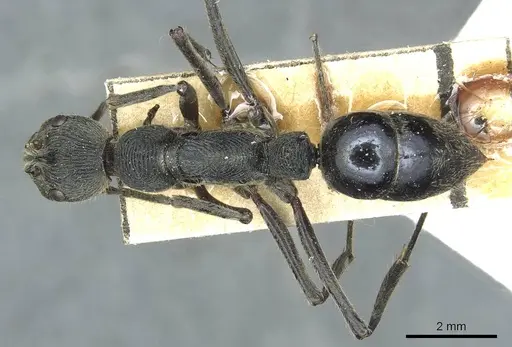
Literature
Loading...Loading products...