

Cyphoidris werneri
- Scientific Name
- Cyphoidris werneri
- Tribe
- Crematogastrini
- Subfamily
- Myrmicinae
- Author
- Bolton, 1981
- Distribution
- Found in 1 countries
Cyphoidris werneri Overview
Cyphoidris werneri is an ant species of the genus Cyphoidris. It is primarily documented in 1 countries , including Uganda. Detailed taxonomic data and occurrence records can be further explored via authoritative databases such as AntWeb or the Global Biodiversity Information Facility (GBIF).
Cyphoidris werneri
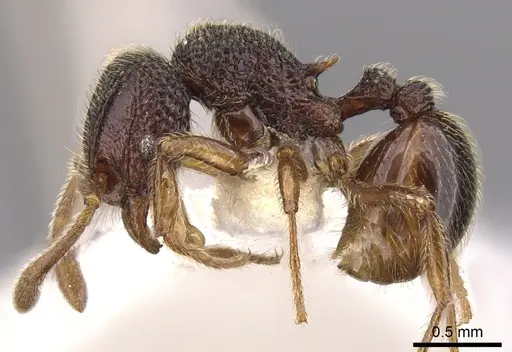
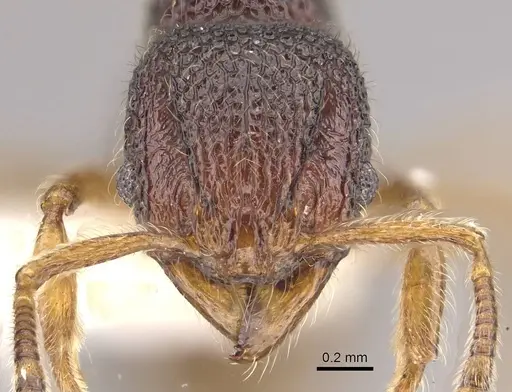
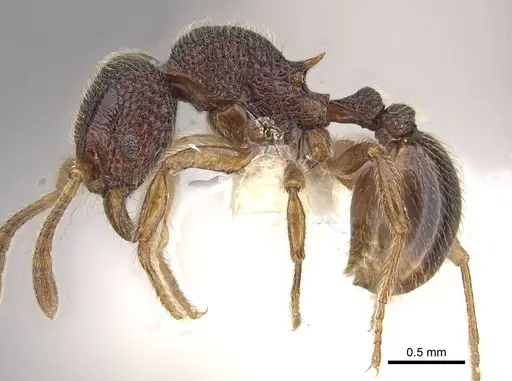
Cyphoidris werneri is a tiny Myrmicinae ant species native to Rwanda, East Africa. Workers measure just 3.5-3.8mm and have a distinctive blackish-brown body with a reddish tint, particularly visible on the sides of the alitrunk. Their most striking feature is the dense covering of short fine curved hairs across all dorsal surfaces. The antennae and legs are a dull orange-yellow, contrasting with the dark body. This species is the only member of the genus Cyphoidris found in East Africa, distinguished from its West and Central African relatives by its strong blanketing sculpture on the alitrunk and the way the propodeal dorsum continues the steep slope of the mesonotum. The genus is unique among African ants for having 12 antennal segments and a propodeal spiracle positioned forward from the declivity margin.
Quick Summary
- Difficulty: Medium
- Origin & Habitat: Rwanda, East Africa. Found in leaf litter at the type locality Rangiro at 1800m elevation [1][2]. The area is in the Afrotropical region with highland forest characteristics.
- Colony Type: Colony structure is unconfirmed. Only known from worker specimens collected in leaf litter samples, no queen or colony-level data exists in scientific literature.
- Size & Growth:
- Queen: Unknown, queen has not been described in scientific literature
- Worker: 3.5-3.8mm [3][2]
- Colony: Unknown, no colony size data available
- Growth: Unknown
- Development: Unknown, no development data exists for this species. Based on typical Myrmicinae patterns from similar small litter ants, estimate 6-10 weeks at optimal temperature. (Development timeline is unconfirmed. Related small Myrmicinae species typically develop in 6-10 weeks.)
- Antkeeping:
- Temperature: Based on the high elevation (1800m) Rwandan habitat, these ants likely prefer cooler conditions than typical lowland tropical ants. Aim for 20-24°C with a gentle gradient. Avoid overheating.
- Humidity: As a leaf litter species from Rwanda, they likely prefer moderate to high humidity. Keep the nest substrate consistently moist but not waterlogged, with some drier areas available.
- Diapause: Unknown, no data on seasonal behavior. The high elevation location suggests they may experience cooler temperatures and potentially a dormancy period.
- Nesting: In nature they are found in leaf litter. A naturalistic setup with moist substrate, or a Y-tong/plaster nest with tight chambers scaled to their small size would work well. Avoid large open spaces.
- Behavior: Behavior is unstudied in captivity. Based on their small size and leaf litter habitat, they are likely secretive and slow-moving. Escape prevention is important due to their tiny size. They likely forage in the litter layer and may be predatory on small micro-arthropods.
- Common Issues: Very limited scientific data means care requirements are largely inferred, expect a learning curve, Tiny size makes escape prevention critical, use fine mesh and tight-fitting lids, No established husbandry guidelines exist in the antkeeping hobby, Growth rate is unknown so patience is required, Wild-caught colonies may have collected parasites that could affect captive survival
Discovery and Taxonomy
Cyphoidris werneri was described by Bolton in 1981 based on specimens collected from Rangiro, Rwanda in September 1976. The type series consists of a holotype worker and 14 paratype workers, all collected from leaf litter by P. Werner (hence the species name 'werneri'). This species holds special significance as it is the only member of the genus Cyphoidris found in East Africa, its three congeners (C. exalta, C. spinosa, and C. parissa) are all West and Central African species. The genus itself is notable for being the only African ant genus with 12 antennal segments and a unique propodeal spiracle position. [3][1][2]
Distribution and Habitat
This species is considered likely endemic to Rwanda, meaning it may be found nowhere else on Earth. The only known specimens come from Rangiro, located at approximately 1800m elevation in western Rwanda (latitude 2.3833,longitude 29.1667). This highland location suggests the species prefers cooler, more temperate conditions than typical lowland tropical ants. The specimens were collected from leaf litter, indicating they are a litter-dwelling species that forages in the decomposing organic layer on the forest floor. [1]
Identification and Morphology
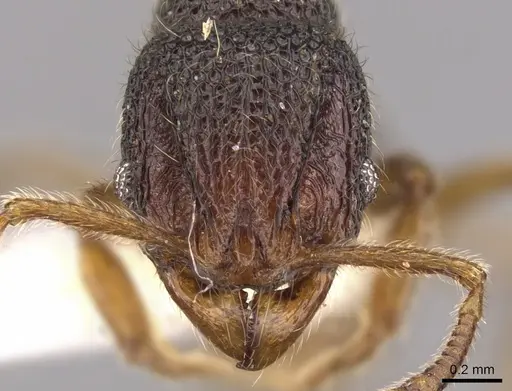
Workers are small at 3.5-3.8mm total length. The most distinctive features are the dense blanketing sculpture covering the entire alitrunk (the middle body section), and the propodeal dorsum that continues the steep downward slope of the mesonotum without a break. The body is covered in dense short fine curved hairs. The head has longitudinal rugae (grooves) that develop into a network pattern toward the back. The antennae have 11 segments (11-merous) and the legs and antennae are a contrasting dull orange-yellow against the blackish-brown body. The eyes are relatively large for their size, about 0.18-0.20 times the head width. [3][2]
Keeping Requirements
Since this species has never been kept in captivity (as far as documented in the hobby), all care recommendations are educated guesses based on its natural history. The high elevation Rwandan habitat suggests a preference for cooler temperatures, aim for 20-24°C rather than the hot conditions preferred by many tropical ants. As a leaf litter species, they likely need moderate to high humidity in the nest. Given their tiny size (under 4mm), excellent escape prevention is essential, use fine mesh and ensure all openings are sealed. They are likely predatory on small micro-arthropods like springtails, so offer live prey appropriate to their size.
Unknown Aspects
This is one of the most poorly documented ant species in existence. We do not know: the queen's appearance, colony size, founding behavior, development timeline, diet preferences, nuptial flight timing, or any aspect of their social structure. The queen has never been described scientifically. This represents both a challenge (no established care guidelines) and an opportunity (a truly unknown species that dedicated antkeepers could potentially pioneer in captivity). Any successful colony would be a significant contribution to antkeeping knowledge.
Frequently Asked Questions
How long does it take for Cyphoidris werneri to develop from egg to worker?
This is unknown, no development data exists for this species. Based on typical small Myrmicinae patterns, expect 6-10 weeks at optimal temperature, but this is purely an estimate.
What do Cyphoidris werneri ants eat?
Diet is unconfirmed. As a leaf litter species, they likely prey on small micro-arthropods like springtails and mites. Offer small live prey appropriate to their tiny size.
Are Cyphoidris werneri good for beginners?
No, this species is not recommended for beginners. There is essentially no scientific data on their care, no established husbandry guidelines, and the queen has never been described. This is a species for experienced antkeepers interested in pioneering care for poorly documented species.
What temperature should I keep Cyphoidris werneri at?
Based on their high elevation Rwandan habitat (1800m), they likely prefer cooler conditions than typical tropical ants. Aim for 20-24°C with a gentle gradient. Avoid overheating.
Do Cyphoidris werneri ants sting?
Unknown, their sting capability has not been documented. Given their very small size (under 4mm), any sting would likely be negligible to humans even if present.
How big do Cyphoidris werneri colonies get?
Unknown, no colony size data exists. The maximum colony size has never been documented in scientific literature.
Can I keep multiple queens together?
Unknown, colony structure has not been studied. Without data on whether they are single-queen or multi-queen colonies, combining unrelated queens is not recommended.
Do Cyphoidris werneri need hibernation?
Unknown, no data on seasonal behavior exists. The high elevation Rwandan location suggests they may experience cooler temperatures and potentially a dormancy period, but this is unconfirmed.
What is the best nest type for Cyphoidris werneri?
A naturalistic setup with moist leaf litter substrate, or a Y-tong/plaster nest with small chambers scaled to their tiny 3.5-3.8mm worker size would be appropriate.
Where is Cyphoidris werneri found?
Only known from Rwanda, East Africa, at the type locality Rangiro at 1800m elevation. It may be endemic to that country.
References

This caresheet is licensed under CC BY-SA 4.0 .
CASENT0900965
View on AntWeb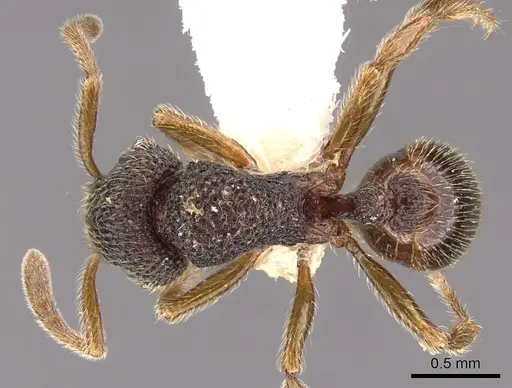
CASENT0911145
View on AntWeb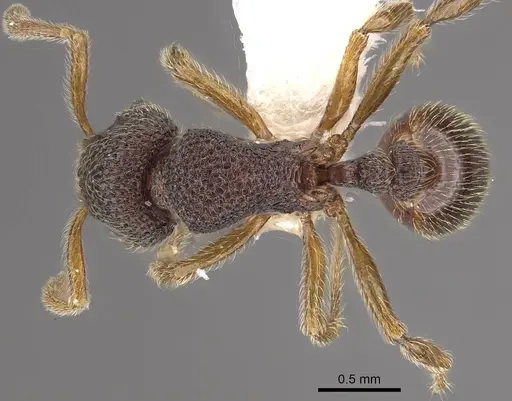
Literature
Loading...Loading products...