

Cladomyrma crypteroniae
- Scientific Name
- Cladomyrma crypteroniae
- Tribe
- Lasiini
- Subfamily
- Formicinae
- Author
- Agosti <i>et al.</i>, 1999
- Distribution
- Found in 1 countries
Cladomyrma crypteroniae Overview
Cladomyrma crypteroniae is an ant species of the genus Cladomyrma. It is primarily documented in 1 countries , including Malaysia. Detailed taxonomic data and occurrence records can be further explored via authoritative databases such as AntWeb or the Global Biodiversity Information Facility (GBIF).
Cladomyrma crypteroniae
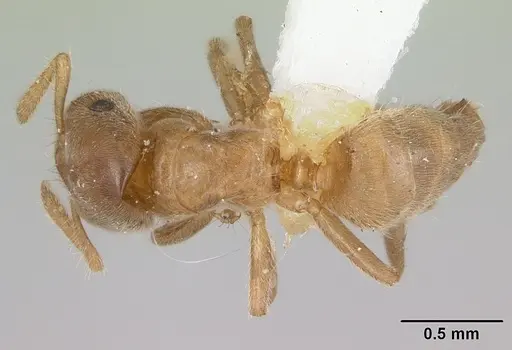
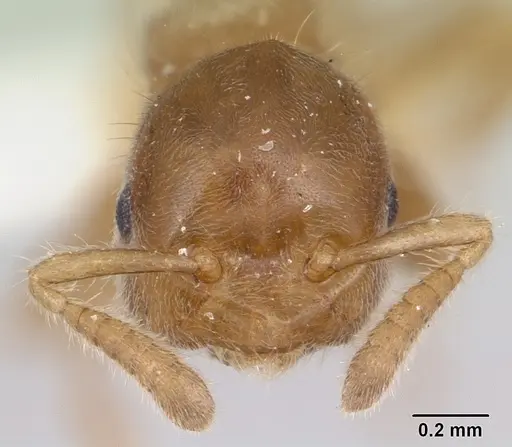
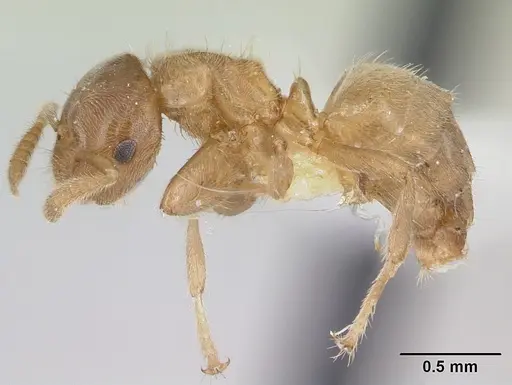
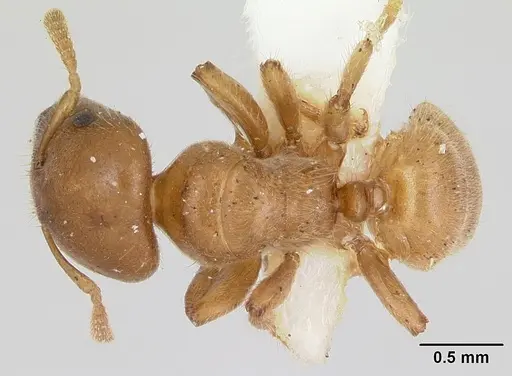
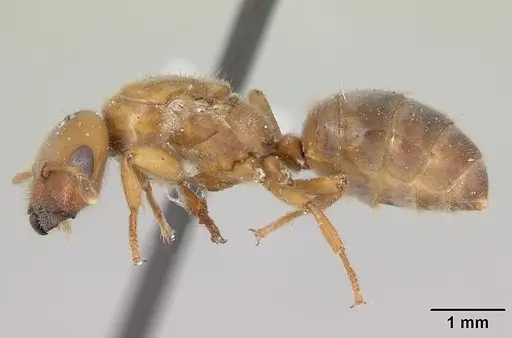
Cladomyrma crypteroniae is a small to medium-sized yellow ant belonging to the Formicinae subfamily. Workers come in two sizes: major workers reach 1.12-1.28mm in alitrunk length with heads measuring 1.06-1.13mm, while minor workers are smaller at 0.76-0.88mm [1]. Queens are notably larger at 2.40-2.72mm [1]. The species is distinguished by its entirely yellow body, smooth clypeus (the face plate above the mouth), and long erect hairs covering the alitrunk (the middle body section) with dense pubescence on the gaster (abdomen) [1]. This ant is endemic to Borneo and Sumatra in Southeast Asia, where it lives in a specialized mutualistic relationship with trees in the genus Crypteronia [1].
What makes C. crypteroniae particularly interesting is its ecological specialization as a plant-ant. It nests exclusively on Crypteronia griffithii trees, occupying domatia (specialized hollow structures) that the tree grows for its ant partners [1]. The species competes with its close relative Cladomyrma maschwitzi for access to these host plants, with crypteroniae tending to colonize a larger percentage of older saplings [1]. This specialized lifestyle means these ants have never been documented in standard antkeeping contexts and would require entirely different husbandry approaches than typical soil-nesting ants.
Quick Summary
- Difficulty: Expert
- Origin & Habitat: Borneo (Sarawak and Sabah in Malaysian Borneo) and Sumatra, Indonesia. Found in lowland tropical rainforest at elevations around 180m in Sumatra [1]. This species lives in obligate association with Crypteronia griffithii trees, nesting in domatia (specialized plant structures) on the host tree.
- Colony Type: Unconfirmed. As a plant-ant species, colony structure has not been studied in detail. Based on related Cladomyrma species, likely single-queen colonies, but this is unconfirmed.
- Size & Growth:
- Queen: 2.40-2.72mm [1]
- Worker: Major workers: 1.12-1.28mm alitrunk length, Minor workers: 0.76-0.88mm [1]
- Colony: Unknown, no colony size data exists in scientific literature
- Growth: Unknown, no development data available
- Development: Unknown, no development studies have been conducted on this species (No data exists for egg-to-worker development time. Related tropical plant-ants typically require several months, but this is purely speculative.)
- Antkeeping:
- Temperature: Unknown, no thermal studies exist. As a tropical species from Borneo and Sumatra, likely requires warm, humid conditions similar to other Southeast Asian ants. Based on typical tropical ant requirements, aim for 24-28°C. Adjust based on colony activity if ever successfully kept.
- Humidity: Unknown, no humidity data exists. As a plant-ant living in tree domatia, likely requires high humidity similar to rainforest conditions. Based on natural habitat, maintain consistently moist conditions.
- Diapause: Unknown, no seasonal studies exist. As a tropical species from consistent climates, diapause may not be required, but this is unconfirmed.
- Nesting: This species cannot be kept in standard ant nests. In the wild, they live inside specialized hollow structures (domatia) on Crypteronia trees. No established captive housing method exists for this species.
- Behavior: No behavioral studies exist for this species. Based on related plant-ants, they likely remain on or near their host plant, tending scale insects or aphids for honeydew. Escape risk cannot be assessed as no captive observations exist.
- Common Issues: This species is not suitable for captive keeping, it requires a living host plant (Crypteronia) which cannot be replicated in typical antkeeping setups, No established care protocols exist for this or related Cladomyrma species, The specialized plant-ant lifestyle means standard feeding, nesting, and humidity approaches would not apply, Wild-caught colonies would likely decline rapidly without access to their specific host plant
Why This Species Is Not Recommended for Antkeeping
Cladomyrma crypteroniae is one of the most specialized ant species you could potentially encounter, and for that reason, it is not suitable for captive keeping. Unlike most ants that nest in soil, rotting wood, or underground, this species lives exclusively inside specialized structures called domatia on Crypteronia trees [1]. These are hollow chambers that the tree itself grows specifically to house its ant partners, this is a classic example of a mutualistic relationship where both the ant and the tree benefit from living together. The ants protect the tree from herbivores, and the tree provides the ants with shelter and likely honeydew from scale insects the ants tend.
This specialized lifestyle means there are no established care protocols for Cladomyrma species in captivity. No one has documented successful captive breeding of any Cladomyrma species, let alone crypteroniae. The requirements would be extreme: you would need access to living Crypteronia trees (which are not commonly cultivated), maintain specific humidity and temperature conditions within the domatia, and replicate the complex ecological interactions that occur on the host plant. Even if you obtained a wild colony, it would almost certainly decline without access to its specific host plant.
The Plant-Ant Mutualism
Cladomyrma crypteroniae represents a fascinating evolutionary adaptation: the plant-ant relationship. In Southeast Asia, particularly in Borneo and Sumatra, certain trees in the genus Crypteronia have evolved specialized hollow structures called domatia that serve as housing for ant colonies [1]. These domatia typically form at the base of leaves, in stem cavities, or in other protected areas of the plant.
The relationship between C. crypteroniae and its host Crypteronia griffithii is not merely housing, it's a mutualistic partnership. The ants likely protect the tree from herbivorous insects and may also help with nutrient cycling through their waste. In return, the tree provides shelter and likely sustains the ants through honeydew-producing scale insects or other plant secretions. Research shows that C. crypteroniae competes with another plant-ant species, Cladomyrma maschwitzi, for access to these host plants, with crypteroniae tending to colonize larger percentages of older saplings [1]. This competition suggests the relationship has significant ecological implications for both ant species.
Distribution and Habitat
Cladomyrma crypteroniae has a limited distribution restricted to two islands in Southeast Asia: Borneo (specifically Sarawak and Sabah regions) and Sumatra (Indonesia) [1]. In Borneo, specimens have been collected from Lambir National Park in Sarawak and Danum Valley in Sabah [1]. In Sumatra, the species has been found in the Muarabungo district at approximately 180m elevation [1].
The habitat is lowland tropical rainforest, which means consistent warmth and high humidity year-round. The altitudinal range in Sumatra (around 180m) suggests this is a lowland species that would not tolerate cooler temperatures found at higher elevations. The association with Crypteronia griffithii trees appears to be obligate, the ants have not been found nesting independently of these specific plants [1]. Herbarium studies also suggest possible association with another Crypteronia species (C. macrophylla), though field data confirming this is lacking due to destruction of primary forest in collecting areas [1].
Identification and Morphology
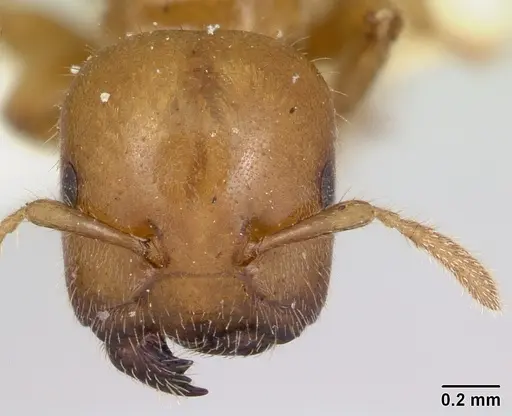
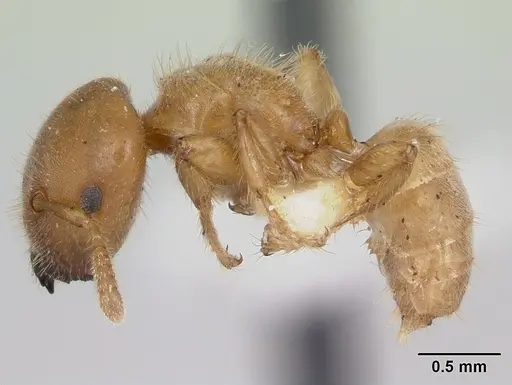
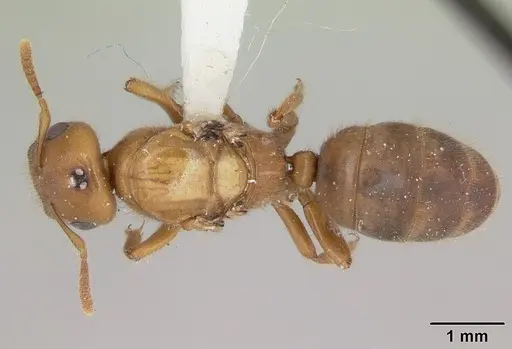
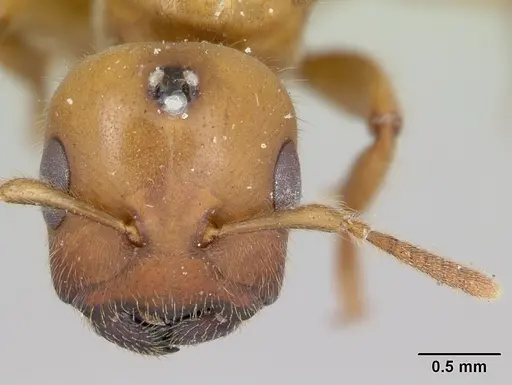
Cladomyrma crypteroniae workers are distinctive among Cladomyrma species due to several key morphological features. The body color is uniformly yellow, with some specimens showing slightly darker gaster [1]. The clypeus (the plate covering the upper lip) is smooth, not longitudinally striated as in some related species, this is a key distinguishing feature from C. maschwitzi [1]. Workers have long erect hairs covering the alitrunk (middle body section) and dense appressed pubescence on the gaster (abdomen) [1].
The species shows polymorphism with major and minor workers. Major workers are larger (1.12-1.28mm alitrunk length) with proportionally larger heads, while minor workers are smaller (0.76-0.88mm alitrunk length) [1]. Queens are significantly larger at 2.40-2.72mm alitrunk length and have a characteristic high, dorsally truncated petiole (the narrow waist segment) [1]. Sumatran populations differ slightly from Borneo populations, with queens being somewhat smaller and darker with slightly longer heads [1].
Frequently Asked Questions
Can I keep Cladomyrma crypteroniae in a formicarium?
No. This species cannot be kept in standard ant nests. They are obligate plant-ants that live exclusively inside specialized hollow structures (domatia) on Crypteronia trees. No established captive housing method exists for this species.
What do Cladomyrma crypteroniae ants eat?
This has not been studied. Based on related plant-ants, they likely consume honeydew from scale insects or aphids they tend on their host plant, plus small insects they capture. Standard ant foods would not be appropriate.
How big do Cladomyrma crypteroniae colonies get?
Unknown. No colony size data exists in scientific literature. Related plant-ant species typically maintain smaller colonies than ground-nesting ants, but specific numbers for this species have not been documented.
Are Cladomyrma crypteroniae good for beginners?
No. This species is not suitable for antkeeping at any experience level due to its extreme specialization requiring a living host plant. There are no established care protocols.
Where does Cladomyrma crypteroniae live in the wild?
Borneo (Sarawak and Sabah) and Sumatra, Indonesia. They live exclusively on Crypteronia griffithii trees, nesting inside domatia (specialized hollow structures) that the tree provides [1].
Do Cladomyrma crypteroniae need hibernation?
Unknown. As a tropical species from consistent climates, they likely do not require a diapause period, but this has not been studied.
How long does it take for Cladomyrma crypteroniae to develop from egg to worker?
Unknown. No development studies exist for this species. Related tropical ants typically require several months, but specific data is unavailable.
References

This caresheet is licensed under CC BY-SA 4.0 .
Literature
Loading...Loading products...