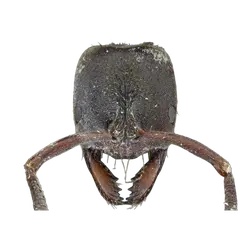
Bothroponera ancilla - "N/A"
Bothroponera ancilla is a striking ant species from tropical and subtropical rainforests of Africa, known for its dark brown to black body with lighter brown to reddish heads and reddish-brown to yellowish-brown mandibles. Workers of this species typically measure between 6.75 and 8.90 mm in total length, featuring a roughly sculptured head, pronotum, propodeum, petiole, and postpetiole. They possess smooth, shiny, and sparsely punctate mandibles with about 7 teeth. The body is covered with silver erect hairs on the mesosoma, while hairs on the petiole and gaster appear yellowish. This species belongs to the Bothroponera sulcata species complex and is a generalized predator of arthropods, including termites.
- Difficulty: Medium
- Origin & Habitat: Africa (Congo, Gabon, Kenya, Mozambique, Tanzania) in Equatorial rainforests, secondary forests, leaf litter, on the ground, under stones..
- Colony Type: Monogyne, semi-claustral founding.
- Size & Growth:
- Queen: Not specified
- Worker: 6.75-8.9mm
- Colony: Small (dozens to hundreds, typically 8 to 100 workers, with a mean of 43).. Slow growth.
- Antkeeping:
- Temperature: Maintain temperatures typically between 24-28°C (75-82°F) for optimal activity and brood development, mimicking their tropical habitat..
- Humidity: Provide a humidity gradient with a moist section around 60-80%, essential for their brood and overall colony health. Their natural environment is rainforest, so consistent humidity is key..
- Diapause: Not required. Not specified at Not specified.
- Nesting: Bothroponera species generally prefer subterranean nests, often found under stones, in leaf litter, or in rotting wood. For captivity, natural setups like Ytong, acrylic nests with a substrate layer, or natural soil/sand setups are recommended. Adequate substrate depth should be provided if using a natural setup to allow for tunneling..
- Behavior: Medium (towards handler and prey) aggressiveness.
- Common Issues: Mold in nest, Humidity fluctuations, Queen stress, Colony stalling if conditions are not met.
Bothroponera ancilla, like many Ponerinae ants, can be quite sensitive to disturbances. Keeping their nesting area dark and minimizing vibrations will help reduce stress on the colony. They are often found in leaf litter and on the ground in their natural habitat, so incorporating a varied substrate with organic elements can greatly benefit their well-being and encourage natural behaviors. These ants are predators, and while they may not be as aggressive as some larger Ponerines, they should still be handled with care to avoid stings.
Colony founding in the Bothroponera genus, including closely related species, is often semi-claustral, meaning the queen will forage for food during the founding stage. This implies that new queens will need to be offered small insect prey during this critical period. Observing their foraging behavior in the outworld can be fascinating, as they are known to be generalized predators of arthropods.
An interesting aspect of Bothroponera, observed in some species, is the presence of gamergates, which are mated workers capable of reproduction, especially if a queen is absent or in some species where queens have been lost. While B. ancilla is typically queen-right, the potential for gamergate development in stressful or queenless situations is worth noting for experienced keepers. This can lead to unique social dynamics within the colony.
Diet-wise, Bothroponera ancilla are primarily insectivorous, making them excellent pest controllers in their natural environment. In captivity, a varied diet of live insects like fruit flies, small roaches, and mealworms is essential. Be sure to gut-load these feeder insects to provide maximum nutrition to your colony. Offering a variety of prey mimics their natural foraging habits.
Due to their natural habitat in tropical regions, maintaining consistent high humidity levels without encouraging mold growth is a delicate balance. Good ventilation in the outworld and regular cleaning are crucial. Overfeeding can lead to uneaten prey rotting, contributing to mold, so feed appropriately for the colony's size and consumption rate. Providing multiple moisture points in the nest rather than saturating the entire setup can also be beneficial.