

Azteca snellingi
- Scientific Name
- Azteca snellingi
- Tribe
- Leptomyrmecini
- Subfamily
- Dolichoderinae
- Author
- Guerrero <i>et al.</i>, 2010
- Distribution
- Found in 1 countries
Azteca snellingi Overview
Azteca snellingi is an ant species of the genus Azteca. It is primarily documented in 1 countries , including Panama. Detailed taxonomic data and occurrence records can be further explored via authoritative databases such as AntWeb or the Global Biodiversity Information Facility (GBIF).
Azteca snellingi
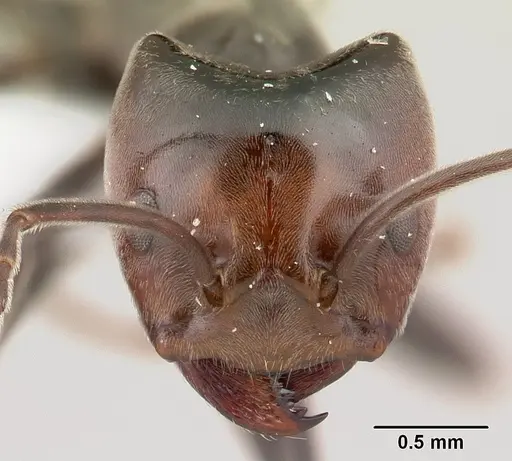
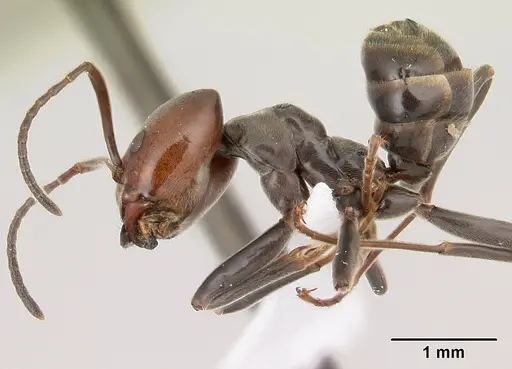
Azteca snellingi is a medium-sized arboreal ant belonging to the Dolichoderinae subfamily, found exclusively in the tropical forest canopy of Panama and Colombia. Workers measure 1.44-1.60mm in head width and display a distinctive coloration pattern unique within the aurita species group: a reddish-brown head contrasting with an entirely dark brown body. The species is characterized by a large, slightly wider-than-long head with strongly convex margins and a deep concavity on the posterior head margin. This ant was formally described in 2010 and named in honor of Roy Snelling, a notable researcher of Hymenoptera. What makes A. snellingi particularly interesting is its ecological role as a canopy-dwelling species that forms mosaic territories with other ant species, making it part of the complex ant communities in upper forest layers [1][2][3].
Quick Summary
- Difficulty: Expert
- Origin & Habitat: Tropical forest canopy of Panama and recently documented in Colombia's Sierra Nevada de Santa Marta. Specimens have been collected at heights of 20-24 meters in trees including Pouteria caimito and Luehea seemannii [2][3][4][5][6].
- Colony Type: Unknown, only the worker caste has been documented. No queens (gynes) or males have been described, making colony structure and social organization entirely unconfirmed [7].
- Size & Growth:
- Queen: Unknown, gyne unknown [7]
- Worker: 1.44-1.60mm head width [2]
- Colony: Unknown, only isolated workers collected, no established colonies studied
- Growth: Unknown
- Development: Unknown, no biological data available (This species is known only from workers collected in the canopy, no brood, founding behavior, or development has been documented)
- Antkeeping:
- Temperature: Unknown, no captive studies exist. Based on its tropical canopy habitat in Panama and Colombia, expect warm conditions in the mid-to-high 20s°C. Start around 24-27°C and monitor colony activity.
- Humidity: Unknown, no captive data. As a canopy-dwelling species from humid tropical forests, likely requires moderate to high humidity. Recommend starting with 60-80% relative humidity.
- Diapause: Unknown, no seasonal data available. As a tropical species from lowland forests in Panama and Colombia, diapause is unlikely but not confirmed.
- Nesting: Unknown, no natural nesting observations exist. As an arboreal species collected high in trees, they likely nest in hollow branches, tree cavities, or epiphytes. Captive recommendations cannot be made with confidence.
- Behavior: A. snellingi is part of the upper canopy ant mosaic, forming semi-exclusive territories. Studies show they share about 50% of their occurrence with other species and will compete at territory borders. They are moderately sized ants with large heads. Escape risk cannot be assessed due to lack of captive observations, but their size suggests standard containment measures should suffice. Temperament is unknown, no aggression or foraging observations have been documented in captivity [2][3][4][5].
- Common Issues: No captive husbandry information exists, this species has never been kept in captivity, Only worker caste known, obtaining a founding queen is likely impossible as queens have never been documented, Canopy-dwelling nature means completely unknown nesting requirements, No information on diet or feeding behavior in captivity, Wild-caught colonies may be impossible to establish since only isolated canopy workers have been collected
Species Identification and Distinction
Azteca snellingi belongs to the azurita group of the genus Azteca, which contains several similar-looking species. What sets A. snellingi apart is its distinctly larger head that is as long as it is wide (cephalic index 99-101), compared to A. aurita (85-88) and A. pilosula (89-90). The posterior head margin has a deep, continuous concavity, while the other two species show a V-shaped concavity. The coloration is unique among the group: workers have a reddish-brown head and entirely dark brown body, a pattern not seen in any other known worker in the aurita group. The metanotal groove is notably wide and deep, while it is absent or inconspicuous in related species. Workers also lack erect hairs on the petiolar node and posterior head margin, unlike A. pilosula which has these hairs [8][9][10][11][12][13][14][15][16][17][18].
Distribution and Habitat
This species was originally described from Panama, specifically from the San Lorenzo Forest in Colón Province. The type specimens were collected at canopy heights between 20 and 24 meters from two tree species: Pouteria caimito (Sapotaceae) and Luehea seemannii (Tiliaceae). In 2020,A. snellingi was recorded for the first time in South America, specifically in the dry forest foothills of Colombia's Sierra Nevada de Santa Marta at approximately 300m elevation. This record extends the known distribution about 677 km northeast from the type locality. The species appears to be exclusively arboreal, living in the upper canopy of tropical forests [2][3][4][5][6].
Ecological Role
In the canopy ant mosaic of the San Lorenzo forest, A. snellingi plays a significant territorial role. Research shows it is the second most frequent ant species at canopy level (26% of samples), surpassed only by A. trigona. These ants establish mosaic territories where they maintain semi-exclusive zones but share about 50% of their occurrence with other species. They have been observed competing at territory borders, including interactions with Camponotus species in the lower canopy. This territorial behavior suggests a well-organized colony structure with active defense, though the exact colony size remains unknown since only individual workers have been collected [2][3][4][5].
Current State of Knowledge
Azteca snellingi represents one of the least known ant species in the hobby. It was formally described in 2010,and to date, only the worker caste has been documented. The queen (gyne) and male castes remain unknown, meaning we have no information about their founding behavior, colony structure, nuptial flight timing, or basic biology. No established colonies have ever been studied, either in the wild or in captivity. This makes A. snellingi entirely unsuitable for ant keeping at this time, as no husbandry guidance can be provided. The species serves as a reminder that much of tropical ant biodiversity remains poorly understood, with many species known from only a handful of specimens collected during canopy studies [7].
Frequently Asked Questions
Can I keep Azteca snellingi as a pet ant?
No. This species has never been kept in captivity and no husbandry information exists. More critically, only workers have ever been documented, queens (gynes) and males are completely unknown, making it nearly impossible to obtain a founding colony.
Where does Azteca snellingi live in the wild?
They live exclusively in the tropical forest canopy at heights of 20-24 meters. They have been found in Panama and recently in Colombia's Sierra Nevada de Santa Marta, typically in trees like Pouteria caimito and Luehea seemannii.
How big do Azteca snellingi workers get?
Workers measure approximately 1.44-1.60mm in head width, making them medium-sized ants. They have a notably large head that is slightly wider than long, a characteristic that helps distinguish them from related species.
What do Azteca snellingi eat?
Unknown, no feeding observations have been documented. As canopy-dwelling ants in the Dolichoderinae subfamily, they may tend aphids or feed on honeydew, but this is entirely speculative.
Are Azteca snellingi good for beginners?
No. This species is entirely unsuitable for any ant keeper, beginner or experienced. No captive husbandry information exists, and obtaining a colony is likely impossible since only workers have ever been documented in scientific collections.
Do Azteca snellingi need hibernation?
Unknown, no seasonal data exists. As a tropical species from Panama and Colombia, diapause is unlikely, but this has not been studied.
How do Azteca snellingi form colonies?
Unknown, the queen (gyne) and male castes have never been described. We have no information about founding behavior, colony structure, or how many queens a colony might have.
What makes Azteca snellingi different from other Azteca ants?
A. snellingi has a unique coloration pattern within its species group, a reddish-brown head with an entirely dark brown body. It also has a distinctly larger head than related species A. aurita and A. pilosula, and lacks the erect hairs on the petiole and head that those species possess.
Can I find Azteca snellingi in the United States?
No. This species is native to Panama and Colombia in Central and South America. It has never been documented as an introduced species anywhere.
References

This caresheet is licensed under CC BY-SA 4.0 .
CASENT0179543
View on AntWeb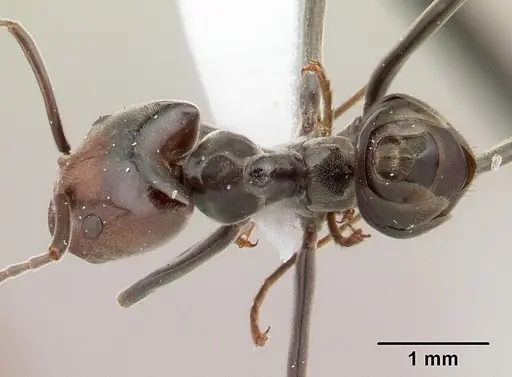
Literature
Loading...Loading products...