

Aphaenogaster kervillei
- Scientific Name
- Aphaenogaster kervillei
- Tribe
- Stenammini
- Subfamily
- Myrmicinae
- Author
- Forel, 1910
- Distribution
- Found in 1 countries
Aphaenogaster kervillei Overview
Aphaenogaster kervillei is an ant species of the genus Aphaenogaster. It is primarily documented in 1 countries , including Syrian Arab Republic. Detailed taxonomic data and occurrence records can be further explored via authoritative databases such as AntWeb or the Global Biodiversity Information Facility (GBIF).
Aphaenogaster kervillei
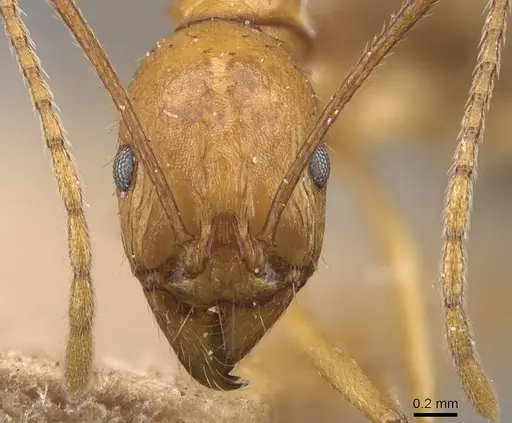
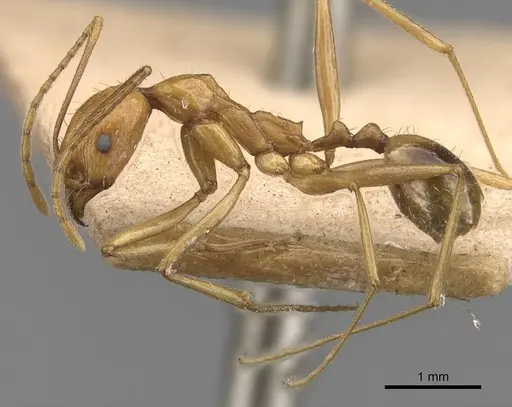
Aphaenogaster kervillei stands out immediately with its elongated head and striking two-tone coloration. Workers are pale yellow with a distinct dark brown band across the rear two-thirds of their first abdominal segment [1]. They are small ants, with heads less than 1mm wide and bodies estimated around 3-4mm long [1]. These ants come from the Eastern Mediterranean, with confirmed records from Israel and Syria, and possible presence in Lebanon and Turkey [1][2]. Despite their distinctive appearance, scientists know almost nothing about how they live in the wild, the queen has never been described, and their nesting habits, diet, and colony structure remain complete mysteries [3].
Quick Summary
- Difficulty: Expert
- Origin & Habitat: Eastern Mediterranean woodlands and scrublands of Israel, Syria, Lebanon, and Turkey [1][2]. Based on their range, they likely inhabit Mediterranean maquis and forest edges with warm, dry summers and mild, wet winters.
- Colony Type: Unknown. The queen has never been scientifically described [3]. While most Aphaenogaster species form single-queen colonies, this remains unconfirmed for Aphaenogaster kervillei.
- Size & Growth:
- Queen: Unknown, queen undescribed [3]
- Worker: Small. Head width 0.73-0.97mm, head length 1.07-1.39mm, with body length estimated around 3-4mm [1].
- Colony: Unknown [3]
- Growth: Unknown
- Development: Unknown, estimated 6-10 weeks at 25°C based on typical Mediterranean Myrmicinae patterns, though unconfirmed. (This is speculative, actual timing may differ significantly.)
- Antkeeping:
- Temperature: Likely 20-25°C during the active season based on Mediterranean climate data. A winter cooling period to 10-15°C is probably necessary, though unconfirmed.
- Humidity: Moderate humidity. Keep nest substrate slightly damp but not waterlogged, similar to Mediterranean woodland floor conditions.
- Diapause: Likely yes, temperate Mediterranean species typically require a winter rest period, though this is unconfirmed for this specific species.
- Nesting: Unknown in the wild. In captivity, provide small chambers with narrow entrances suitable for tiny ants. A test tube setup or small Y-tong nest would be appropriate based on related species.
- Behavior: Unknown. Their extremely small size means escape prevention must be excellent, they can squeeze through gaps that larger ants cannot.
- Common Issues: no confirmed care guidelines exist, you will be pioneering their captive care., founding behavior is completely undocumented, it is unknown if queens seal themselves in (claustral) or need to forage (semi-claustral)., workers are extremely small (head width under 1mm) and can escape through tiny gaps without proper barriers., seasonal requirements are unknown but likely include winter cooling based on their Mediterranean origin.
Identification and Appearance
Aphaenogaster kervillei workers are easy to identify once you know what to look for. They have unusually elongated heads compared to other Aphaenogaster, with the sides behind the eyes weakly rounded rather than strongly converging [1]. The head surface has longitudinal ridges only on the front half, while the back half is smooth [1]. Their coloration is distinctive: the head, middle body section, legs, and antennae are pale yellow, while the rear body section (abdomen/gaster) is yellow with a dark brown band covering the rear two-thirds of the first segment [1]. They have very short, upward-pointing spines on their rear body section [1]. Workers are small, with heads less than 1mm wide and bodies around 3-4mm long [1].
Natural Range and Habitat
These ants come from the Eastern Mediterranean region. They have been confirmed in Israel and Syria, with possible records in Lebanon and Turkey awaiting confirmation [1][2]. In Israel, they have been found in the central Coastal Plain region [4]. Their range falls within the Mediterranean climate zone, characterized by hot, dry summers and mild, wet winters. While their specific nesting habits are unknown, related Aphaenogaster species in this region typically nest under stones or in soil in woodland and scrubland areas.
Captive Care Guidelines
Keeping Aphaenogaster kervillei is challenging because no one has documented their care requirements. Based on patterns from other Aphaenogaster species and their Mediterranean origin, maintain them at roughly 20-25°C during their active period. They likely need a winter rest period (diapause) at 10-15°C for several months, though this is unconfirmed. Provide moderate humidity, the nest material should feel slightly damp but not soaked. For feeding, offer a mix of small insect prey like fruit flies or springtails and sugar sources such as honey water, but be prepared to experiment since their natural diet is unknown. Because of their tiny size, use very fine mesh or barriers like Fluon to prevent escapes.
The Challenge of Unknown Biology
The biggest obstacle to keeping Aphaenogaster kervillei is that scientists have never observed their basic biology. The queen has never been described, so we do not know if she seals herself in during founding or needs to forage [3]. We do not know how many queens form a colony, how large colonies grow, or how long development takes. This means you will be keeping a species without a safety net, there are no established protocols to follow if problems arise. Only experienced antkeepers comfortable with uncertainty should attempt this species.
Frequently Asked Questions
Can I keep Aphaenogaster kervillei in a test tube?
Probably, but this is unconfirmed. Most small Aphaenogaster species can be founded in test tubes, but since the founding behavior of Aphaenogaster kervillei is completely unknown, you may need to experiment. If the queen needs to forage (semi-claustral founding), a test tube would need to be connected to an outworld immediately.
How long does Aphaenogaster kervillei take from egg to worker?
Unknown. Based on related Aphaenogaster species, you might expect roughly 6-10 weeks at 25°C, but this is purely an estimate. The actual timing could be significantly different.
Do Aphaenogaster kervillei need hibernation?
Probably yes. They come from the Eastern Mediterranean where winters are mild but cool. A winter rest period at 10-15°C is likely necessary, though this has not been confirmed for this specific species.
What do Aphaenogaster kervillei eat?
Unknown in the wild. Aphaenogaster species are generally omnivorous, eating seeds, dead insects, and honeydew. Offer your colony small live prey like springtails or fruit flies, plus sugar water, and observe what they accept.
Are Aphaenogaster kervillei good for beginners?
No. This species is only suitable for expert antkeepers. There are no care guides, the queen is undescribed, and basic requirements like temperature, humidity, and founding behavior are completely undocumented.
How big do Aphaenogaster kervillei colonies get?
Unknown. Colony size has never been documented for this species.
Can I keep multiple Aphaenogaster kervillei queens together?
Not recommended. Combining unrelated queens of this species has not been documented. Most Aphaenogaster are single-queen species, so multiple queens would likely fight.
Where does Aphaenogaster kervillei come from?
They are native to the Eastern Mediterranean, specifically Israel and Syria, with possible presence in Lebanon and Turkey.
References

This caresheet is licensed under CC BY-SA 4.0 .
CASENT0907687
View on AntWeb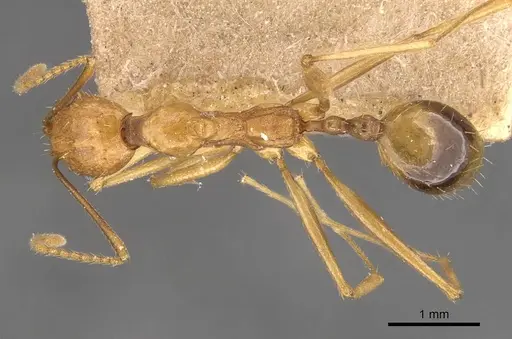
Literature
Loading...Loading products...