

Anochetus rufostenus
- Scientific Name
- Anochetus rufostenus
- Tribe
- Ponerini
- Subfamily
- Ponerinae
- Author
- Shattuck & Slipinska, 2012
- Distribution
- Found in 1 countries
Anochetus rufostenus Overview
Anochetus rufostenus is an ant species of the genus Anochetus. It is primarily documented in 1 countries , including Australia. Detailed taxonomic data and occurrence records can be further explored via authoritative databases such as AntWeb or the Global Biodiversity Information Facility (GBIF).
Anochetus rufostenus
Anochetus rufostenus is a small trap-jaw ant found only on Cape York Peninsula in Queensland, Australia [1][2]. Workers have a dark brown body with yellow-brown heads and legs, and bright yellow antennae and mandibles [1]. They are tiny ants, with workers measuring roughly 4mm in total length (their heads are about 1mm long and their middle body section about 1.3mm) [1]. The species was described in 2012 and remains one of the rarer Australian Anochetus, with all known specimens coming from pitfall traps set in savannah woodlands [1].
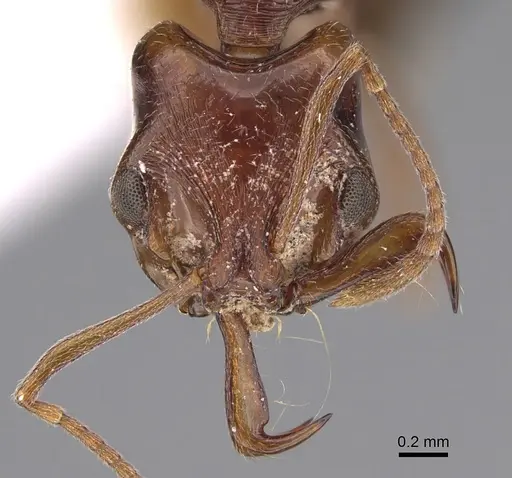
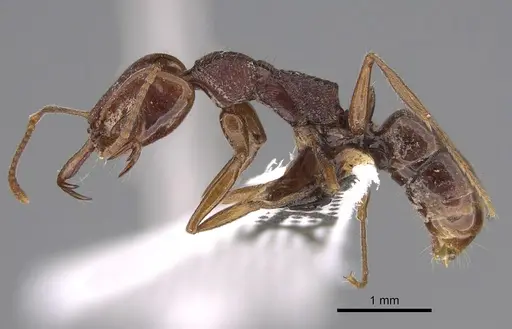
What sets them apart from similar species is their unique sculpturing pattern. The front of the head has texture extending slightly beyond the eyes, the pronotum (the first segment of the middle body) shows distinct lengthwise striations on both top and sides, and the mesonotum (the middle section) is completely smooth and shiny [1]. The petiole node is thick and trapezoid-shaped with a blunt, cut-off top and horizontal striations [1].
Quick Summary
- Difficulty: Expert
- Origin & Habitat: Cape York Peninsula, Queensland, Australia, savannah woodlands [1][2]
- Colony Type: Unknown, no studies on queen number or colony structure
- Size & Growth:
- Queen: Unknown
- Worker: Approximately 4mm (head length 1.02-1.03mm, mesosoma length 1.26-1.32mm) [1]
- Colony: Unknown
- Growth: Unknown
- Development: Unknown, no data available (Development time has not been studied for this species)
- Antkeeping:
- Temperature: Likely warm, around 25-28°C (estimated from tropical savannah habitat) [1]
- Humidity: Moderate humidity, substrate should feel damp but not waterlogged (inferred from savannah woodland habitat) [1]
- Diapause: Likely unnecessary, tropical species from northern Queensland [2]
- Nesting: Unknown, pitfall trap capture suggests ground-foraging but nest site unconfirmed [1]
- Behavior: Expected to show trap-jaw hunting behavior typical of the genus [2], but specific activity patterns unstudied. Small size means escape risk is high.
- Common Issues: extreme rarity in collections means captive care is completely undocumented., small worker size (roughly 4mm) requires excellent escape prevention with fine mesh barriers., unknown founding behavior makes starting colonies from queens experimental., lack of colony size data means housing requirements are unclear.
Identification and Physical Traits
Anochetus rufostenus workers have several distinctive features that separate them from similar species like Anochetus rufolatus. The pronotum (the first segment of the thorax) has distinct lengthwise striations on both the top and sides, grading into rougher texture toward the back [1]. The mesonotum (middle thoracic segment) is completely smooth and shining without any sculpturing [1]. The petiole node is robust with a thick, blunt, cut-off top and shows horizontal striations running along its entire height [1].
Coloration is also distinctive: the body is brown, while the head and legs are yellow-brown, and the antennae and mandibles are yellow [1]. The mandibles are substantial relative to body size at 0.54-0.56mm long, suggesting trap-jaw function [1]. Workers have heads about 0.92-0.97mm wide and 1.02-1.03mm long, with scapes (antenna bases) that do not reach the back corners of the head [1].
Natural Habitat and Distribution
This species is known only from Cape York Peninsula in far north Queensland, Australia [1][2]. All specimens were collected in pitfall traps placed in savannah woodlands, which tells us they forage on the ground but gives no information about where they nest [1].
The type specimen came from Hann River (15°1'S,143°52'E) collected between September 20 and October 15,1993 [1]. A second specimen came from Weipa collected in July 1982 [1]. This timing suggests they remain active during the dry season months, but this is speculative. The restricted range and limited collection records make this one of the rarer Australian ant species [1].
Trap-Jaw Biology and Expected Behavior
As members of the genus Anochetus, these ants likely possess spring-loaded trap-jaw mandibles used to strike prey [2]. The mandible length of 0.54-0.56mm is substantial relative to their head size, supporting this function [1]. However, no direct observations of hunting behavior exist for this species.
Related Anochetus species typically hunt small soil arthropods like springtails and tiny insects. They are generally cryptic ants that forage in leaf litter and soil. Based on their capture in pitfall traps, Anochetus rufostenus likely forages on the ground surface in open woodland habitats [1].
Captive Care Considerations
Keeping Anochetus rufostenus is currently experimental due to the complete lack of captive breeding records. Based on their tropical origin, they likely need warm temperatures around 25-28°C and moderate humidity [1]. Because they were caught in pitfall traps in open savannah rather than rainforest, they may prefer slightly drier conditions than some tropical ants, but this is unknown.
The founding behavior, whether queens seal themselves in (claustral) or need to forage (semi-claustral), is unconfirmed, making it difficult to advise on starting colonies. If you obtain a founding queen, provide both a sealed chamber option and access to food to cover both possibilities. Watch whether she attempts to leave the chamber, if she searches for food, she is semi-claustral and needs regular feeding until her first workers hatch.
Conservation and Availability
This is a rare species with only a handful of known specimens in scientific collections [1]. They are not available in the ant trade and should not be collected from the wild without proper permits. Their restricted range on Cape York Peninsula makes them vulnerable to habitat changes from fire, cattle grazing, and climate shifts.
For antkeepers, this means you are extremely unlikely to encounter this species in captivity. Any care information remains theoretical based on genus patterns rather than documented experience with this specific species.
Frequently Asked Questions
What do Anochetus rufostenus eat?
Their specific diet is unstudied, but as trap-jaw ants they likely hunt small live prey such as springtails and tiny insects [2]. They may accept sugar sources like honey water, but this is unconfirmed.
How long does Anochetus rufostenus take from egg to worker?
The development timeline is completely unknown for this species. Related Anochetus species may take 6-10 weeks at tropical temperatures, but this is only an estimate based on similar-sized ants.
Do Anochetus rufostenus need hibernation?
Likely not. They come from tropical northern Queensland where temperatures remain warm year-round [2].
Can I keep Anochetus rufostenus in a test tube?
Unknown. Their founding behavior has not been documented. If you have a founding queen, provide both a sealed chamber option and access to food to cover both claustral and semi-claustral possibilities.
Are Anochetus rufostenus good for beginners?
No. They are an expert-level species due to their extreme rarity, complete lack of care documentation, and small size.
How big do Anochetus rufostenus colonies get?
Colony size is unknown. Related Anochetus species typically have small to moderate colonies of a few dozen to a few hundred workers, but this is speculative.
Where can I buy Anochetus rufostenus?
They are not commercially available and are unlikely to enter the ant trade due to their rarity and restricted range on Cape York Peninsula [1].
References

This caresheet is licensed under CC BY-SA 4.0 .
CASENT0887809
View on AntWeb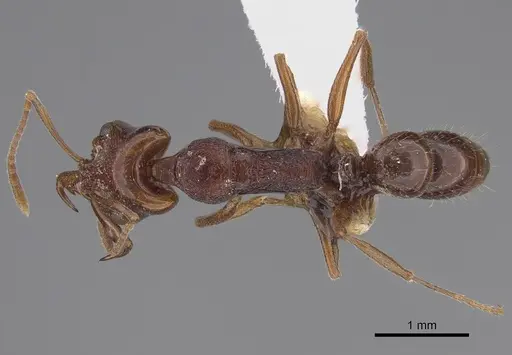
Literature
Loading...Loading products...