

Anillomyrma decamera
- Scientific Name
- Anillomyrma decamera
- Tribe
- Solenopsidini
- Subfamily
- Myrmicinae
- Author
- Emery, 1901
- Distribution
- Found in 1 countries
Anillomyrma decamera Overview
Anillomyrma decamera is an ant species of the genus Anillomyrma. It is primarily documented in 1 countries , including Viet Nam. Detailed taxonomic data and occurrence records can be further explored via authoritative databases such as AntWeb or the Global Biodiversity Information Facility (GBIF).
Anillomyrma decamera
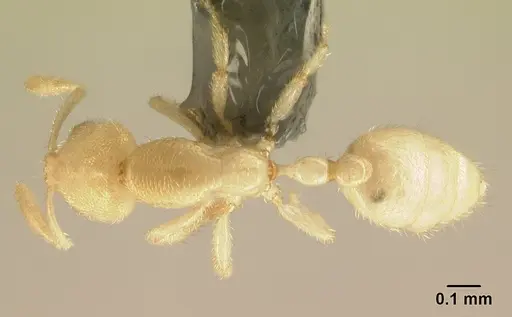
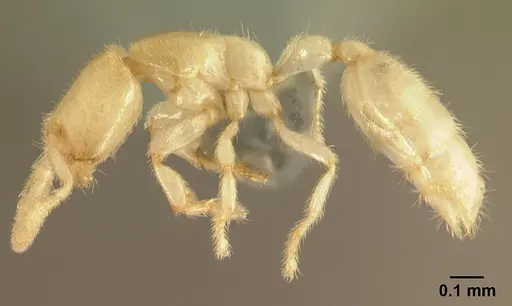
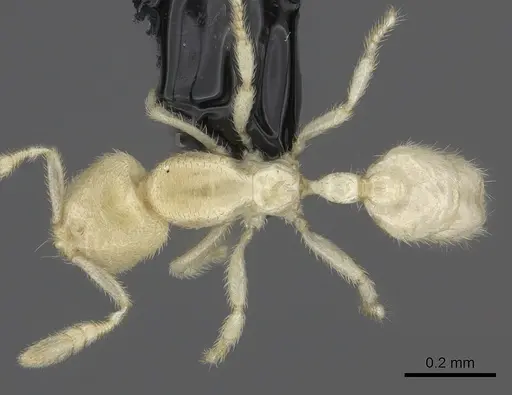
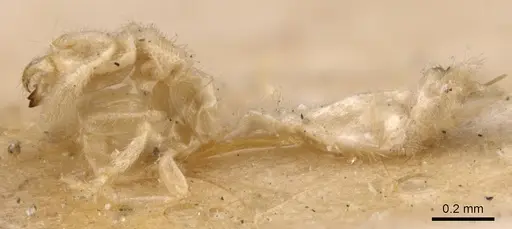
Anillomyrma decamera are tiny, pale yellow ants barely reaching 2 mm in length, with workers measuring just 1.7-1.9 mm from head to tail [1]. These subterranean specialists are completely blind, they lack eyes entirely, and live their entire lives underground in sandy soils across Southeast Asia, from India and Sri Lanka to Vietnam, China, and the Philippines [2][1]. Their bodies are soft and pale, adapted for moving through soil rather than defending against predators above ground [2].
What makes these ants truly unique is their intimate connection with termites and underground hunting. The original specimens were discovered inside termite nests, and researchers believe they actively hunt soil invertebrates, possibly including termites, using their well-developed stings to subdue prey [3][2]. They are rarely encountered by collectors, researchers typically find them only by burying pork sausage baits deep in sandy soil or sifting through soil cores from 30 cm below the surface [2][1][4]. This extreme subterranean lifestyle makes them one of the most challenging and mysterious ants to attempt keeping in captivity.
Quick Summary
- Difficulty: Expert
- Origin & Habitat: Tropical and subtropical Asia including India, Sri Lanka, Vietnam, southern China, Taiwan, Philippines, and Cambodia. Found in well-developed dry forests and abandoned agricultural lands with deep sandy loam soils, often at depths of 30 cm or more [2][1][5].
- Colony Type: Unknown, colony structure has not been documented. Based on related Solenopsidini tribe patterns, likely single-queen colonies, but this is unconfirmed.
- Size & Growth:
- Queen: Unknown, queens have not been described in scientific literature.
- Worker: 1.7-1.9 mm total length (HL 0.33-0.38 mm) [1][2].
- Colony: Unknown, likely small given subterranean habits and rarity in collections.
- Growth: Unknown, estimated slow based on specialized underground lifestyle.
- Development: Unknown, no development data exists for this species. (Development timing is completely unstudied. Related Myrmicinae ants typically take 6-12 weeks, but this is speculative.)
- Antkeeping:
- Temperature: Warm and stable, roughly 24-28°C (inferred from tropical distribution). Avoid fluctuations, subterranean species need thermal stability [2][1].
- Humidity: High humidity essential. Keep substrate damp but not waterlogged, think moist sandy forest soil, not wet mud. Surface should feel damp to touch with no dry pockets [2].
- Diapause: No, tropical species that remains active year-round [2].
- Nesting: Deep, sandy substrate required. Naturalistic setup with 20-30 cm of sandy loam soil in a dark container. Avoid standard formicaria, they need to burrow deep and require complete darkness [1][4].
- Behavior: Completely blind and subterranean. Workers navigate by touch and chemical trails underground. Non-aggressive toward humans but equipped with functional stings for hunting soil prey. Extremely photophobic, will stress and die if exposed to light. Tiny size makes escape prevention critical despite their slow movement [2][1].
- Common Issues: escape prevention is critical, at under 2 mm, workers squeeze through the tiniest gaps in standard mesh or lid fittings., desiccation kills quickly, subterranean ants need consistently moist substrate, dry conditions are fatal., starvation from inappropriate diet, they likely require live soil invertebrates (springtails, termites, small larvae) rather than standard ant foods like honey or large insects., light stress, even brief exposure to bright light can cause death in blind subterranean species, complete darkness is essential., queen acquisition is nearly impossible, no queens have been documented in field collections, and founding behavior is completely unknown.
Subterranean Lifestyle and Natural History
Anillomyrma decamera are true underground specialists. Unlike many ants that nest in soil but forage on the surface, these ants live their entire lives below ground at depths of 30 cm or more [1]. They are completely blind, lacking any eyes, and have soft, pale bodies adapted for moving through soil tunnels rather than defending against surface predators [2].
Researchers find them almost exclusively through specialized methods: burying pork sausage baits 10 cm deep in sandy soil, or sifting through deep soil cores taken from sandy loam of volcanic origin [2][4]. They have been collected in well-developed dry forests in Vietnam, abandoned agricultural land in the Philippines overgrown with bamboo and tree ferns, and lowland forests in Cambodia [2][5]. The type specimen came from a termite nest in Sri Lanka, suggesting a possible relationship with termites, either as predators or as tolerated nest guests [3].
Their distribution spans the Indomalayan region including India, Sri Lanka, Vietnam, China, Taiwan, and the Philippines, typically at low elevations (44-550 meters above sea level) [2].
Morphology and Identification
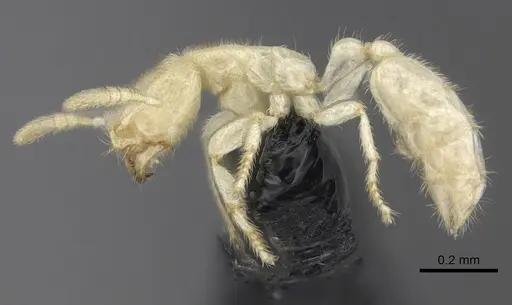
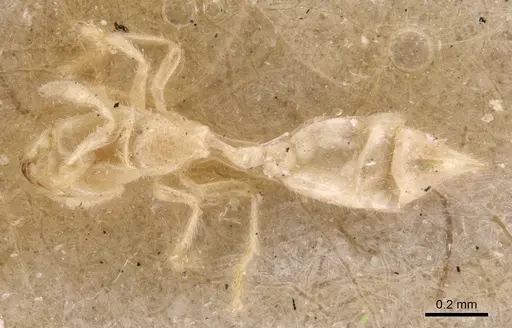
Workers are monomorphic, meaning all workers are the same size, measuring just 1.7-1.9 mm in total length with head lengths of 0.33-0.38 mm [1][2]. They are pale yellow in color with brownish mandibles, and their bodies are extensively depigmented (lacking dark coloring) and weakly hardened [2][1].
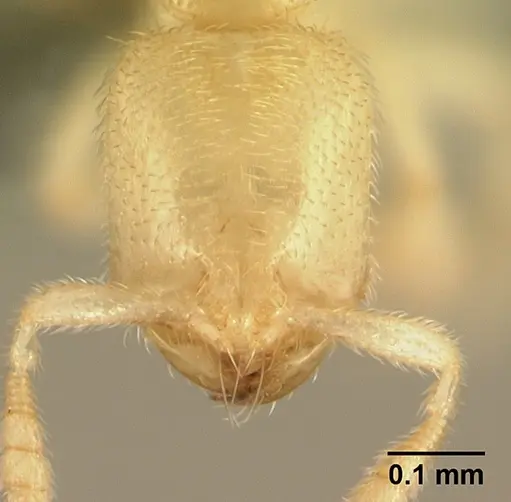
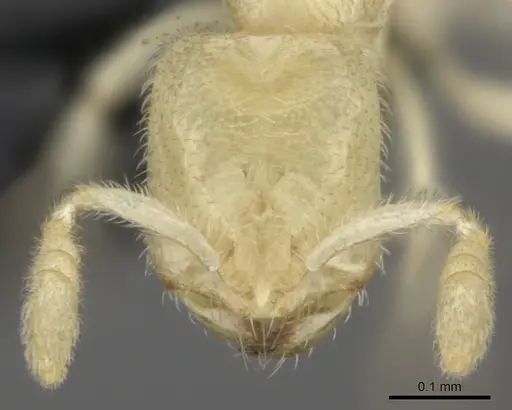
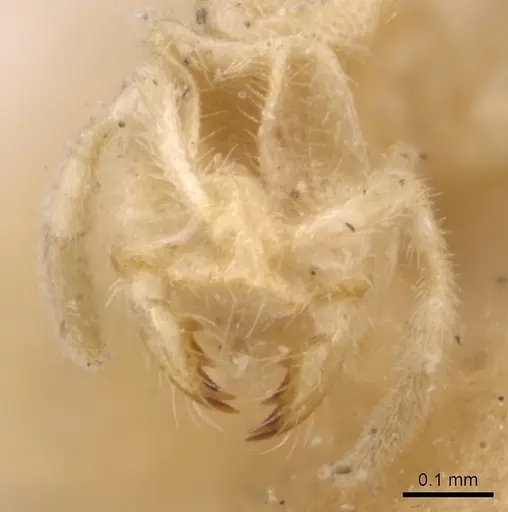
Key identifying features include their completely eyeless heads, short antennae that barely reach three-quarters of the way across the head, and mandibles with four distinct teeth (the fourth being smaller than the others) [2]. This four-toothed mandible separates them from their close relative Anillomyrma tridens, which has only three teeth [2]. They possess a strongly developed sting for subduing prey [2].
Males are dramatically different, much larger than workers at 5-6 mm in length, dark brown to blackish in color, with large eyes and wings [6]. The male was only described in 2019,highlighting how poorly known this genus remains.
Nesting and Substrate Requirements
In captivity, you must recreate their deep, sandy, dark underground habitat. Standard ant farms or formicariums with visible chambers will not work, these ants need to burrow deep and require complete darkness [1].
Use a deep container with at least 20-30 cm of sandy loam substrate, a mix of fine sand and organic soil that holds moisture but drains well [2][1]. The substrate should be kept consistently moist but never waterlogged. You can test moisture by squeezing a handful, it should hold together slightly but not drip water.
Provide no lighting. Cover the container completely with blackout material or keep it in total darkness. Even brief exposure to bright light can stress and kill these blind ants. If you need to check on them, use a dim red light for the shortest time possible.
Feeding and Diet
Based on field observations, Anillomyrma decamera are likely specialized predators and scavengers of soil invertebrates. Researchers successfully baited them with buried pork sausage, suggesting they scavenge animal matter underground [2][4]. Their well-developed stings and association with termite nests suggest they may actively hunt termites and other soft-bodied soil arthropods [3][2].
In captivity, offer small, soft-bodied live prey that moves through soil, springtails, tiny termites, small soil larvae, or minute worms. Cut larger prey into tiny pieces (they are only 2 mm long). They may accept small pieces of raw meat or fish as they did in bait traps, but live prey is likely more stimulating.
Sugar sources like honey or sugar water are probably unnecessary, these ants live underground where such resources are rare. Focus on protein sources. Remove uneaten food quickly to prevent mold growth in the humid environment they require.
Temperature and Environmental Stability
As a tropical species from India, Southeast Asia, and the Philippines, Anillomyrma decamera need warm, stable temperatures around 24-28°C [2][1]. Subterranean ants are particularly sensitive to temperature fluctuations because they cannot regulate their environment by moving to the surface.
Avoid placing the nest near windows, air conditioning, or heating elements. Use a heating cable on one side of the nest (not underneath) to create a gentle gradient, but ensure the entire setup stays within the tropical range. Temperatures below 20°C may slow them down dangerously, while overheating above 30°C can be fatal given their soft bodies and underground adaptations.
Humidity must remain high, 70-80% relative humidity with damp substrate throughout. Surface-drying is a major risk factor for colony failure.
Why This Species Is Expert-Only
Anillomyrma decamera represents one of the most challenging ants to keep in captivity. First, queens have never been documented in field collections, we do not know what they look like, how they found colonies, or if they are even available to collectors [2][1]. All collections to date have been of workers only.
Second, their specialized subterranean needs, deep sandy substrate, complete darkness, high humidity, and specific soil prey, make housing complex and expensive. Standard ant-keeping equipment is unsuitable.
Third, their tiny size (under 2 mm) makes escape prevention nearly impossible with standard setups, yet their rarity means losing even one worker is significant.
Finally, their biology is so poorly understood that any captive attempt would be experimental. You would be pioneering care methods with no established guidelines. Only attempt this species if you have extensive experience with other small Myrmicinae and can provide the specialized deep-soil, dark environment they require.
Frequently Asked Questions
Can I keep Anillomyrma decamera in a test tube?
No. These ants require deep, sandy substrate to burrow and cannot be kept in test tubes. They need at least 20-30 cm of soil depth and complete darkness, which test tubes cannot provide [1].
What do Anillomyrma decamera eat?
They likely eat soil invertebrates and scavenged protein. In the field, researchers caught them using buried pork sausage, suggesting they scavenge animal matter underground. They may also hunt termites and small soil arthropods using their stings [2][3].
Do Anillomyrma decamera need light?
No, they are completely blind and live underground. Light stresses them and can be fatal. Keep them in total darkness [2][1].
How big do Anillomyrma decamera colonies get?
Unknown. No colony size data exists for this species. Based on their subterranean lifestyle and rarity in collections, they likely remain small, but this is speculation [2].
Are Anillomyrma decamera good for beginners?
No, they are expert-only. They require specialized deep-soil setups, complete darkness, specific prey, and no queens have ever been documented for founding captive colonies [2][1].
What substrate is best for Anillomyrma decamera?
Sandy loam soil, a mix of fine sand and organic material that holds moisture but drains well. They need at least 20-30 cm of depth to burrow naturally [2][1].
How do I find Anillomyrma decamera queens?
Queens have never been documented in field collections. We do not know what they look like or how they found colonies. All available specimens are workers collected from deep soil samples [2][1].
Do Anillomyrma decamera need hibernation?
No. They are a tropical species from Southeast Asia and remain active year-round at warm temperatures [2].
Can I keep multiple Anillomyrma decamera queens together?
Unknown. Since queens have never been collected, we do not know their colony structure or whether they tolerate multiple queens. Do not attempt to combine unknown foundresses [2].
Why are my Anillomyrma decamera dying?
Common causes include: exposure to light (fatal for blind subterranean ants), substrate that is too dry (they need constant moisture), wrong food type (they need soil invertebrates, not standard ant foods), or temperature fluctuations (they need stable tropical warmth) [2][1].
References

This caresheet is licensed under CC BY-SA 4.0 .
Literature
Loading...Loading products...