

Aenictus wudangshanensis
- Scientific Name
- Aenictus wudangshanensis
- Subfamily
- Dorylinae
- Author
- Wang, 2006
- Distribution
- Found in 1 countries
Aenictus wudangshanensis Overview
Aenictus wudangshanensis is an ant species of the genus Aenictus. It is primarily documented in 1 countries , including China. Detailed taxonomic data and occurrence records can be further explored via authoritative databases such as AntWeb or the Global Biodiversity Information Facility (GBIF).
Aenictus wudangshanensis
Aenictus wudangshanensis are tiny army ants, with workers measuring just 2.3 to 3.2 millimeters long [1]. They have a reddish-brown body with yellowish-brown abdomens and legs, and distinctive rectangular subpetiolar processes that point sharply downward [1][2]. So far, scientists have only found workers, no queens or males have ever been collected [3]. They live in the evergreen broad-leaved forests of eastern China's Wudangshan and Gutianshan Nature Reserves, at elevations between 600 and 880 meters [2][1]. Like other army ants, they likely live in large nomadic colonies, though the specific habits of this species remain unstudied.
Quick Summary
- Difficulty: Expert
- Origin & Habitat: Hubei and Zhejiang Provinces, eastern China, evergreen broad-leaved forest at 600-880m elevation [2][1]
- Colony Type: Unknown, only worker caste documented [3]
- Size & Growth:
- Antkeeping:
- Temperature: Unknown, collected in August at mid-elevation [1]. Based on habitat, likely prefers warm stable conditions roughly 20-25°C.
- Humidity: Unknown, evergreen forest habitat suggests consistently moist conditions [2]
- Diapause: Unknown
- Nesting: Unknown, army ants are nomadic and do not construct permanent nests
- Behavior: Army ant foraging behavior expected, group raiding and nomadic lifestyle. Workers are extremely small (under 3mm) creating severe escape risks [1].
- Common Issues: no queens known means you cannot start a colony from a foundress., extremely small size (under 3mm) makes escape prevention nearly impossible in standard setups., army ant biology requires massive space and continuous food supplies unsuitable for home keeping., only ten specimens have ever been collected, biological data is extremely limited.
Identification and Appearance
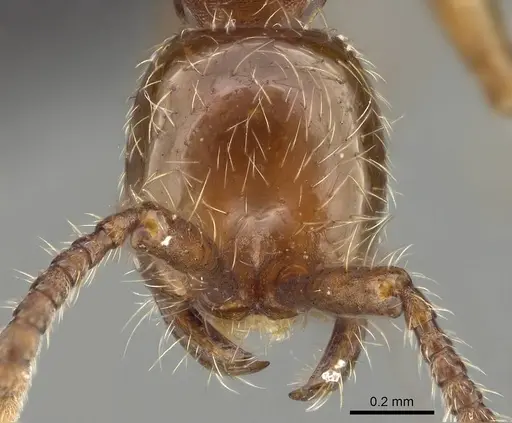
Workers of Aenictus wudangshanensis are among the smallest ants you might encounter, ranging from 2.31 to 3.15 millimeters in length [1]. They have elongated triangular mandibles with two large teeth at the tip followed by seven smaller teeth [1]. When closed, the mandibles leave a noticeable gap between them and the clypeus [1]. The subpetiolar process, the little bump underneath the waist segment, is rectangular and points downward with a sharp tip [1][2]. Their bodies are reddish-brown while the abdomen and legs are yellowish-brown [1]. The head is slightly longer than wide with convex sides, and the antennae have ten segments with the final segment about as long as the previous three combined [1].
Natural History and Habitat
This species comes from the mountains of eastern China. The original specimens were collected at 600 meters elevation in the Wudangshan Nature Reserve in Hubei Province [1]. Additional workers were found at 880 meters in the Gutianshan National Nature Reserve in Zhejiang Province, caught in pitfall traps set in secondary mixed evergreen broad-leaved forest [2]. Both locations are mid-elevation evergreen forests, suggesting this ant may be restricted to this specific habitat type [2]. The collection date of August 8th suggests summer activity [1].
Why This Species Cannot Be Kept in Captivity
You cannot keep Aenictus wudangshanensis in a standard ant setup for one simple reason: no queens have ever been found [3]. Without a queen, workers cannot reproduce and the colony will die out as workers age. Even if queens were discovered, army ants present extreme challenges for captivity. They are nomadic, meaning they do not build permanent nests but instead move frequently to new hunting grounds. They require massive amounts of space and food, army ant colonies in the wild can contain thousands to millions of individuals. The tiny size of these workers (under 3mm) also means they can escape through the smallest gaps in any container [1]. Combined with the fact that only ten specimens have ever been collected [1][2], this species remains a scientific curiosity rather than a pet.
Army Ant Biology
Aenictus wudangshanensis belongs to the subfamily Dorylinae, the true army ants [3]. Army ants are characterized by their nomadic lifestyle and group predatory behavior. Unlike most ants that establish permanent nests, army ants form temporary bivouacs and move regularly to exploit new food sources. They typically prey on other social insects and arthropods. Army ant queens are permanently wingless (dichthadiigynes) and colonies reproduce by fission, splitting into two parts, rather than by single queens flying out to start new nests. This biology makes them impossible to keep in standard formicaria designed for nest-building species.
Frequently Asked Questions
Can I keep Aenictus wudangshanensis in a test tube?
No. Only workers have ever been found, no queens are known to exist in collections. Without a queen, workers cannot lay eggs and the colony will die out. Additionally, army ants require specialized conditions impossible to provide in test tubes.
Do Aenictus wudangshanensis have a queen?
Queens have never been collected or described for this species. Like other army ants, they likely have wingless queens (dichthadiigynes), but these remain undiscovered for A. wudangshanensis specifically.
What do Aenictus wudangshanensis eat?
Their specific diet is unknown, but Aenictus army ants are specialized predators of other social insects and arthropods. They do not accept standard ant foods like sugar water or seeds.
How long until Aenictus wudangshanensis get their first workers?
Unknown. Founding behavior has never been observed, and no queens have been studied.
Are Aenictus wudangshanensis dangerous?
They are too small to sting effectively and pose no danger to humans. However, like all army ants, they can bite if handled.
Do Aenictus wudangshanensis need hibernation?
Unknown. They were collected in August in mid-elevation China, but their seasonal cycle has not been studied.
How big do Aenictus wudangshanensis colonies get?
Unknown. Army ant colonies typically contain thousands to millions of workers, but colony size for this specific species has never been documented.
Why are my Aenictus wudangshanensis dying?
If you have obtained these ants, they are likely dying because they are worker-only samples with no queen to replace them, or because army ants require specialized nomadic conditions impossible to provide in captivity.
References

This caresheet is licensed under CC BY-SA 4.0 .
CASENT0914927
View on AntWeb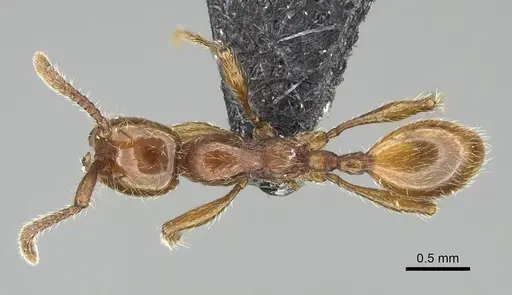

Literature
Loading...Loading products...