

Aenictus parahuonicus
- Scientific Name
- Aenictus parahuonicus
- Subfamily
- Dorylinae
- Author
- Jaitrong & Yamane, 2011
- Distribution
- Found in 0 countries
Aenictus parahuonicus Overview
Aenictus parahuonicus is an ant species of the genus Aenictus. It is primarily documented in 0 countries . Detailed taxonomic data and occurrence records can be further explored via authoritative databases such as AntWeb or the Global Biodiversity Information Facility (GBIF).
Aenictus parahuonicus
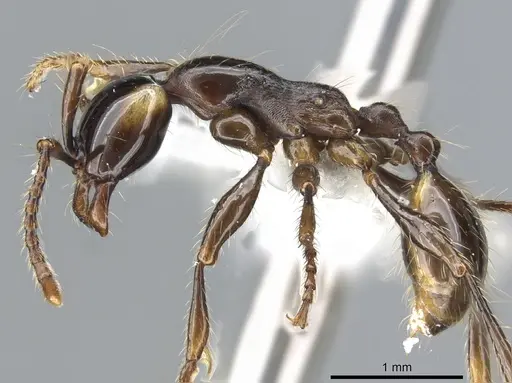
Aenictus parahuonicus is a small army ant native to Southeast Asia, with workers measuring 3.85-4.25 mm in length [1]. They are dark reddish-brown with a distinctive large pale spot on the back corner of the head and relatively short antennae [2]. You can tell them apart from similar army ants by looking at the propodeum, the back face is rounded and lacks the sharp rim found in related species [1].
These ants range from northern Vietnam to southern Thailand, living in varied habitats from open plantations to deep forest [1]. They are surface-active army ants that hunt both day and night, conducting raids across the ground to find prey [1]. Unlike typical ants that build permanent nests, they are nomadic, constantly moving to new hunting grounds and preying on other ant species (particularly Pheidologeton and Dolichoderus) and termites [1].
Quick Summary
- Difficulty: Expert (Not suitable for standard captive keeping)
- Origin & Habitat: Southeast Asia (Vietnam, Laos, Thailand, Malay Peninsula), found in open areas, plantations, light cover, and deep forest [1]
- Colony Type: Unknown, only workers are known from collections, likely single specialized queen (dichthadiiform) typical of army ants but unconfirmed [2]
- Size & Growth:
- Queen: Unknown, no queens collected or described [2]
- Worker: 3.85-4.25 mm [1]
- Colony: Unknown, army ants typically maintain large colonies with thousands of workers
- Growth: Unknown
- Development: Unknown (Army ants have complex cyclical development with nomadic and statary phases not suited to standard captive keeping)
- Antkeeping:
- Temperature: Warm tropical conditions, likely 24-28°C (inferred from Southeast Asian distribution)
- Humidity: High humidity preferred, keep substrate moist but not waterlogged (inferred from tropical forest habitat)
- Diapause: No, tropical species active year-round [1]
- Nesting: Nomadic species, does not build permanent nests, forms temporary bivouacs in soil or leaf litter [1]
- Behavior: Highly aggressive surface raiders, active day and night, nomadic lifestyle with frequent colony emigrations, preys on other ants and termites [1]
- Common Issues: cannot be kept in standard formicaria due to nomadic lifestyle and massive space requirements., require constant supply of live ant colonies and termites as prey., no known method to establish captive colonies from single queens., only worker caste is known, no queens have been collected or described.
Army Ant Biology and Raiding Behavior
Aenictus parahuonicus lives as a nomadic army ant. Colonies do not stay in one place long enough to build permanent nests. Instead, they form temporary bivouacs, living clusters of workers that protect the brood, and move frequently to new hunting grounds [1].
Workers conduct surface raids both during the day and at night, spreading across open ground, plantations, and forest floors to find prey [1]. When they locate other ant colonies or termite nests, they attack en masse, overwhelming defenders through sheer numbers. They have been documented preying specifically on Pheidologeton and Dolichoderus ants, as well as termites [1]. After depleting local prey resources, the entire colony emigrates to a new area [1].
Why This Species Is Not Suitable for Captive Keeping
This species cannot be kept in standard ant farms or formicaria. Their nomadic nature means they require enormous enclosures, essentially room-sized habitats, to accommodate their constant movement and foraging ranges [1].
They need a continuous supply of live prey, specifically other ant colonies and termites, which is impractical for most keepers [1]. Additionally, only workers are known from scientific collections, meaning the queen caste has never been documented for this species [2]. Without queens, founding a colony is impossible. Even if a colony were obtained, their constant emigrations and aggressive raiding would make them impossible to contain in anything but specialized research facilities.
Identification Features
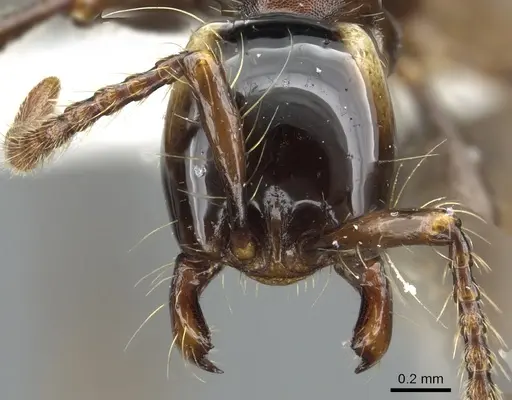
Workers are small (3.85-4.25 mm), dark reddish-brown, with a large pale typhlatta spot on the occipital corner of the head [1]. The head is slightly longer than broad with feebly convex sides [1].
The key identifying feature is the propodeum (the rear section of the middle body). In A. parahuonicus, the declivity (back face) of the propodeum is feebly convex with blunt lateral carinae but is not encircled by a distinct transverse carina or rim [1]. Similar species in the currax group have a sharp rim encircling this area.
Frequently Asked Questions
Can I keep Aenictus parahuonicus in a test tube?
No. Army ants require massive space and cannot be confined to test tubes. They are nomadic and need room to move, raid, and emigrate constantly [1].
How do I start an Aenictus parahuonicus colony?
You cannot start a colony with this species using standard antkeeping methods. Only workers have ever been collected and described, no queens are known [2]. Army ants reproduce by colony fission (splitting existing colonies), not by single queens founding new nests.
What do Aenictus parahuonicus eat?
They are specialized predators of other ants and termites. They have been observed preying on Pheidologeton and Dolichoderus ants, as well as termites [1].
Are Aenictus parahuonicus good for beginners?
Absolutely not. This species requires specialized facilities, constant live prey, and enormous space. They are research subjects, not pets [1].
How big do Aenictus parahuonicus colonies get?
The exact size is unknown, but army ants typically maintain colonies with thousands to millions of workers. They are not small colony species [1].
Do Aenictus parahuonicus need hibernation?
No. They are tropical ants from Southeast Asia and remain active year-round [1].
Can I keep multiple Aenictus parahuonicus queens together?
This question does not apply to this species. Army ants do not have multiple queens in the traditional sense, and no queens have ever been collected for this species [2].
How long until Aenictus parahuonicus get their first workers?
This is unknown and irrelevant for captive keeping since you cannot found a colony from a single queen. Army ant reproduction involves complex colony cycles and fission, not simple egg-to-worker timelines [1].
Are Aenictus parahuonicus dangerous?
They can bite but do not sting. However, their aggressive raiding behavior and massive colony sizes make them potentially dangerous to other insects in your home if they escape.
References

This caresheet is licensed under CC BY-SA 4.0 .
CASENT0903691
View on AntWeb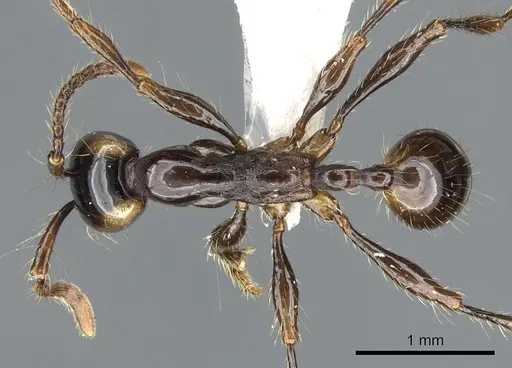
Literature
Loading...Loading products...