

Aenictus nganduensis
- Scientific Name
- Aenictus nganduensis
- Subfamily
- Dorylinae
- Author
- Wilson, 1964
- Distribution
- Found in 1 countries
Aenictus nganduensis Overview
Aenictus nganduensis is an ant species of the genus Aenictus. It is primarily documented in 1 countries , including Papua New Guinea. Detailed taxonomic data and occurrence records can be further explored via authoritative databases such as AntWeb or the Global Biodiversity Information Facility (GBIF).
Aenictus nganduensis
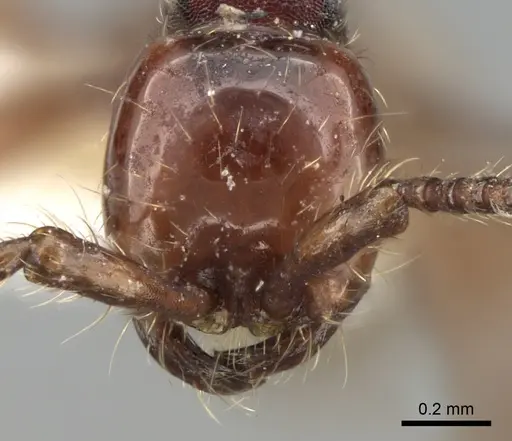
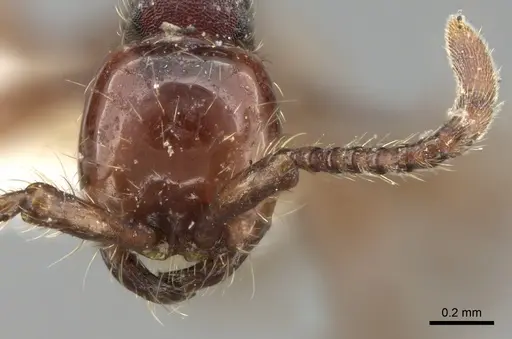
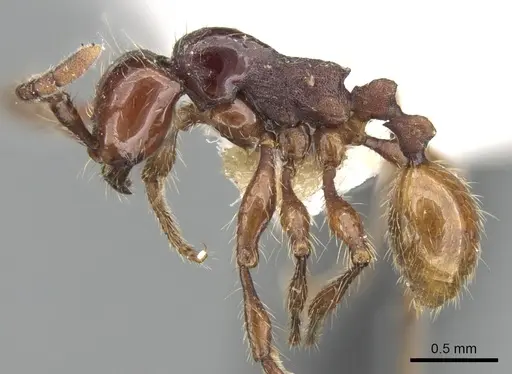
These are tiny true army ants from the mountains of New Guinea. Workers measure barely 2mm in length with distinctive narrow mandibles bearing three sharp teeth [1]. They belong to the ceylonicus species group within the army ant genus Aenictus [2]. Only worker ants have ever been found, no queens or males are known for this species, leaving much of their biology a mystery [3]. They were collected from midmountain rainforest at 1000 meters elevation on the Huon Peninsula [1]. Like other army ants, they likely live a nomadic lifestyle with no permanent nest, though specific behaviors remain unconfirmed.
Quick Summary
- Difficulty: Expert
- Origin & Habitat: Papua New Guinea, Huon Peninsula, Mongi-Mape Watershed at 1000m elevation in midmountain rainforest [1].
- Colony Type: Unknown, no queens have ever been observed for this species [3]. Based on typical Aenictus patterns, colonies likely contain thousands of workers with a single reproductive queen (monogyne), but this remains unconfirmed.
- Size & Growth:
- Queen: Unknown, no queens described [3].
- Worker: Approximately 2mm total length (HW 0.56-0.58mm, HL 0.61mm) [1].
- Colony: Unknown, based on typical Aenictus army ant patterns, likely hundreds to thousands of workers.
- Growth: Unknown
- Development: Unknown (Development timeline is unconfirmed. Army ants typically have rapid development compared to other ants, but specific data for this species does not exist.)
- Antkeeping:
- Temperature: Likely 22-26°C based on tropical montane location, though specific requirements are unconfirmed. Start at 24°C and observe activity levels.
- Humidity: High humidity required, damp rainforest conditions. Keep substrate moist but not waterlogged, with good ventilation to prevent mold.
- Diapause: No, tropical species from equatorial region [1].
- Nesting: Unknown. In nature, army ants are nomadic with no permanent nest structure. Captive housing is problematic and has not been documented for this species.
- Behavior: Presumably active predators like other army ants, though specific temperament is unconfirmed. Workers are extremely small (under 3mm) and can escape through the tiniest gaps, excellent escape prevention is essential despite their poor climbing ability on smooth surfaces.
- Common Issues: no known successful captive breeding, colonies cannot be founded without queens., extreme escape risk due to tiny worker size (under 3mm) requiring specialized barriers., nomadic lifestyle makes standard formicarium housing unsuitable., massive food requirements typical of army ants, likely need constant supply of live prey., unknown colony cycle and biology means captive care protocols are speculative.
Army Ant Biology and Captive Challenges
Aenictus nganduensis is a true army ant in the subfamily Dorylinae. Army ants are characterized by their nomadic lifestyle, they do not build permanent nests but instead form temporary bivouacs and move frequently to exploit new foraging areas. This presents an immediate housing problem for antkeepers: standard formicaria with fixed nest chambers are unsuitable for species that must roam constantly.
Additionally, army ants require enormous amounts of food. A colony may consume thousands of prey items per day, raiding other insect colonies and arthropod populations. In captivity, providing this volume of live prey is practically impossible for most keepers. The combination of unknown colony size, nomadic behavior, and massive food requirements makes this species effectively unkeepable using current antkeeping methods.
Most critically, no queens have ever been collected for Aenictus nganduensis [3]. Without queens, colonies cannot be founded or maintained long-term. Even if workers were collected, they would eventually die without replacement, and without knowing the queen's morphology or founding behavior, captive propagation is impossible.
Natural History and Habitat
This species is known only from the type locality at Nganduo in the Mongi-Mape Watershed of the Huon Peninsula, Papua New Guinea [1]. The collection site was midmountain rainforest at 1000 meters elevation, suggesting these ants prefer cool, humid tropical montane conditions rather than lowland heat.
As members of the ceylonicus species group, they likely share behavioral traits with other Asian army ants in this group, including specialized predation on other social insects and arthropods. Workers possess the characteristic army ant morphology: elongated mandibles for capturing prey, reduced eyes (typical for subterranean/leaf litter foraging), and a subpetiolar process that may help anchor them during prey capture [1].
The complete absence of queen specimens suggests either that queens are extremely rare, morphologically cryptic (possibly wingless and worker-like), or that collections have missed the reproductive caste entirely. In some Aenictus species, queens are winged and participate in nuptial flights, while in others they may be ergatoid (wingless). Without specimens, we cannot determine which applies here.
Housing Requirements
Standard antkeeping housing is unsuitable for Aenictus nganduensis. Test tubes and Y-tong nests assume a permanent nest site, but army ants require space to roam. If one were to attempt housing, a massive naturalistic setup with extensive foraging areas (outworlds) and multiple hiding spots might temporarily accommodate workers, but this is purely theoretical.
Escape prevention would be the primary challenge. Workers have a head width of only 0.56-0.58mm [1], meaning they can pass through gaps invisible to the naked eye. Any enclosure would need microscope-level sealing, fine mesh (under 0.4mm), tight-fitting glass lids with petroleum jelly barriers, and absolutely no cracks or tubing gaps.
Humidity should remain high to mimic montane rainforest conditions, but ventilation is critical to prevent fungal growth in the warm, wet environment. A soil-based naturalistic setup with live plants might help maintain humidity gradients, though the ants' nomadic behavior would likely result in them wandering constantly rather than settling.
Feeding and Diet
As army ants, Aenictus nganduensis are almost certainly obligate predators. They likely specialize in hunting other social insects, termites, and small arthropods in the leaf litter and soil. In captivity, this would translate to a constant need for live prey, not weekly feedings, but daily or continuous availability.
Suitable prey would include tiny soft-bodied insects: springtails, minute crickets, fruit flies, and possibly termite workers. Sugar sources like honey or sugar water are unlikely to be accepted given their predatory army ant biology, though this is unconfirmed for this specific species.
The sheer volume of prey required makes captive feeding impractical. A small army ant colony might require hundreds of prey items per week. Without the ability to forage naturally and raid multiple food sources, captive colonies would likely starve or fail to thrive.
Temperature and Humidity
Specific thermal requirements are unconfirmed, but the type locality at 1000m elevation in tropical New Guinea suggests moderate temperatures. Unlike lowland tropical ants that tolerate 28-30°C, montane species often prefer cooler conditions between 20-26°C. Start at 24°C with a slight gradient (warmer side 25°C, cooler side 22°C) and observe worker activity.
Humidity should be high, think damp forest floor, not dry air. The substrate should feel moist to the touch but not create standing water. Given the montane rainforest origin, aim for 70-80% relative humidity if measurable, though substrate condition matters more than exact percentages. Regular misting or a water feature in a naturalistic setup would help maintain these conditions.
No diapause is required, this is a tropical species from an equatorial region without significant seasonal variation [1]. Cooling them for winter would likely harm the colony.
Frequently Asked Questions
Can I keep Aenictus nganduensis in captivity?
Captive keeping of Aenictus nganduensis is not recommended and has not been documented. As army ants, they require nomadic space, massive amounts of live prey, and no queens have ever been found to start a colony [3]. Even if you collected workers, the colony would eventually die without a queen.
Do Aenictus nganduensis have queens?
No queens have ever been collected or described for this species [3]. They are known only from worker specimens [1]. It is unknown whether queens are winged, wingless, or morphologically distinct from workers.
What do Aenictus nganduensis eat?
Based on typical Aenictus army ant patterns, they are specialized predators feeding on other insects and arthropods. They likely hunt termites, other ant brood, and small soil-dwelling invertebrates. Sugar sources are probably not accepted.
How big do Aenictus nganduensis colonies get?
Colony size is unknown for this specific species. Based on other Aenictus army ants, colonies likely range from several hundred to several thousand workers, though this is inferred from genus patterns rather than direct observation.
What temperature do Aenictus nganduensis need?
Specific requirements are unconfirmed. Based on their montane rainforest origin at 1000m elevation in New Guinea, start around 22-26°C. They likely prefer moderate tropical temperatures rather than extreme heat.
Do Aenictus nganduensis need hibernation?
No. They come from tropical Papua New Guinea near the equator [1]. Tropical ants do not hibernate and should be kept at stable temperatures year-round.
Are Aenictus nganduensis dangerous?
They are not dangerous to humans due to their extremely small size (workers under 3mm) [1]. However, they can bite, and as army ants they may be aggressive toward other insects. The main risk is escape due to their tiny size rather than personal harm.
How long until Aenictus nganduensis get their first workers?
This is unknown and likely impossible to determine without finding a queen. Since no queens have ever been observed, founding behavior and development timelines remain completely unconfirmed [3].
References

This caresheet is licensed under CC BY-SA 4.0 .
CASENT0281957
View on AntWeb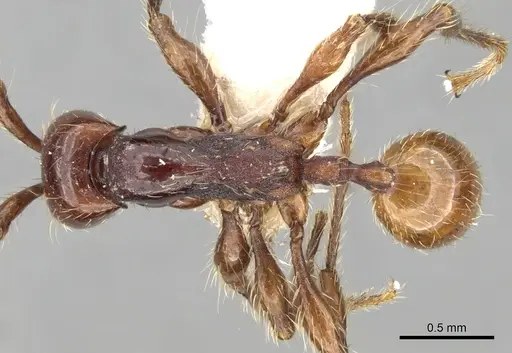
Literature
Loading...Loading products...