

Aenictus luzoni
- Scientific Name
- Aenictus luzoni
- Subfamily
- Dorylinae
- Author
- Wheeler & Chapman, 1925
- Distribution
- Found in 1 countries
Aenictus luzoni Overview
Aenictus luzoni is an ant species of the genus Aenictus. It is primarily documented in 1 countries , including Philippines. Detailed taxonomic data and occurrence records can be further explored via authoritative databases such as AntWeb or the Global Biodiversity Information Facility (GBIF).
Aenictus luzoni
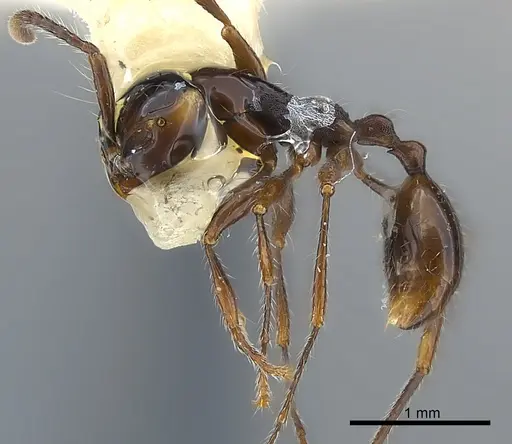
Aenictus luzoni is a tiny army ant from the Philippines, with workers measuring just under 4mm long. They have smooth, shiny reddish-brown bodies and distinctive pale yellow "Typhlatta spots", eye-like markings on the sides of their heads [1][2]. These ants are known only from the worker caste, no queens or males have ever been found [3]. They belong to the laeviceps species group within the army ant genus Aenictus [2][4]. Found only on Luzon and Negros islands, this species remains a complete mystery in terms of its colony life and breeding habits [1][3].
Quick Summary
- Difficulty: Expert
- Origin & Habitat: Luzon and Negros islands, Philippines [1][2]. Tropical forest habitats, specific microhabitat preferences unknown.
- Colony Type: Unknown, only worker ants have ever been collected [3]. Army ants typically reproduce by colony splitting (fission), but this has not been observed in this species.
- Size & Growth:
- Antkeeping:
- Temperature: Unknown. Based on their tropical Philippine origin, they likely prefer warm conditions around 25-28°C, but this is unconfirmed.
- Humidity: Unknown. Tropical forest origin suggests high humidity needs, but specific requirements are undocumented.
- Diapause: Unknown. Tropical army ants typically do not hibernate, but this is inferred from related species, not confirmed data.
- Nesting: Unknown. Army ants are typically nomadic and do not build permanent nests, instead occupying temporary bivouacs.
- Behavior: Army ants are nomadic predators that require massive colony sizes to survive. They likely prey on small arthropods and possibly termites. Workers are small (under 4mm) and would require excellent escape prevention if kept.
- Common Issues: impossible to start a colony from a single queen since no queens are known to science., army ant biology requires specialized care, massive colony sizes, and constant food supply that most keepers cannot provide., complete lack of biological data means all care parameters are guesswork., tiny worker size (under 4mm) means they can escape through minute gaps.
Why Aenictus luzoni Cannot Currently Be Kept
You cannot keep Aenictus luzoni in captivity because only worker ants have ever been found [3]. Without queens, there is no way to start a colony. Army ants like Aenictus reproduce through colony fission, where a large colony splits into two, rather than through single queens founding new nests. This means you would need to collect an entire established colony with its queen, which has never been documented for this species. Additionally, army ants require massive colony sizes (often thousands or tens of thousands of workers) to maintain their social structure and feeding habits. These requirements make them unsuitable for standard ant keeping setups.
What We Know About Their Appearance
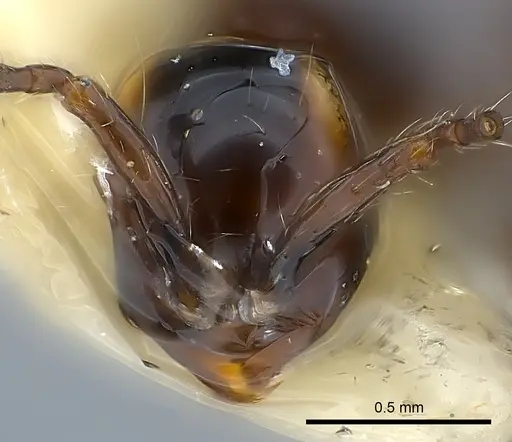
Workers are small, measuring 3.95-4.00 mm in total length with a head width of only 0.78 mm [2]. They have smooth, shiny reddish-brown bodies with sparse hairs on the back section [1]. The head is slightly longer than wide with a nearly straight back margin [1]. Their antennae have 10 segments and are relatively short, not reaching the back corners of the head [1]. A key identifying feature is the presence of large yellow "Typhlatta spots", pale eye-like markings located on the sides of the head near the back [1]. The underside of the waist segment (subpetiolar process) is weakly developed and triangular in shape [2].
Army Ant Biology and Natural History
Aenictus luzoni belongs to the true army ants (subfamily Dorylinae). Army ants are nomadic predators that do not build permanent nests. Instead, they form temporary living structures called bivouacs using their own bodies. They are specialized predators that hunt in groups, likely targeting small arthropods and possibly termites. While the specific diet of A. luzoni is unknown, related species in the laeviceps group are known to raid termite colonies. Army ants require constant food supplies and cannot tolerate periods of starvation that smaller colonies might survive. They also lack a permanent home, making them difficult to house in standard formicarium setups. [3]
Housing Requirements (Hypothetical)
If you somehow obtained a colony, you would need an enormous setup. Army ants require large spaces to accommodate their nomadic behavior and massive colony size. A standard test tube or small formicarium would be completely inadequate. You would need a large, sealed container with excellent escape prevention, remember these workers are only 4mm long and can squeeze through tiny gaps. The setup would need constant high humidity and tropical temperatures, but specific parameters are unknown. Most importantly, you would need a constant supply of appropriate prey, likely termites or small insects, delivered daily.
Temperature and Environment
Specific temperature requirements are unknown for this species. However, since they come from the tropical Philippines, they likely prefer warm conditions between 25-28°C. They probably do not require hibernation (diapause) given their tropical origin, but this is inferred from related species rather than direct observation. High humidity would likely be necessary given their forest habitat, but exact percentages are undocumented. Without established colonies in captivity, these parameters remain speculative. [1][2]
Frequently Asked Questions
Can I keep Aenictus luzoni in a test tube?
No. This species is not suitable for test tube keeping. Only workers are known to exist (no queens), so you cannot start a colony. Additionally, as army ants, they require massive colony sizes and specialized care that test tubes cannot provide.
How do I start an Aenictus luzoni colony?
You cannot start a colony of this species. No queens have ever been found, and the species has never been kept in captivity. Army ants reproduce by colony fission (splitting), not by single queens founding nests, so you would need to collect an entire wild colony, which has never been successfully documented for this species.
What do Aenictus luzoni eat?
The specific diet is unknown. Based on related army ants in the laeviceps group, they likely prey on small arthropods and possibly termites. Army ants are specialized predators that require constant food supplies.
How big do Aenictus luzoni colonies get?
Colony size is unknown. Army ant colonies typically number in the thousands or tens of thousands, but specific data for A. luzoni does not exist.
Why are only workers known for Aenictus luzoni?
Army ant queens are extremely rare to find because they are massive, wingless, and stay deep within the colony. Most army ant species are described from workers only. The queens and males of A. luzoni have never been collected by scientists.
What is the Typhlatta spot on Aenictus luzoni?
Typhlatta spots are pale, eye-like markings on the sides of the head. In A. luzoni, these spots are large and yellow, located near the back of the head. They are a characteristic feature of this species group.
Where does Aenictus luzoni live?
This species is found only in the Philippines, specifically on Luzon and Negros islands. They were originally collected from Ilocos Norte Province on Luzon.
References

This caresheet is licensed under CC BY-SA 4.0 .
CASENT0217378
View on AntWeb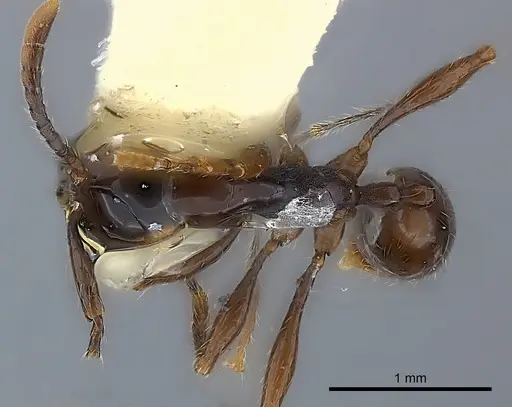
Literature
Loading...Loading products...