

Aenictus hitai
- Scientific Name
- Aenictus hitai
- Subfamily
- Dorylinae
- Author
- Gómez, 2022
- Distribution
- Found in 2 countries
Aenictus hitai Overview
Aenictus hitai is an ant species of the genus Aenictus. It is primarily documented in 2 countries , including Kenya, Mozambique. Detailed taxonomic data and occurrence records can be further explored via authoritative databases such as AntWeb or the Global Biodiversity Information Facility (GBIF).
Aenictus hitai
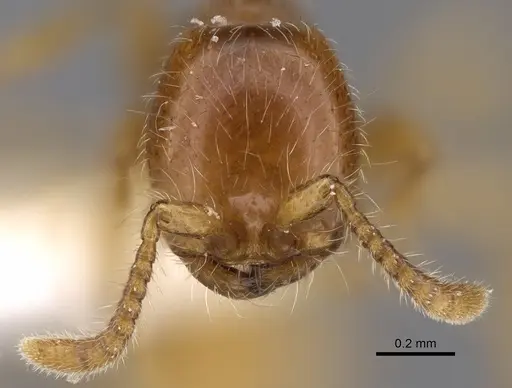
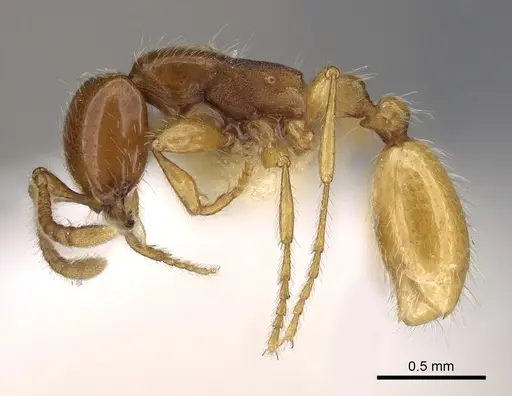
Aenictus hitai are tiny army ants from East Africa, with workers measuring under a millimeter in head width. They show clear size differences within the worker caste, minor workers are elongate and light yellow, while major workers have broader heads and darker brown coloration [1]. Their bodies are covered in dense, short white hairs that distinguish them from related species [1]. These ants inhabit dry forests and Miombo woodlands in Kenya and Mozambique [1][2].
As members of the army ant genus Aenictus, they have a highly specialized lifestyle that makes them unsuitable for standard antkeeping. Only worker ants have ever been found, no queens are known for this species [1]. Like other army ants, they likely live in large nomadic colonies that move constantly through the forest rather than building permanent nests, and they reproduce by splitting existing colonies rather than through single queens starting new nests [2].
Quick Summary
- Difficulty: Expert
- Origin & Habitat: Kenya and Mozambique, found in dry forest and Miombo woodland [1][2].
- Colony Type: Army ant, only worker caste known, no queens described. Colonies likely reproduce by fission (splitting) rather than single-queen founding [1][2].
- Size & Growth:
- Queen: Unknown, no queens have been described for this species [1].
- Worker: 0.28-0.56 mm head width, approximately 1-2 mm total body length (extremely small) [1].
- Colony: Unknown, likely hundreds to thousands of workers based on typical Aenictus patterns [2].
- Growth: Unknown, army ant colonies grow through fission events rather than steady worker production.
- Development: Not applicable, this species cannot be founded from a single queen. Army ant colonies reproduce by splitting existing colonies [2]. (No founding data exists. Colonies must be collected as fragments from the wild, which is extremely difficult and often unsuccessful.)
- Antkeeping:
- Temperature: Likely 24-28°C based on Afrotropical dry forest habitat, though exact requirements are unconfirmed [1].
- Humidity: Moderate to dry conditions inferred from dry forest habitat, substrate should not be wet [2].
- Diapause: Not required, tropical species from Kenya and Mozambique do not experience cold winters [2].
- Nesting: No permanent nest, army ants form temporary bivouacs. Standard test tubes, formicaria, and acrylic nests are unsuitable [2].
- Behavior: Nomadic army ant behavior, colonies constantly move and hunt. Extremely small size (under 1mm) creates severe escape risk even through tiny gaps. Specialized predatory lifestyle requires constant movement and large foraging areas [2].
- Common Issues: no queens available means colonies cannot be started traditionally, only wild colony fragments can be collected, which rarely establish in captivity., extremely small worker size (under 1mm) allows escape through the smallest gaps in any standard ant setup., nomadic lifestyle requires massive enclosures with constant space to roam, impossible to provide in home antkeeping setups., specialized army ant diet requires constant supply of live prey and likely specific prey types that are difficult to maintain., colony fragments collected from the wild often die from stress or improper composition of worker/brood ratios.
Army Ant Biology and Why They Cannot Be Kept in Standard Setups
Aenictus hitai belongs to the army ant genus Aenictus, which has biological requirements that make captivity nearly impossible for hobbyists. Unlike typical ants that live in permanent nests with a single queen, army ants have a nomadic lifestyle where the entire colony moves regularly through the forest [2]. They do not build permanent nests but instead form temporary living structures called bivouacs using their own bodies.
Only workers have ever been collected for this species, no queens, males, or even eggs have been documented [1]. This means you cannot start a colony from a single queen in a test tube. Army ant colonies reproduce by fission, where a large colony splits into two parts, each taking some workers and brood. In captivity, this would require collecting a substantial fragment of a wild colony, which is technically challenging and ethically questionable for a rare species with few known collections.
The colony likely requires massive foraging territories to find enough food. Attempting to confine them to a standard formicarium would result in stress, starvation, or constant escape attempts.
Morphology and Worker Polymorphism
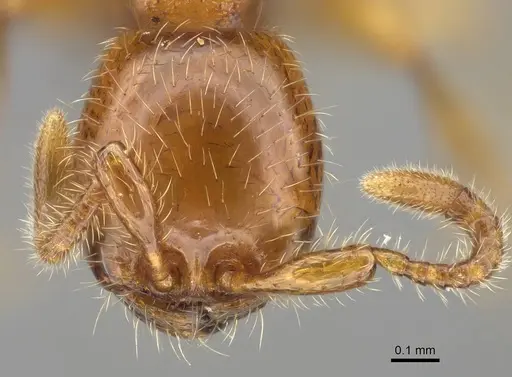
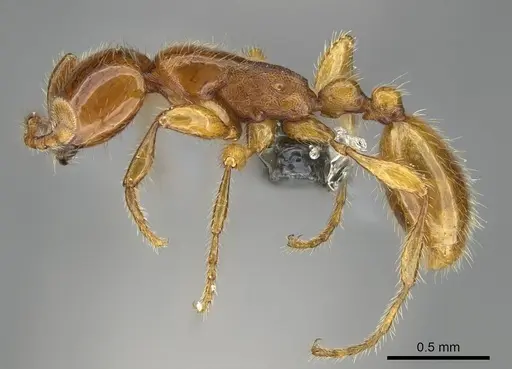
These ants are among the smallest you might encounter in antkeeping, with head widths ranging from 0.28 mm to 0.56 mm, smaller than the thickness of a credit card [1]. Workers show clear polymorphism, meaning they come in different sizes within the same colony. Minor workers have elongated rectangular heads and lighter yellow coloration, while major workers develop broader, more square heads and darker brown coloring [1].
You can identify them by their dense covering of short white hairs, which is heavier than in related species [1]. The back of their thorax (dorsopropodeum) has a distinct net-like texture even in the smallest workers, unlike smooth-backed relatives [1]. Their antennae are short, barely reaching the middle of the head when folded back [1].
Natural Habitat and Distribution
Aenictus hitai has been found only in Kenya and Mozambique, specifically in dry forest habitats and Miombo woodland [1][2]. Miombo woodland is a tropical grassland with scattered trees, characterized by a dry season and wet season pattern. The type specimens were collected in Kajiado, Kenya in September 1978 [1].
The scarcity of collections suggests either extreme rarity or difficulty in sampling rather than true abundance. Only 30 specimens total were used to describe the species (one holotype and 29 paratypes), all collected on the same date [1]. This makes them one of the least documented Aenictus species, with virtually no behavioral or ecological data beyond their habitat type.
Diet and Feeding Requirements
While specific diet studies do not exist for Aenictus hitai, all Aenictus species are specialized predators that hunt other arthropods, particularly other ants, termites, and small soil-dwelling invertebrates [2]. They hunt in groups using chemical trails to coordinate attacks.
In captivity, this would require a constant supply of appropriate live prey, not just occasional feeding but a steady stream of small insects, possibly including other ant species. Their tiny size means they need very small prey items, likely including springtails, mites, and ant larvae. The volume of food required to sustain even a small army ant colony would be substantial, and they cannot survive on sugar water or standard ant keeping foods like honey and seeds.
Housing Requirements
Standard ant keeping equipment is completely unsuitable for Aenictus hitai. Test tubes, formicaria, plaster nests, and acrylic setups all fail to meet their biological needs [2]. These ants require space to roam constantly, and their tiny size means they can escape through gaps invisible to the naked eye.
If one were to attempt keeping them (which is not recommended), it would require a massive naturalistic setup with soil substrate, live plants, and enough space for the colony to move and forage naturally, essentially a room-sized terrarium with carefully controlled conditions. Even then, without knowledge of their specific humidity, temperature, and dietary needs, survival would be unlikely.
Frequently Asked Questions
Can I keep Aenictus hitai in a test tube?
No. Army ants like Aenictus hitai cannot be kept in test tubes or standard formicaria. They require massive space to roam constantly and do not build permanent nests. Additionally, their extremely small size (under 1mm) makes escape inevitable from standard setups [2].
How do I start an Aenictus hitai colony?
You cannot start a colony from a single queen because no queens have ever been found for this species. Army ants reproduce by splitting existing colonies (fission), not by queens founding alone. You would need to collect a wild colony fragment, which is extremely difficult, rarely successful, and not recommended for this poorly known species [1][2].
What do Aenictus hitai eat?
Specific diet information is unknown, but like all army ants they are specialized predators that hunt other arthropods. They likely require constant access to live prey such as other ants, termites, and small soil invertebrates. They cannot survive on sugar water or standard ant keeping foods [2].
How long until Aenictus hitai get their first workers?
This question does not apply to army ants. Aenictus hitai does not develop through single-queen founding with 'first workers.' Colonies grow by splitting existing colonies, not by queens raising workers from eggs [2].
Do Aenictus hitai need hibernation?
No. They come from tropical Kenya and Mozambique where temperatures remain warm year-round. They do not require diapause or hibernation [2].
How big do Aenictus hitai colonies get?
Exact colony size is unknown, but based on other Aenictus species, they likely contain hundreds to thousands of workers. Army ant colonies are typically much larger than those of typical garden ants [2].
Can I keep multiple Aenictus hitai queens together?
This species is not known to have queens in the traditional sense. Army ant colonies may have multiple reproductive individuals, but they are not comparable to typical queen ants. Combining separate colony fragments would likely result in fighting [2].
Are Aenictus hitai dangerous?
While they are army ants, their extremely small size (workers under 1mm) means they cannot sting humans effectively. However, they can bite, and keeping them is impractical due to their specialized biology rather than danger to humans [1].
Why are my Aenictus hitai dying?
If you have obtained these ants, they are likely dying because army ants cannot be kept in standard ant setups. They require constant movement, massive foraging space, specific live prey, and appropriate humidity/temperature conditions that are nearly impossible to provide in captivity. Additionally, wild-caught colony fragments often fail to establish [2].
What temperature do Aenictus hitai need?
Exact requirements are unknown, but based on their dry forest habitat in Kenya and Mozambique, they likely need warm temperatures around 24-28°C. Avoid temperatures below 20°C [1].
References

This caresheet is licensed under CC BY-SA 4.0 .
CASENT0777863
View on AntWeb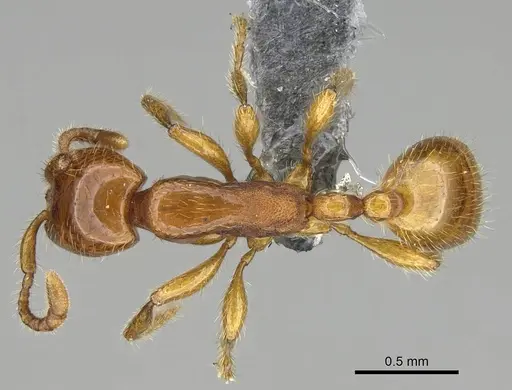
NHMUK012849306
View on AntWeb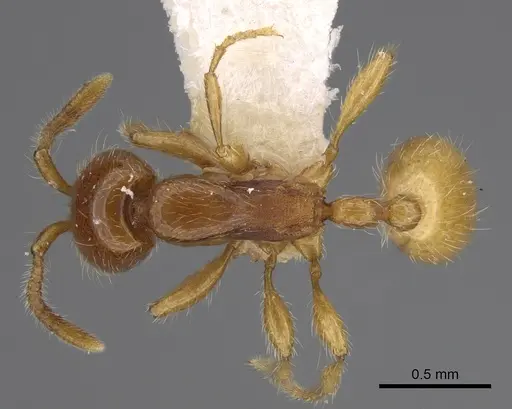
Literature
Loading...Loading products...