

Aenictus exilis
- Scientific Name
- Aenictus exilis
- Subfamily
- Dorylinae
- Author
- Wilson, 1964
- Distribution
- Found in 1 countries
Aenictus exilis Overview
Aenictus exilis is an ant species of the genus Aenictus. It is primarily documented in 1 countries , including Papua New Guinea. Detailed taxonomic data and occurrence records can be further explored via authoritative databases such as AntWeb or the Global Biodiversity Information Facility (GBIF).
Aenictus exilis
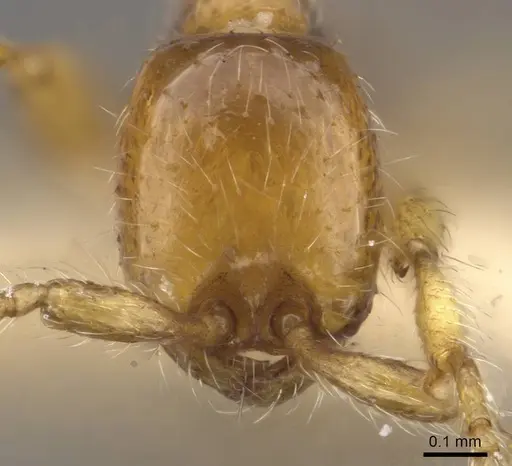
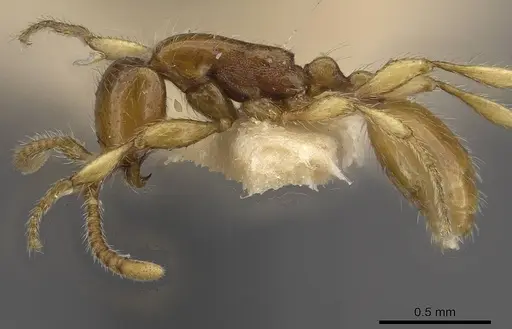
These are tiny army ants from the rainforests of New Guinea. Workers have heads only 0.37-0.42 mm wide, smaller than most ants you will find in your home [1]. They are light brownish yellow all over and belong to the ceylonicus group of army ants, which are known for raiding other ant colonies [2]. Unlike typical ant farm species, no one has ever found a queen of this species, and like other army ants, they do not build permanent nests [3]. Wilson first collected them in 1955 running in loose columns through leaf litter at the edge of virgin lowland rainforest near Port Moresby at noon on a sunny day [1]. They were also found in soil and leaf litter samples from the forest floor along the Busu River [1].
Quick Summary
- Difficulty: Expert
- Origin & Habitat: Lowland rainforests of New Guinea (Papua New Guinea), specifically Karema near Port Moresby and the Busu River on the Huon Peninsula [1][3]. They live in the leaf litter and soil of virgin forest floors [1].
- Colony Type: Army ant, no permanent nest, likely reproduces by colony splitting (fission). No queens have ever been found for this species [3].
- Size & Growth:
- Queen: Unknown, no queens known [3]
- Worker: Head width 0.37-0.42 mm, extremely small [1]
- Colony: Unknown, related Aenictus species maintain colonies of thousands
- Growth: Unknown
- Development: Unknown, no queens known, development never observed [3] (Army ant colonies typically grow by fission (splitting) rather than single queen founding.)
- Antkeeping:
- Temperature: Warm tropical conditions, roughly 24-28°C based on lowland rainforest habitat [1]
- Humidity: High humidity with damp substrate mimicking rainforest floor conditions [1]
- Diapause: No, tropical lowland species do not hibernate
- Nesting: No permanent nest, they are nomadic army ants that form temporary living clusters (bivouacs). Standard test tubes and formicariums do not work
- Behavior: Nomadic army ants that forage in diffuse columns over the ground and through leaf litter [1]. Extremely small size means they can escape through the tiniest gaps. They are specialized predators that likely raid other ant nests.
- Common Issues: no queens known means you cannot start a colony from a single queen, you would need an entire colony section (fission) which is rarely available., extremely small size (under 0.5 mm head width) means they escape through gaps that stop larger ants., nomadic lifestyle requires constant relocation between containers, unlike standard ant farms., predatory diet requires massive amounts of live prey, likely other ants, making feeding difficult., tropical requirements mean they die quickly if temperature drops below roughly 20°C or if humidity is too low.
Natural History and Army Ant Biology
Aenictus exilis belongs to the true army ants, a group of ants that do not build permanent nests [3]. Instead, they are nomadic, moving regularly to new hunting grounds and forming temporary resting places called bivouacs made of living worker bodies. They belong to the ceylonicus species group, which are specialized predators of other ants and small arthropods [2].
The species was described from workers collected in virgin lowland rainforest in New Guinea [1]. They forage during the day, running in loose single-file columns over the ground surface and under leaf litter [1]. This diffuse column formation helps them cover ground while hunting. They were found alongside other specialized litter-dwelling ants like Strumigenys and Eurhopalothrix species, suggesting they occupy the same microhabitat on the forest floor [1].
Unlike most ants kept by hobbyists, no reproductive queens have ever been collected for this species [3]. Army ants typically reproduce by colony fission, where the colony splits into two parts, each taking some of the brood and workers. This makes standard captive founding impossible.
Housing and the Nomadic Problem
Standard ant keeping setups fail for Aenictus exilis for two reasons: their size and their lifestyle. At 0.37-0.42 mm head width, these workers are smaller than the mesh holes in most standard ant keeping equipment [1]. You would need specialized barriers, possibly fine talcum powder or Fluon-coated surfaces with absolutely no gaps, to contain them.
More importantly, army ants do not stay in one place. They need space to roam and constant changes of hunting ground. In captivity, this means you would need a large, complex setup with multiple connected chambers or the ability to move them between containers regularly. They do not dig permanent tunnels like Lasius or Camponotus. Instead, they cluster in temporary bivouacs when resting.
If you somehow obtained a colony section, you would need a large, escape-proof outworld with deep substrate for them to hunt through, and you would need to disturb them regularly to simulate their nomadic cycle. This is far beyond standard formicarium setups.
Feeding Requirements
As army ants in the ceylonicus group, these are almost certainly specialized predators of other ant species and small soil arthropods [2]. They do not eat sugar water or standard ant keeping foods like honey. They need live prey, likely in large quantities given their colony size.
Feeding would require providing other ant colonies or abundant small arthropods like springtails and mites. This makes them expensive and difficult to maintain compared to generalist feeders. They may also require specific prey species found in their native New Guinea forests, making captive keeping outside their range nearly impossible.
Temperature and Humidity
Coming from lowland rainforests of New Guinea, these ants need warm, stable temperatures and high humidity [1]. Keep them around 24-28°C with minimal fluctuation. They will not tolerate cold or dry conditions.
The substrate should stay damp but not waterlogged, mimicking the moist leaf litter where they were collected [1]. Use a water source that maintains humidity without flooding, such as a plaster base or frequent misting. Because they are so small, they dehydrate quickly if humidity drops.
Frequently Asked Questions
Can I keep Aenictus exilis in a test tube?
No. Test tubes are designed for single queens founding colonies. Aenictus exilis has no known queens, and army ants do not found colonies this way. They are nomadic and need space to move and hunt, not a static test tube setup.
How do I found an Aenictus exilis colony?
You cannot found a colony from a single queen because no queens have ever been found for this species. Army ants reproduce by colony fission (splitting), so you would need to obtain an entire colony section with workers and brood. This is extremely difficult and rarely done in captivity.
What do Aenictus exilis eat?
They are specialized predators. As members of the ceylonicus army ant group, they likely prey on other ants and small arthropods. They do not accept sugar water or typical ant keeping foods. You would need to provide live prey, likely other ant colonies.
Do Aenictus exilis need hibernation?
No. They come from tropical lowland rainforests and remain active year-round. They do not hibernate and will die if exposed to cold temperatures.
How big do Aenictus exilis colonies get?
The exact colony size is unknown for this species. Related Aenictus species maintain colonies of thousands of workers, but without queen observations, we cannot confirm the size for A. exilis specifically.
Are Aenictus exilis dangerous?
They pose no danger to humans due to their extremely small size (workers under 0.5 mm head width). However, they are dangerous to other ants and would likely kill any other ant colonies you keep if they escaped.
Why are my Aenictus exilis dying?
If you somehow obtained these, they are likely dying because they are extremely difficult to keep. Common causes include: escape and desiccation (they are tiny and need high humidity), lack of appropriate live prey (they need other ants), incorrect temperature (they need tropical heat), or stress from being unable to roam nomadically.
Can I buy a queen for Aenictus exilis?
No. Queens have never been found for this species. Any seller claiming to have queens is misidentifying the species or selling something else.
References

This caresheet is licensed under CC BY-SA 4.0 .
CASENT0911128
View on AntWeb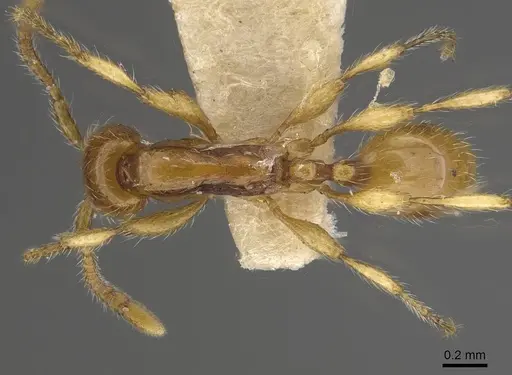
Literature
Loading...Loading products...