

Aenictus artipus
- Scientific Name
- Aenictus artipus
- Subfamily
- Dorylinae
- Author
- Wilson, 1964
- Distribution
- Found in 2 countries
Aenictus artipus Overview
Aenictus artipus is an ant species of the genus Aenictus. It is primarily documented in 2 countries , including China, Thailand. Detailed taxonomic data and occurrence records can be further explored via authoritative databases such as AntWeb or the Global Biodiversity Information Facility (GBIF).
Aenictus artipus
Aenictus artipus is a tiny army ant from Southeast Asia. Workers measure just over 3mm long and show a deep yellow to pale brown color with long antennae [1]. They live in forests across Thailand, Vietnam, and southern China, where they roam the forest floor in foraging columns [1][2]. Unlike most ants you can keep in a formicarium, these are true army ants, they do not build permanent nests and only worker ants have ever been found (no queens are known to science) [3]. This makes them impossible to maintain as a breeding colony in captivity.
Quick Summary
- Difficulty: Expert (effectively impossible for long-term keeping)
- Origin & Habitat: Forests in continental Southeast Asia including Thailand, Vietnam, and Yunnan Province, China. Found in hill evergreen forest, savanna forest, evergreen forest, disturbed forest, and agricultural areas near natural seasonal forest from 200-800m elevation [1][2].
- Colony Type: True army ant, nomadic species with massive colonies. Only the worker caste has ever been observed, queens remain unknown [3].
- Size & Growth:
- Queen: Unknown, queens have never been collected [3].
- Worker: 3.2-3.3 mm total length, head width 0.50-0.53 mm [1][4].
- Colony: Unknown in detail, based on army ant patterns, likely thousands to millions of workers.
- Growth: Unknown.
- Development: Unknown, queens have never been observed [3]. (Army ant development timing varies by species and temperature, but specific data for Aenictus artipus is unavailable.)
- Antkeeping:
- Temperature: Exact requirements unknown. Based on tropical distribution in Thailand and Vietnam [1], aim for roughly 24-28°C.
- Humidity: Exact preferences unconfirmed. They inhabit forest floor leaf litter in evergreen forests [1], so provide moderate to high humidity with damp substrate.
- Diapause: No, tropical species from low to mid elevations [1].
- Nesting: They do not build permanent nests. In nature they form temporary bivouacs under stones or on the forest floor [1]. Standard formicaria are unsuitable.
- Behavior: Highly active, nomadic predators that travel in foraging columns across the forest floor [1]. Workers are small (3mm) and require excellent escape prevention. They possess strong mandibles with 10-12 teeth [1].
- Common Issues: only workers are known to science, so colonies cannot reproduce or survive long-term in captivity., army ants require massive amounts of prey daily that is difficult to provide in captivity., tiny size (3mm) means they can escape through the smallest gaps without proper barriers., nomadic behavior means they do not thrive in static setups and will eventually die without continuous movement.
Why This Species Cannot Be Kept as a Breeding Colony
Aenictus artipus presents a unique problem for antkeepers: only workers exist in collections. Scientists have never found a queen, male, or even a pupa for this species [1][3]. Without queens, you cannot start a colony. Even if you collect hundreds of workers from a foraging column, they will eventually die of old age without replacement. Additionally, this is a true army ant. Army ants do not build permanent nests like Lasius or Camponotus. Instead, they form temporary bivouacs, living structures made from the ants' own bodies, and move frequently [1]. They require massive amounts of prey to feed thousands of workers, making them impossible to sustain in a standard home setup.
Natural History and Habitat
These ants inhabit the forest floor across continental Southeast Asia. Researchers have found them in Thailand, Vietnam, and southern China (Yunnan) [1][2][5]. They live in various forest types including hill evergreen forest, savanna forest, disturbed forest, and agricultural areas near natural seasonal forest [1]. Most collections come from foraging columns on the ground surface, though one colony was found under a stone in a dry evergreen forest in October [1]. They occur mainly at higher elevations above 800m, but occasionally appear in lowlands around 200-500m [1].
Identification and Similar Species
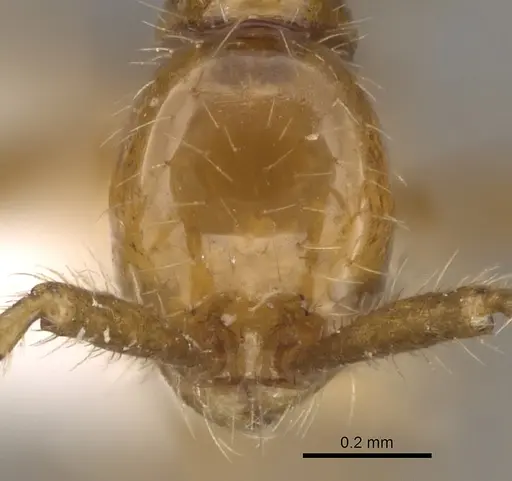
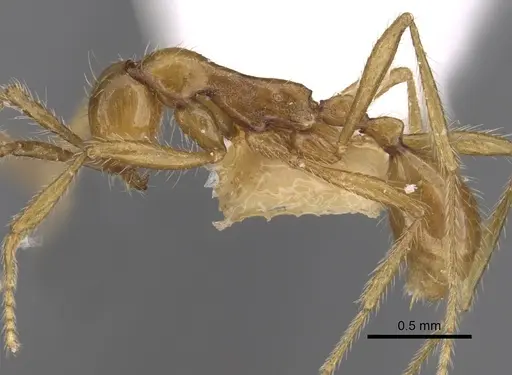
Workers are small (3.2-3.3mm) with a distinctive appearance. They have extremely long antennae that extend well past the back of the head, with a scape index of 130-140 [1][4]. The body is smooth, shiny, and deep yellow to pale brown [1]. You can distinguish them from the similar Aenictus wroughtonii and A. sagei by their longer scapes and the subpetiolar process (a small projection under the waist) which has a clearly angled front corner [1][4]. The mandibles carry a large curved apical tooth followed by 10-12 tiny teeth [1].
Short-Term Observation Guidelines
If you encounter a bivouac in the field, you can observe the colony temporarily, but expect it to survive only weeks or months. House them in a large, flat container with a tight-fitting lid and fine mesh ventilation. Provide damp paper towels or leaf litter to mimic their forest floor habitat. They will need constant access to live prey, likely other small ants or termites based on related species. Do not attempt to keep them in a test tube or standard formicarium, they need space to move and will quickly outgrow or die in small enclosures. [1]
Frequently Asked Questions
Can I keep Aenictus artipus in a test tube?
No. They are army ants that require open space to form bivouacs and massive amounts of food. Additionally, only workers are known, so the colony will die out without a queen.
How long until Aenictus artipus get their first workers?
This is unknown. Queens have never been observed for this species, so the egg-to-worker timeline is undocumented.
Can I keep multiple Aenictus artipus queens together?
This is impossible to test because queens have never been found for this species.
Are Aenictus artipus dangerous to humans?
No. They are very small (3mm) and pose no threat to humans, though they can bite with their mandibles.
What do Aenictus artipus eat?
Their specific prey is unknown [1].
Do Aenictus artipus need hibernation?
No. They come from tropical Southeast Asia and do not require a winter rest period [1].
Why are my Aenictus artipus workers dying?
This is expected. Since queens are unknown, any workers you collect are already doomed. Workers cannot reproduce, and army ant workers typically live only a few weeks to months.
How big do Aenictus artipus colonies get?
Exact colony size is unknown, but army ants typically maintain colonies of thousands to millions of workers.
References

This caresheet is licensed under CC BY-SA 4.0 .
CASENT0281956
View on AntWeb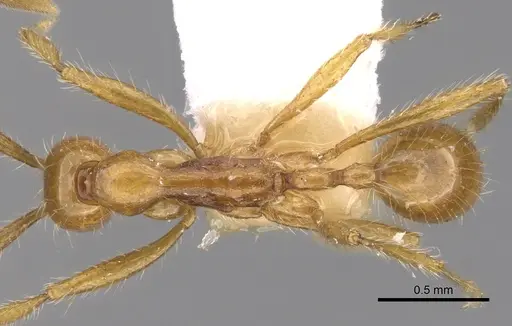
Literature
Loading...Loading products...