

Acanthomyrmex careoscrobis
- Scientific Name
- Acanthomyrmex careoscrobis
- Tribe
- Crematogastrini
- Subfamily
- Myrmicinae
- Author
- Moffett, 1986
- Distribution
- Found in 1 countries
Acanthomyrmex careoscrobis Overview
Acanthomyrmex careoscrobis is an ant species of the genus Acanthomyrmex. It is primarily documented in 1 countries , including Malaysia. Detailed taxonomic data and occurrence records can be further explored via authoritative databases such as AntWeb or the Global Biodiversity Information Facility (GBIF).
Acanthomyrmex careoscrobis
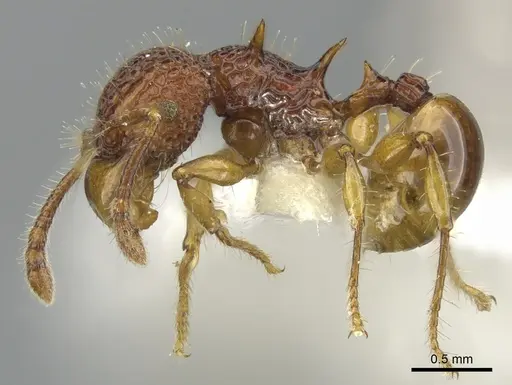
Acanthomyrmex careoscrobis are tiny, dimorphic ants from the rainforests of Borneo and Peninsular Malaysia. Minor workers are minute with heads barely 1mm wide, while majors sport massive heads over 2mm wide with powerful mandibles [1]. They live in small colonies of roughly 20 workers and nest in rotten twigs hidden under leaf litter on the forest floor [1][2]. What sets them apart is their remarkable reproductive system: colonies can produce both normal winged queens and wingless "ergatoid" queens that look like oversized workers [1]. These ants also have a specialized diet, collecting and storing fig seeds inside their nests and producing "trophic eggs", unfertilized eggs used as food for larvae [1][3].
Quick Summary
- Difficulty: Expert
- Origin & Habitat: Lowland rainforests of Borneo (Sarawak, Sabah) and Peninsular Malaysia, nesting in rotten branches under leaf litter [1][4][2]
- Colony Type: Monogynous (single queen) colonies containing either a dealate (winged-derived) queen or an ergatoid (wingless) queen. Ergatoid queens may serve as secondary reproductives if the primary queen dies [1]
- Colony: Monogyne
- Size & Growth:
- Queen: Alate queens 1.86-2.00 mm head width, Ergatoid queens 1.94-2.18 mm head width [1]
- Worker: Minors 1.03-1.14 mm head width, Majors (soldiers) 2.03-2.27 mm head width [1]
- Colony: Small colonies averaging 22 workers (range approximately 10-35), with roughly 2 majors and 20 minors [1]
- Growth: Slow, small colony sizes and specialized rearing requirements limit growth speed
- Development: Unknown, not directly studied. Based on tropical habitat and related small-colony species, estimate 6-10 weeks at 25-28°C (Development time is inferred from habitat data, actual timing requires observation)
- Antkeeping:
- Temperature: Warm tropical conditions approximately 24-28°C. Start at 25°C and adjust based on activity levels
- Humidity: High humidity required, nest substrate should feel damp to the touch, mimicking their forest floor habitat in rotten wood [1][2]
- Diapause: No, tropical species that remains active year-round
- Nesting: Small cavities in rotten wood or twigs. Use naturalistic setups with wood pieces or small Y-tong nests with tight chambers scaled to their tiny size [1][2]
- Behavior: Slow-moving, cryptic leaf litter dwellers. Majors likely specialize in defense or processing hard foods like seeds. Not aggressive, but minor workers are extremely small (1mm) and pose significant escape risks [1]
- Common Issues: tiny minor workers can squeeze through the smallest gaps, use fine mesh barriers and Fluon., specialized diet of fig seeds may be difficult to replicate, colonies may fail without appropriate seed sources., small colony size makes them vulnerable to overfeeding and disturbance., high humidity requirements can promote mold if ventilation is inadequate.
Nest Preferences
In nature, Acanthomyrmex careoscrobis nests in cavities within rotten branches and twigs lying under accumulated leaf litter on the forest floor [1][2]. They prefer small, enclosed spaces with high humidity. For captive care, recreate this with naturalistic setups containing small wood cavities or rotting twigs. If using an artificial nest, choose Y-tong or plaster nests with very small chambers and narrow passages, majors need space for their large heads, but minors need tight spaces to feel secure. Keep the nest in a dark, humid environment with minimal disturbance.
Feeding and Diet
These ants have a specialized diet centered on fig seeds. Field studies found 7 to 250 tiny fig seeds stored inside nests, confirming this is a primary food source [1]. They also practice trophic egg laying, all castes including the queen, majors, and minors produce unfertilized 'trophic eggs' that are fed to larvae or eaten by adults [1][3]. In captivity, offer small seeds (fig, chia, or similar small seeds) and small live prey like springtails or tiny fruit flies. Provide a protein source regularly, but research suggests seeds are crucial for long-term success. Sugar water or honey may be accepted but should not replace their specialized seed diet.
Queen Polymorphism and Colony Reproduction
Acanthomyrmex careoscrobis produces two types of queens. Alate queens are winged and likely found new colonies independently. Ergatoid queens are wingless, look like large majors with ocelli (simple eyes), and have the same reproductive capacity as alate queens, both types have six ovarioles [1]. Ergatoid queens likely serve as backup reproductives, when researchers orphaned colonies in the lab, the colonies produced new ergatoid (and sometimes alate) queens to replace the lost queen [1]. This means if your queen dies, the colony might raise a replacement from existing workers or brood, potentially extending the colony's lifespan.
Temperature and Care
As a tropical lowland rainforest species, they require warm, stable temperatures around 24-28°C. Use a heating cable or mat on one side of the nest to create a gentle gradient, but avoid overheating. Maintain high humidity by keeping the nest substrate damp, think forest floor after rain, not swamp. Because they are small and cryptic, they do not need large outworlds, but any outworld requires excellent escape prevention. Do not hibernate this species, they remain active year-round. [1]
Behavior and Temperament
These are slow-moving, secretive ants that prefer to stay hidden. The major workers with their massive heads likely function in defense and seed processing, while minors handle foraging and brood care. They are not aggressive and will likely play dead or hide when disturbed rather than attack. However, their tiny size means they are expert escape artists, minors can pass through gaps that would stop larger ants. Use Fluon or fine mesh barriers on all ventilation and access points. [1]
Frequently Asked Questions
Can I keep Acanthomyrmex careoscrobis in a test tube?
Test tubes are not ideal long-term because they lack the wood cavities and humidity gradients this species prefers. While a founding queen might survive temporarily in a test tube, you should move her to a naturalistic wood setup or small formicarium as soon as possible.
How long until first workers for Acanthomyrmex careoscrobis?
The egg to worker timeline is unconfirmed. Based on their tropical habitat and small colony size, expect approximately 6-10 weeks at 25-28°C, but this is an estimate.
What do Acanthomyrmex careoscrobis eat?
They specialize in eating fig seeds, storing up to 250 seeds per nest in the wild. They also produce and eat trophic eggs (unfertilized eggs used as food). In captivity, offer small seeds like fig or chia, plus small live prey such as springtails.
Do Acanthomyrmex careoscrobis need hibernation?
No. They come from tropical rainforests and remain active year-round. Keep them warm (24-28°C) continuously.
How big do Acanthomyrmex careoscrobis colonies get?
They stay small. Field studies found colonies average about 22 workers, with the largest observed colonies containing roughly 35 workers and 2 majors.
Are Acanthomyrmex careoscrobis good for beginners?
No. They are expert-level ants due to their tiny size (escape risk), specialized fig seed diet, small colony size making them vulnerable to mistakes, and tropical humidity requirements.
What is an ergatoid queen in Acanthomyrmex careoscrobis?
An ergatoid queen is a wingless reproductive that looks like an oversized major worker but has ocelli (simple eyes) on her head and fully developed ovaries. She can lay fertilized eggs and may replace the primary queen if she dies.
Can I keep multiple Acanthomyrmex careoscrobis queens together?
No. They are monogynous (single queen) species. Colonies with multiple queens have not been documented, and queens would likely fight.
Do Acanthomyrmex careoscrobis ants sting?
They can likely sting (they are in the Myrmicinae subfamily), but given their tiny size, they cannot penetrate human skin. They are not dangerous to humans.
Why are my Acanthomyrmex careoscrobis dying?
Common causes include: escape and desiccation (they are tiny), lack of appropriate fig seeds in their diet, colony collapse after the queen dies (unless an ergatoid replacement develops), or mold from excessive humidity without proper ventilation.
References

This caresheet is licensed under CC BY-SA 4.0 .
CASENT0901703
View on AntWeb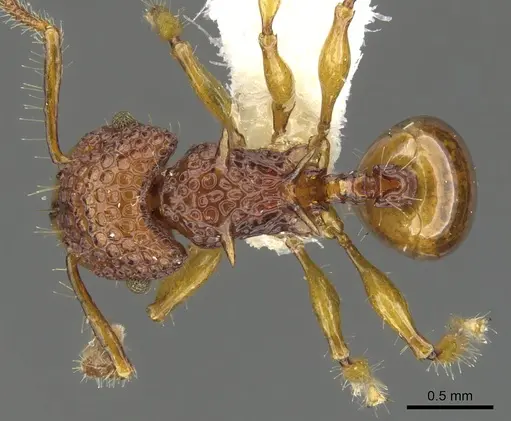

Literature
Loading...Loading products...